Life and Fortune by Honda Seiroku, a forester and professor at Tokyo Imperial University, is the book behind this personal record of what I've actually started doing at 66. I'd long heard the story behind it — how he built a considerable fortune in his younger years using his own "quarter-savings method," then gave almost all of it away the moment he retired. Reading it in his own words, though, I found something that went well beyond money: honest, direct thoughts on ageing and happiness running through nearly every page. In the preface, written at eighty-five, he sums up his outlook in eight words — "life is effort, effort is happiness" — and at sixty-six, I found the book speaking to me quietly but firmly.

Translating "a quarter" into a pension-age practice
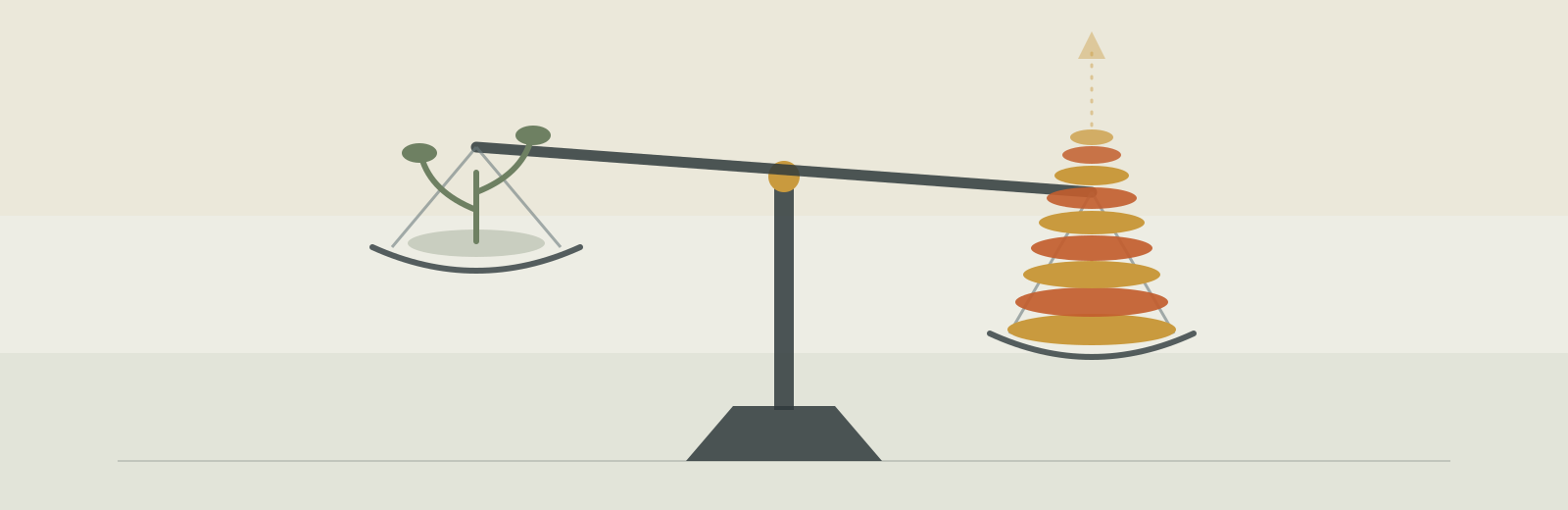
The book's best-known idea is Honda's "quarter-savings method": as soon as regular income arrives, a quarter of it is set aside immediately, as if it had never existed, while irregular income — royalties, bonuses — is saved in full. He describes building his fortune this way without ever feeling deprived, simply by structuring his life around a portion of his salary he'd already decided not to count.
I no longer draw a "salary," but I do have pension and dividend income. Borrowing the same logic, I've made a small rule: unexpected money — a favourable exchange-rate movement, a larger-than-usual dividend — gets moved into a long-term account before I spend it, treated as if it had never arrived. I'm not naturally good at tracking numbers closely, and this has proven far easier to sustain than keeping a detailed household ledger.
Applying "effort itself is happiness" to small daily tasks
In his preface, Honda states plainly that even at eighty-five he feels no physical or mental decline, and credits this to living by a new philosophy: effort itself, not its outcome, is happiness. Effort isn't a means to happiness — it already is happiness.
Since reading that, I've started treating small, ordinary tasks — watering the tomatoes in the greenhouse, trimming Meg's claws, doing a bit of proper research before writing a blog post — not as means to some later result, but as today's happiness in themselves. Instead of checking traffic or reactions afterwards, I ask myself whether I was satisfied during the few minutes I was actually doing the thing.
Treating a leisurely retirement as a gradual shift, not a switch to zero
Later in the book, Honda writes about what he calls the "joyful old-age period" — arguing that suddenly dropping all responsible work is bad for body and mind, and that it's better to gradually reduce one's workload while shifting toward light, undemanding work such as small-scale farming or gardening.
I retired last year at sixty-five, and I quickly felt uneasy with the idea of "doing nothing." Now I split my day into three loose blocks: writing and research in the morning, the greenhouse and garden in the afternoon, and reading or the everyday logistics of moving between the UK and Japan in the evening. Rather than dropping work to zero, gradually reshuffling my roles feels close to what Honda meant by "shifting."

Following the "eighty-year-old schoolboy" into a new language
Honda was fluent in German, but had never had the chance to properly learn English — so past eighty, he began teaching himself through radio lessons, calling himself "an eighty-year-old first-year student." Sitting down at the same time each day and slowly picking up a new language, without treating his age as an excuse, struck me as quietly admirable.
My own "eighty-year-old first-year student" moment is learning to work with Claude, which I only started in 2026. Programming and generative AI had never been part of my life, but I try to approach new tools the way Honda approached his radio English lessons — a little at a time, out of curiosity. On the days it doesn't go well, I remind myself it isn't failure — I'm still only in my first year.
Thinking about "what to leave behind" as a record, not a donation
After retiring, Honda gave away nearly all his fortune, and the fund he established went on to support tuition for over 1,300 students across several decades. The sheer scale of returning personal wealth to society is striking on its own.
I don't have anything approaching that kind of fortune, but reading this made me think I could still have my own version of "what to leave behind." For me, that's this blog — an honest, ongoing record. Writing down the experience of one person in his sixties — the chronic worry over whether the money will last, losing the rhythm of daily life when "every day is Sunday," and still finding moments that feel genuinely enjoyable — isn't something you'll find in a statistics report or a specialist book. I've come to see keeping that record as my own small way of giving something back.
Using old age's "familiar patterns" as a mirror for self-correction
At one point, the book lays out — with a wry, sometimes unsparing humour — the habits almost everyone slips into with age: repeating the same story, not letting others finish speaking, refusing to learn anything new while endlessly returning to the old. I caught myself laughing, a little uncomfortably, while reading it.
Since then, I occasionally hold that short list up against myself. Have I told this same story to someone twice already? Am I dismissing something new out of hand before really considering it? Rather than hiding from ageing, keeping a light, humorous awareness of these tendencies feels like a small but useful way of preparing to enjoy this stage of life well.
Treating effort itself as happiness
Honda was already eighty-five when he wrote this book's preface, and it wasn't his fortune that let him say he felt no decline — it was a stance that treated effort itself as happiness. Saving a quarter, treating effort as happiness, shifting work gradually rather than stopping abruptly, taking on a new language, leaving a record, laughing at one's own ageing habits — none of these are extraordinary, but at sixty-six, they're practices worth holding onto deliberately. I'm still well short of eighty-five myself, but I'd like to carry the stance this book describes forward as a small daily habit, starting today.
The book I mentioned here:
Honda Seiroku, Life and Fortune (Japanese edition)
(This site is a participant in the Amazon.co.jp Associates Program, an affiliate advertising program.)
Other books you might like
You're welcome to take a look.
EAST TO WEST: The Heart of Haiku, the Light of Scripture
A quiet essay moving between the language of haiku and the light of Scripture. A book in which Japanese poetic sensibility and the world of the Bible turn out to echo one another in unexpected places. This was my father-in-law's final work.
View on AmazonCataract Surgery-A Memoir: Double cataract surgery in Osaka, Japan
A candid record of double cataract surgery in Osaka, written from the perspective of a 66-year-old living between Japan and the UK. From choosing a lens to the costs involved and what vision is actually like afterwards — set down exactly as it happened.
View on AmazonSushi Business in Britain: the complete four-volume series
A novel series following thirty-five years in the British sushi trade, from apprentice to factory manager to a small sushi school.
View on Amazon
Who Was Honda Seiroku — His Era and His Character
Honda Seiroku was born in 1866, right as Japan was tipping from the closing years of the Edo period into the upheaval of the Meiji Restoration. Adopted into the Honda family as a young man through marriage, he finally set off in 1890 on the long-desired trip to study in Germany. To save money, he travelled third class out of Yokohama — and watching the treatment given to first- and second-class passengers, he resolved, in his own words, never to be troubled by money for the rest of his life. Partway through his studies, his adoptive father's bank failed and his remittances stopped, a hardship he later credited as the real foundation of his rigorous savings philosophy. At the University of Munich he studied under the economist Lujo Brentano, absorbing German forestry science alongside practical economic thinking.
Back in Japan, he helped lay the foundations of modern forestry and landscape architecture, working on Hibiya Park and, most famously, designing the forest of Meiji Jingu Shrine. Looking a hundred, even two hundred years ahead, he planned a three-stage succession of tree species — from pine, to cedar and cypress, to evergreen broadleaf trees — and that forest has developed almost exactly as he predicted. He retired at sixty in 1927, then gave away nearly his entire fortune to establish a scholarship trust, and spent his later years fielding personal advice questions in newspapers and magazines for ordinary readers.
Honda spent his final years in the years just after Japan's wartime defeat, as the country worked to rebuild itself. This book's preface, written in 1950 at eighty-five, carries a conviction that must have felt genuinely persuasive to readers rebuilding their own lives from near economic zero. He died in 1952 at eighty-six. What stands out most about him, to me, is how scientific rigour, a self-imposed frugality, and real generosity toward society all sat comfortably together in one person.