Life in the UK: London — Two Homes
Date: 2018-05-28
This is my twenty-ninth year living in London — I've spent half my life here now. Here I look back on the two homes we lived in over those years, an old house with plenty of character and a new-build flat, and on how we came to decide to leave London for somewhere new once the children had left home.
The First House
It was a neighbourhood with a distinct atmosphere, where many people held closely to traditional beliefs and customs. The local community had deep roots in old traditions, and there were moments when I felt as though I'd wandered into a foreign town altogether.
We lived just one street back from the main road, in an old semi-detached house — the kind that shares a wall with its neighbour. The previous owner told us he'd moved there from Europe as a young man.
Upstairs had several bedrooms and bathrooms, and downstairs there was a spacious entrance hall, a living room, a dining room, and a kitchen. The hallway walls were covered floor to ceiling — all the way up to the second floor — in oak panelling that had been there since the house was built.
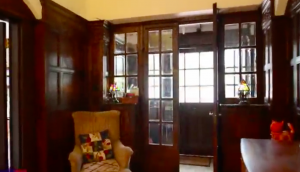
It was a small house, of course, but it had the air of a manor house, or even a church. In English, a house like this gets called one "with character" — the kind of thing people take care to preserve rather than strip away. Almost everyone who stepped inside reacted with surprise: "What an entrance!", "It's just like my grandparents' old house," "It feels like being inside a church." Wood-panelled hallways like ours weren't unusual a generation or two ago, but these days most people rip the panelling out and paint the walls white instead, since it makes a room look bigger. So a house that still had its original panelling intact had become something of a rarity.
After we became the owners, we added an extension at the back and built a new kitchen looking out onto the garden, turning the old kitchen into a utility room — the kind of space where you keep the washing machine and do the ironing. The extension had a skylight in the ceiling, so the new kitchen ended up bright and full of good light.
The back garden was spacious too, with a fine old tree standing at the far end that rustled pleasantly whenever the wind picked up.
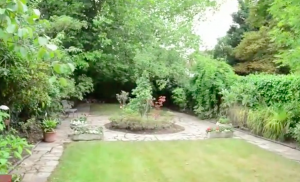
Our children grew up in that house. For a while we even took in a lodger. Old houses like ours have high ceilings, and every room — and the garden too — tends to be generously sized, which was one of the real pleasures of living there: all that space. The flip side was that something was always breaking. Heavy rain meant a drip somewhere, the boiler would suddenly quit and leave us without hot water, and there was a constant rotation of specialists coming round to take a look, give quotes, and carry out repairs. In winter, no matter how much we heated the place, the high ceilings meant our feet stayed cold, so warm socks and loungewear were simply non-negotiable.
The Second Home: A New-Build Flat
We lived like that for more than twenty years, until the children were grown. Once our daughter had moved out and we were a family of three, with our son then at college, we sold the house and moved to a brand-new three-bedroom flat (think of it as an apartment building, roughly like a Japanese "mansion") in a town a bit further north, in a slightly nicer setting.

The Tube station was right outside, the area was surrounded by parks, everyone else living in the building seemed thoroughly decent, and security was solid — altogether, it was a very comfortable way to live. Compared with the old house, nothing ever needed fixing, and every room had underfloor heating, so warm that I barely needed socks even in winter. You had to unlock three separate doors between the street and our own front door, so there was never any worry about burglars or strangers wandering in — living there always felt safe, and genuinely comfortable.
While we were living there, our son left home too, for university, and it was back to just the two of us. Around that time, I started thinking it might be time to leave London and try living somewhere else in the UK for a change. We put the flat on the market, but since there was no great rush, our attitude was that we'd take our time and wait until the right buyer came along — someone we felt good about. We chose an estate agent with a reputation for honest, careful service, and in the end it took about two years to sell. The buyer turned out to be an elderly lady living alone nearby; a developer had bought up the old house she was in (apparently to build flats on the site later), and she'd been quietly looking for somewhere new in the same area.
With the children gone, school was no longer a factor tying us down, and it struck me as a waste to have lived in the UK all this time and seen nothing but London. I wanted to give it another go and try living somewhere completely new, so we decided to move out to a different town outside London. We couldn't find our next home right away, though, so in the meantime we moved into a rented flat in north London and went house-hunting whenever we had a spare moment between work.

Talking to English people, I often hear the same line: "London isn't really Britain — London is its own special place." And it's true, in a way. People from all over the world have settled and made their lives there. Many are refugees who fled their home countries. My son's primary school, for instance, was a completely ordinary local school, but in his class of twenty-five, every single child's parents seemed to come from a different country. With that much variety, there's really no room for racial prejudice — or rather, it doesn't get the chance to take hold. Someone I know who'd lived in the US once told me London felt far less racially charged, and easier to live in as a result. I've heard that Londoners speak more than a hundred different languages at home, and if you count regional dialects on top of that, the number multiplies three or four times over. So when true British locals talk about it, the phrase they reach for is "London is London" — technically in England, but not somewhere they'd quite call Britain.
Other books you might like
You're welcome to take a look.
EAST TO WEST: The Heart of Haiku, the Light of Scripture
Moving through the chapters of a life, one home at a time — the sort of passage this collection traces through haiku. This is a book my father-in-law left behind.
View on AmazonCataract Surgery-A Memoir: Double cataract surgery in Osaka, Japan
Another new experience at 66 — an honest account of the cataract surgery I went through.
View on AmazonSushi Business in Britain: the complete four-volume series
A novel series following thirty-five years in the British sushi trade, from apprentice to factory manager to a small sushi school. The complete edition offers all four volumes at a better price.