My cat, Meg, does not seem to mind in the slightest when I am hunched over my computer late into the night. She simply curls up on my lap and occasionally peeks at me with just one eye open. Sitting next to Meg, I have been grappling with something for the past few days: creating a small system to connect with my readers — one that lets them know how they felt about an article, and allows them to "listen" to it when their eyes are tired.

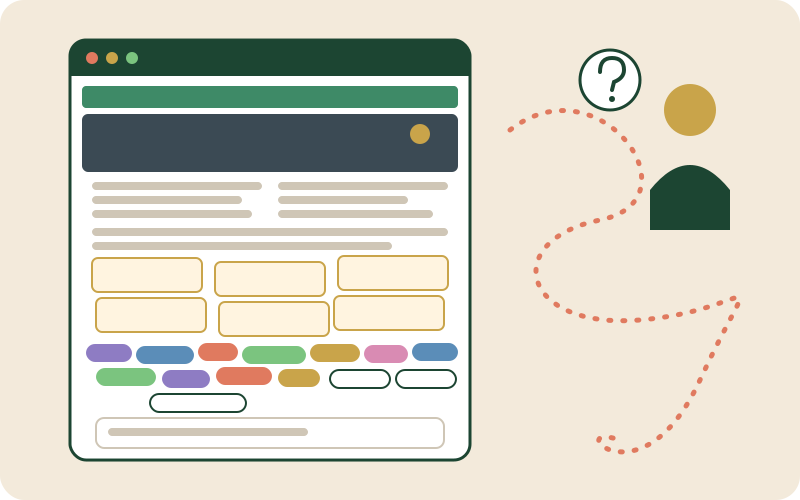
A diagram of the uncertainty of writing without any way to know whether it reaches a reader.
There Was No Way to Check Whether My Message Was Getting Through
I have been writing this blog for some time now, but to be honest, I had no way of knowing whether my articles were actually reaching anyone's heart. I was reluctant to set up a comments section, yet continuing to write without knowing anything felt like shouting into the darkness — it was rather unsettling. This is because, although the absence of a reply should not necessarily mean the message "has not reached" anyone, as the writer, I could not see that distinction.
On top of that, there was something else on my mind. As I get older, there are days when I find it tiring to follow text on a screen for long periods. That is precisely why I began to feel I wanted to provide an alternative to simply "reading" the articles — the option to listen to them.
Laying the Invisible Pipes One by One
The first thing I tackled was a system to place 👍👎 buttons at the end of articles and automatically record the results in a Google spreadsheet. The concept was similar to running water pipes through the walls of a house. Whilst readers only see a single button, behind the scenes, the information captured the moment the button is pressed must quietly flow through numerous pathways to reach the spreadsheet.
This "plumbing" work was far from straightforward. Programmes I thought I had deployed were still running on outdated versions, and test requests I sent for verification were being rejected with 403 errors. Every time I investigated the cause, I encountered unexpected obstacles time and again. It felt just like discovering yet another leak just after fixing one. Nevertheless, as Claude and I narrowed down the causes one by one, we eventually realised that the deployment settings on Google's app side were still out of date. The moment we redeployed the new version, the relief I felt when the first entry finally appeared in the spreadsheet — which had been empty all along — brought a small sense of achievement.

Behind a single button, information had to make its way to a spreadsheet through several unexpected obstacles — much like laying pipes through a wall.
Do Not Mix "Conversational Voices" with "Narration Voices"
Another feature I worked on was the ability to have the article text read aloud verbatim. In fact, this blog had previously featured audio recordings where two presenters — powered by a different AI (NotebookLM) — discussed their impressions of the articles. The key challenge here was ensuring readers did not confuse the two. This is because one is an audio recording of two people exchanging views on what I have written, whilst the other is an audio recording that simply reads the text aloud — they are entirely different in nature. After reviewing the label text several times, I settled on the clearly distinguishable phrases "Listen to the Discussion" and "Listen to This Article".
During implementation, I also discovered a bug where the button display would briefly appear incorrect immediately after pausing, and another where the audio would stop if playback was resumed after changing the speed. I do not think I would have noticed either of these on my own. Watching Claude meticulously test the system by actually pressing the buttons and fixing the issues on the spot, I was reminded once again of how grateful I am to have such a reliable partner.
Leaving My Name on Hidden Articles Too
Once everything was more or less in place, there was one thing I wanted to check just to be on the safe side. I wanted to see if, amongst the articles I had previously set to private for various reasons, there were any where only the audio description remained, whilst the crucial audio button was missing. Upon checking, sure enough, three articles were in this situation. Fortunately, as these were private pages that readers would never see, there was no real harm done; however, I made sure to tidy up the text properly in case I ever decide to make them public again. Just as I leave unripe strawberries alone whenever I go out to check on the crop in the garden, I have decided not to touch this for now and simply wait for the right time.
Why I Continue, Even If It Costs Money
Building and maintaining a system like this takes not only time but also money. The fees for using Claude, plus the various costs of running the site — for someone living on a pension, these are by no means small expenses. Yet I continue because I have realised that actually seeing readers' reactions — even if it is just a single 👍 — holds more value than I had imagined. There is proof that someone has read an article and paused, even for just a moment. That alone makes me feel that the late-night hours spent grumbling at my desk were not wasted.

From a quiet "before" with no reaction, to an "after" where readers can connect through 👍👎, read-aloud audio, and the discussion recording.
Between My Younger Self and Who I Am Now
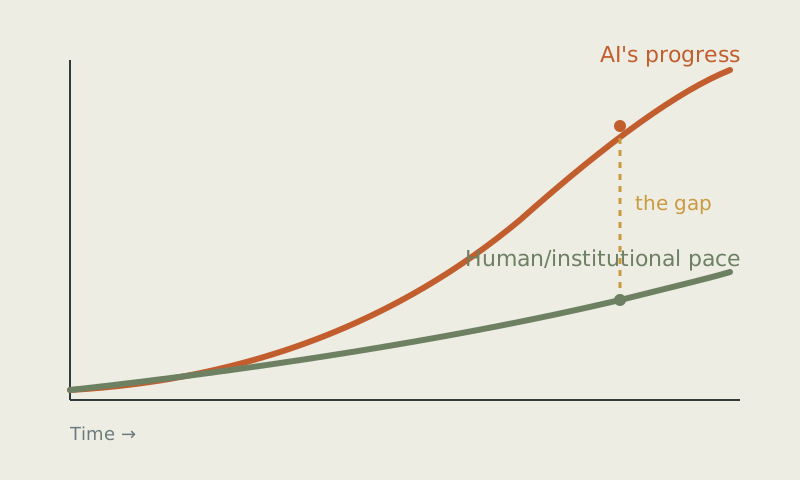
If this were my twenties, whilst I was studying medicine, I would surely have tried to build such a system from scratch by writing the code myself. The current me lacks both the stamina and the accumulated knowledge for that. However, with my partner Claude by my side, I was able to take it step by step — even whilst not fully understanding everything — and see it through to the very end. There is certainly a gap between my younger self and who I am now, but I feel that the modern age provides us with the tools to bridge that gap. My days were spent taking a break from work, warming my Zusanli acupoint with Sennenkyu moxa when my shoulders felt stiff, whilst patiently watching the small progress unfolding on the screen.
Come to think of it, the tangible results of this whole process are extremely small — just a single feedback button and a single audio button. Yet behind the scenes, there are countless invisible pipes running through it all. I believe trust between people is built in much the same way. It is the accumulation of steady, unassuming interactions — invisible from the outside — that quietly underpins it all.
In the UK, text-to-speech support on public websites is effectively required by law (the Equality Act), and awareness of accessibility is deeply ingrained as a matter of course. On personal blogs in Japan, this is not yet quite so common. Perhaps the sense of accessibility that I had naturally picked up whilst living in the UK was one of the reasons that inspired me to create this feature.
Even without dialogue, if readers can feel that there are others looking at the same scenery, I believe that is connection enough. I would be delighted if this little button could serve as a catalyst for such a connection.
Other books you might like
You're welcome to take a look.
EAST TO WEST: The Heart of Haiku, the Light of Scripture
A quiet essay where the words of haiku and the light of scripture echo one another — the kind of book worth returning to between rounds of trial and error with AI. This was my father-in-law's final work.
View on AmazonCataract Surgery-A Memoir: Double cataract surgery in Osaka, Japan
A candid memoir of quietly working through trial and error and hard decisions, told by a 66-year-old living between Japan and the UK.
View on AmazonSushi Business in Britain: the complete four-volume series
A novel series following thirty-five years in the British sushi trade, from apprentice to factory manager to a small sushi school.
View on Amazon