🎧 Listen to the Discussion(two hosts talk through their thoughts on this article)
This is an AI-generated audio overview of this article, created with Google NotebookLM. Two hosts discuss the article together, sharing their own thoughts and commentary — it is not a reading of the article text.
I have now lived in England for more than 35 years. My life here began in the kitchen of a Japanese restaurant in London, and over the decades it quietly reshaped itself — into a Japanese food business, then an acupuncture and herbal medicine clinic, and later into property and stock investment. Now retired at 65 and dividing my time between Japan and the UK, I find myself noticing something I had taken for granted for years: the "fine English things" that have quietly sat on our table for decades have, in their own quiet way, done a great deal of good for our daily life.
The finest example of this is the jam I want to introduce today — Tiptree's Little Scarlet Jam.
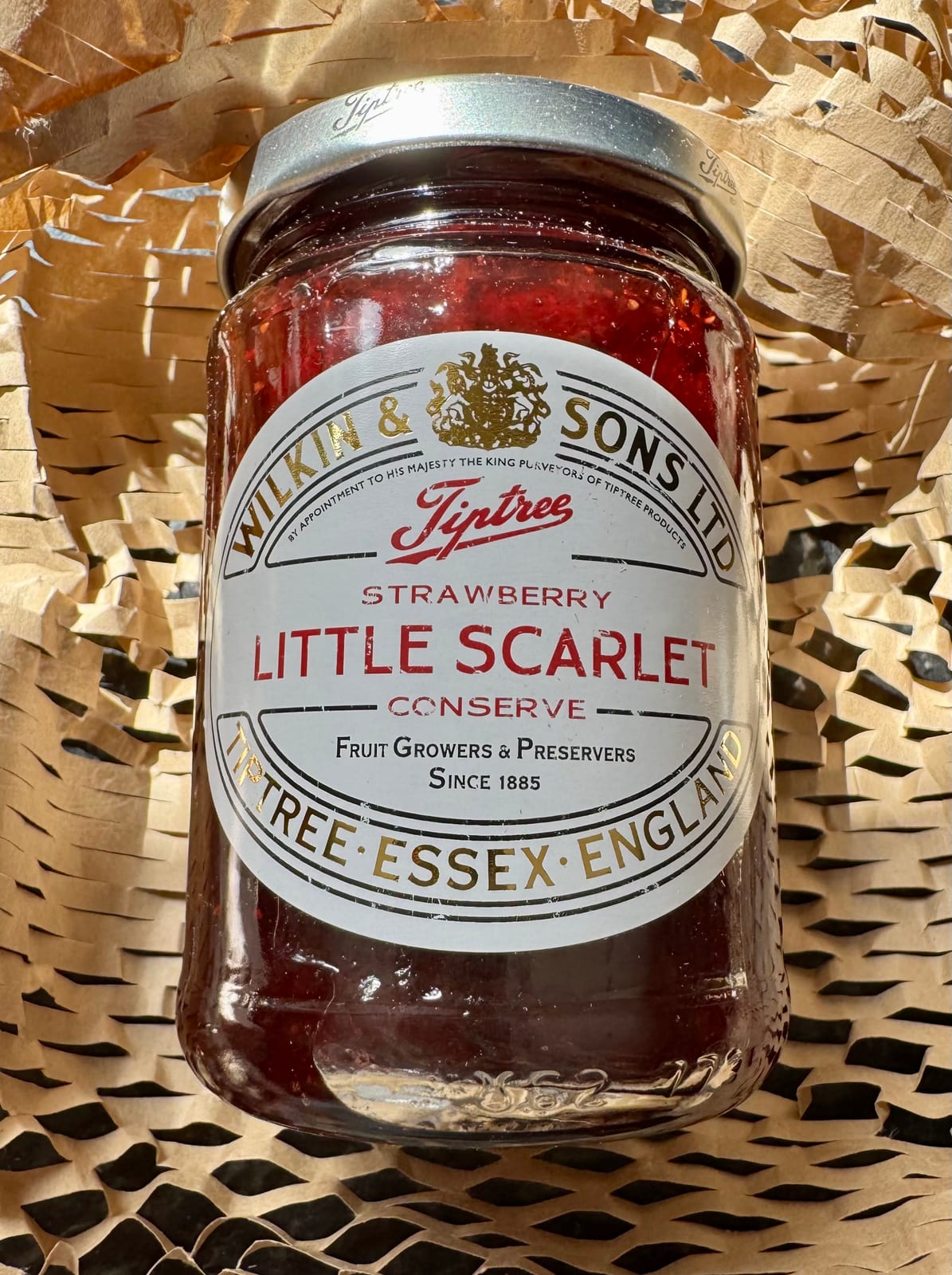
Little Scarlet jam from Wilkin & Sons. The label carries the Royal Warrant crest.
At first glance, it looks like nothing more than a luxury strawberry jam. But packed inside that small jar is the story of one family stretching back to the 19th century — and, I think, a few real hints about how to think about life in retirement.
The Only Field of Its Kind: The Wilkin Family and the "Little Scarlet Keeper"
Founded in 1885, Wilkin & Sons is a heritage jam maker based in the village of Tiptree, Essex. It is the company behind Little Scarlet jam, affectionately known as "the Queen of jams."
The strawberry at its heart, the Little Scarlet, is barely the size of a one-penny coin. It grew wild in America during the pioneer era, and the story goes that a member of the Wilkin family, visiting the country, was so taken with the little berry that he brought cuttings back to England to cultivate.
Everything about it — planting, harvesting — is still done entirely by hand, because the fruit is far too delicate for machinery. To this day, the only place in the world growing it commercially is that same family farm. The farm even employs a dedicated "Little Scarlet keeper," a person whose entire job, year after year, is simply to raise, plant, and tend this one variety of strawberry.
When I first heard this, it reminded me of Japan's traditional craft world — an artisan devoted to polishing a single skill for a lifetime, a potter guarding one kiln passed down through generations. It is the opposite of scale and efficiency; it is a life spent on the one thing you have decided matters. Much like the craftsmen who populate the historical novels I love, the Little Scarlet keeper seems to find a quiet pride inside that tiny red berry. There is a kind of richness in tending something that can be grown nowhere else on earth — a richness that has nothing to do with volume or scale.
A Taste Loved by Royalty — and by James Bond
Little Scarlet jam holds a Royal Warrant, and the late Queen Elizabeth II is said to have enjoyed it every year. In Ian Fleming's novel From Russia, with Love, James Bond spreads this very jam on his breakfast toast — a detail well known among fans as one of his favourites.
From royalty to a fictional spy, this one small jar has drawn in people from every walk of life and every era. Almost every luxury hotel breakfast room in the world seems to keep a little jar of Tiptree on the table. That kind of enduring popularity, across so many different kinds of people, feels to me like proof of something genuinely authentic.
A Small Ritual That Settles the Mind and Body
Having spent so many years in Oriental medicine, I have come to believe that caring for the body and caring for the mind are never truly separate. In the clinic, the best medicine often turned out to be simply the quality of someone's daily life.
In our house, we have a small yearly habit: around July, we start checking Tiptree's official website. As soon as that year's fresh batch of Little Scarlet jam goes on sale, we order it, and on the very day it arrives we go out and buy scones and clotted cream. The jam arriving, the scones being warmed, the tea being poured — this small sequence has become, for my wife and me, a quiet ritual that marks the turning of the seasons.
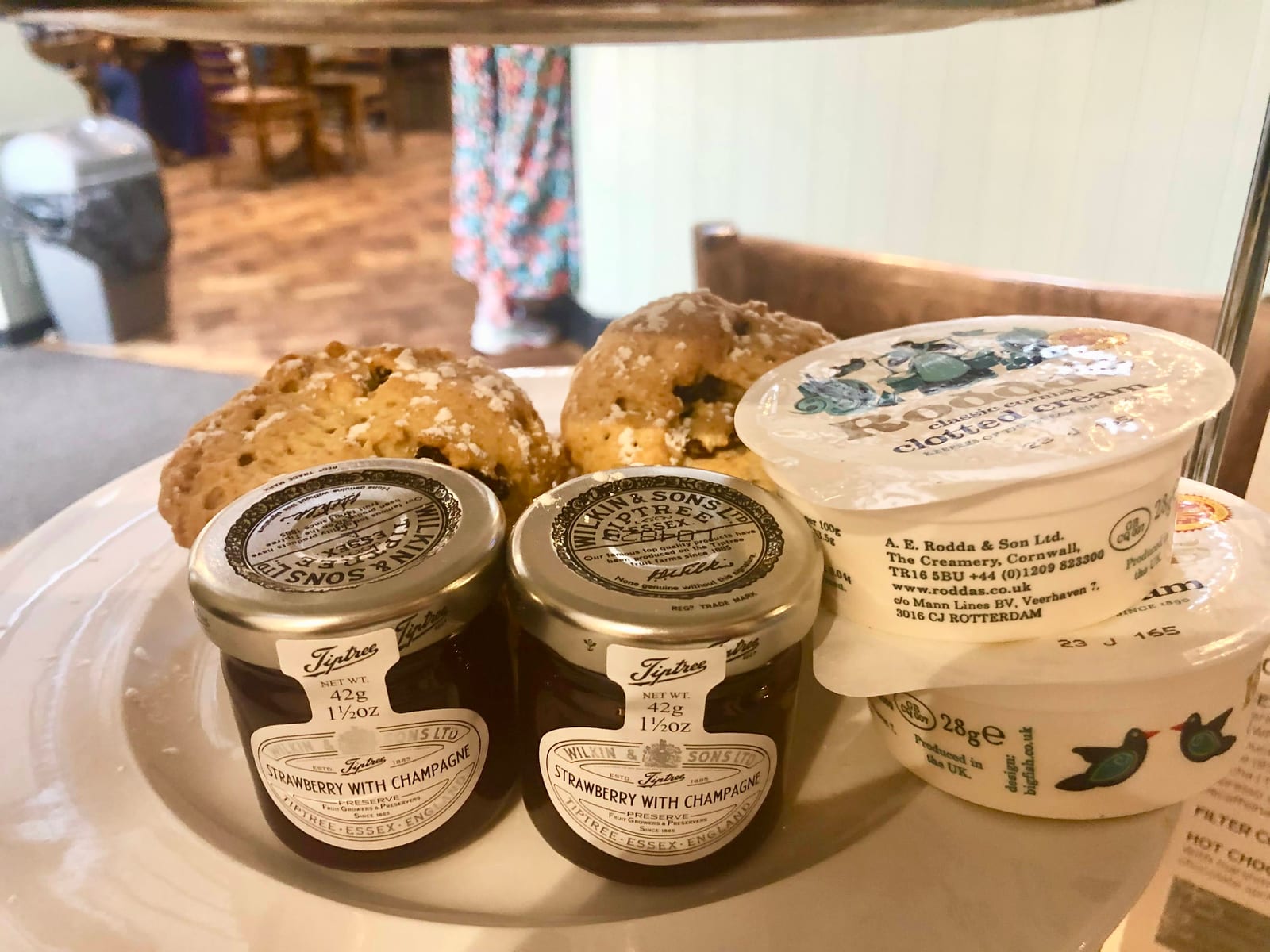
Scones, Tiptree's mini jam (Strawberry with Champagne), and clotted cream, laid out for a cream tea.
As we grow older, moments of slipping focus or memory become more common. But I have come to feel that the pleasure of waiting for a season, and the discipline of repeating a small ritual faithfully, is not a bad habit for the mind at all. The capacity to look forward to something, to taste it fully with all five senses, and to share that moment with someone you love — a fine thing like this quietly delivers that small trigger, faithfully, every single year.
Luxury or Investment? A Pensioner's Dilemma
I will be honest: fine English things like this are never cheap. For those of us living on a pension, setting aside a fixed budget every year for what is, frankly, a luxury, can feel like real financial pressure. A voice in the back of my mind sometimes asks, "Wouldn't a cheaper jam do just as well?"
And yet we keep choosing this one jar, year after year. After a long time thinking about why, here is where I have landed.
The price of a fine thing is never only the price of the object — it also includes the price of time and of story. Each time we open the jar, we are, in a sense, reliving the whole process: a single field in the whole world, a Little Scarlet keeper tending the plants once again that year, the whole staff hand-picking the harvest, the fruit turned into jam in copper pans on the very day it was picked. A cheaper alternative could never sell us that experience of tasting the story along with the fruit — and that, I think, is worth more than money.
In retirement, what a fine thing gives us is not merely satisfaction. It is a small, quiet sense of achievement and relief — "we made it safely to this season again." That is a kind of psychological richness that I don't think should be dismissed when we talk about a long, healthy life. Of course, we cannot buy every fine thing without limit. Perhaps the wiser approach, for those of us living on a pension, is to choose carefully the handful of things that truly matter to us, and to give those our full, unstinting attention — a deliberate kind of moderation in how we relate to luxury.
New Encounters That Colour an English Tea Time
Our relationship with a fine thing is never only about the object itself. We once travelled to the Wilkin & Sons farm and factory in the village of Tiptree, Essex, on the outskirts of London.
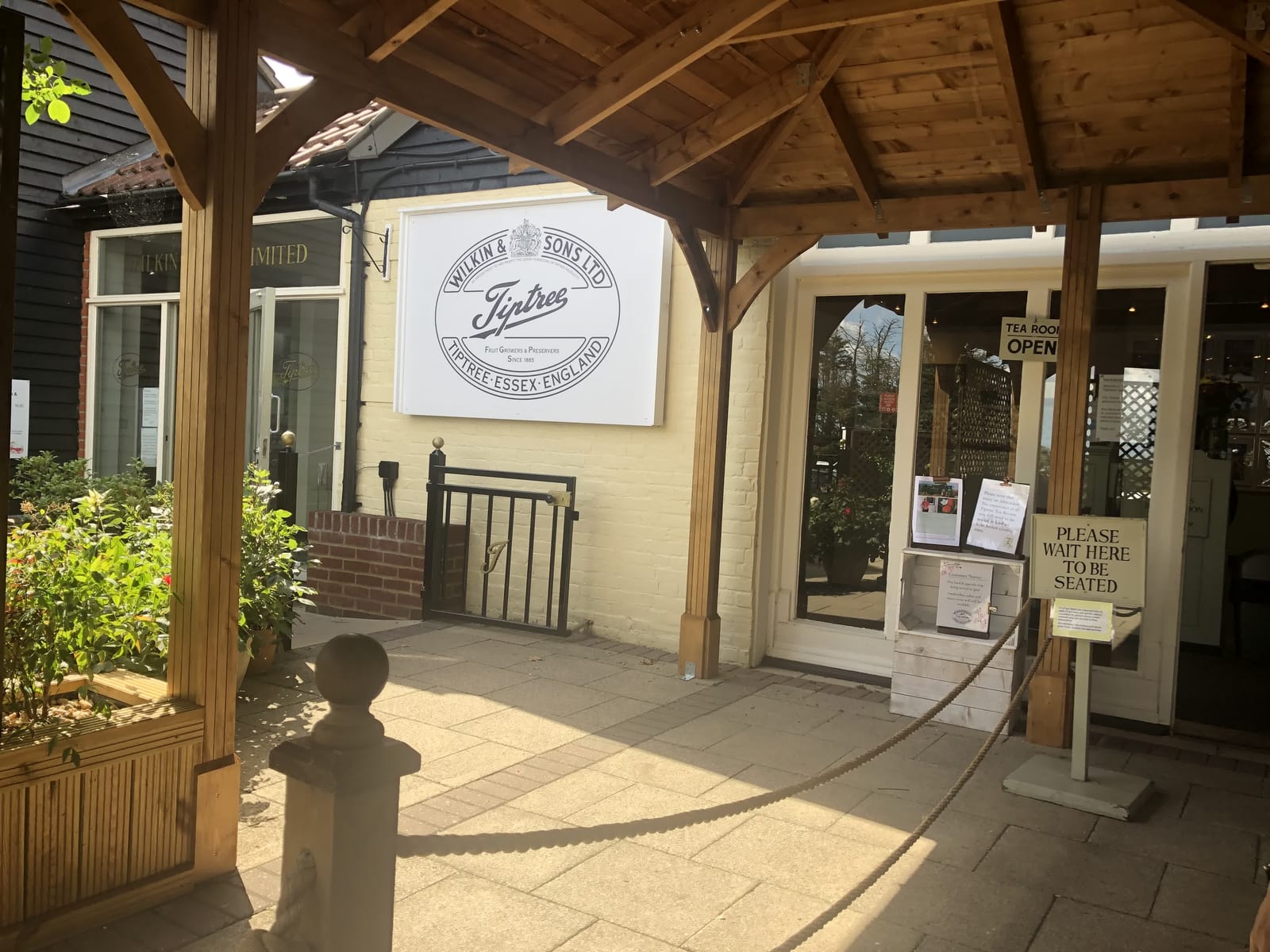
The tea room entrance at Wilkin & Sons in Tiptree village, with its timber porch and sign.
Driving into the village, we were greeted by a charming sign decorated with a strawberry. As we drove further onto the estate, orchards stretched as far as the eye could see, and the sweet smell of jam drifted from the factory chimney. The afternoon tea we had at the tea room behind the factory was something you could never get at a luxury London hotel — full of genuine, local, unmistakably English character. A traditional three-tier afternoon tea for two came to just £50, less than half of what a five-star London hotel would charge (£75–£100 per person) — remarkably good value.
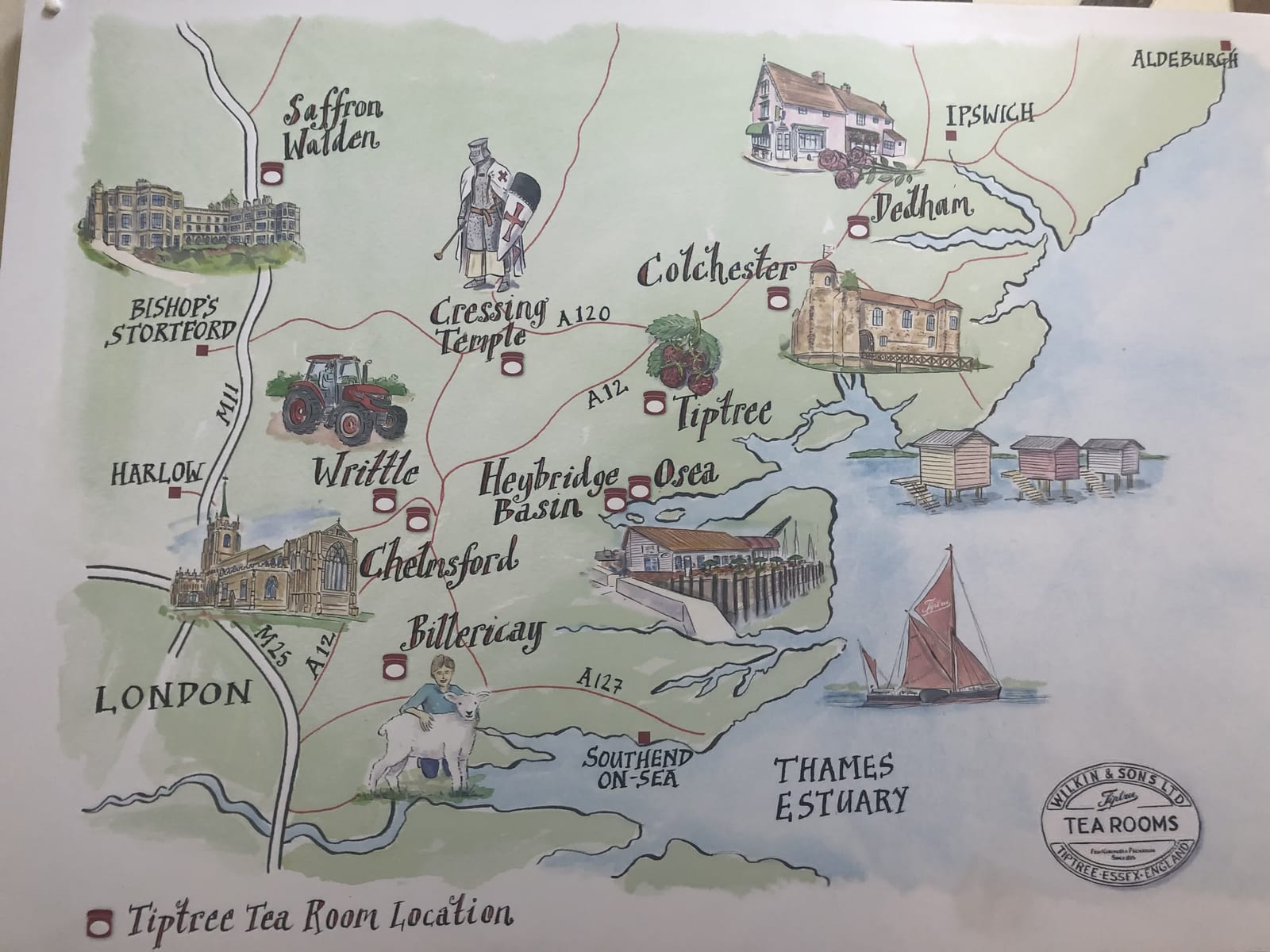
A hand-drawn map of Tiptree tea room locations scattered across Essex — seven in all.
Next to the factory is a small Wilkin & Sons museum, free to visit, tracing the history of Tiptree. As it turns out, this flagship branch is not the only one — Tiptree runs seven tea rooms in all, scattered across villages throughout Essex. Looking at the map and wondering which village's tea room to visit next has become one of our own small pleasures. It is also clearly a beloved local gathering place, and the easy conversations we had there with staff and other visitors still live vividly in my memory today.
Trying to understand a fine thing more deeply gives you a reason to encounter the land and the people behind it. Ordering online from Japan is satisfying enough on its own — but travelling all the way to the place itself, breathing the air of the village where it is made, and exchanging a few words with the people who live there, brings something else entirely: new relationships and new scenery, woven into the fabric of a retired life. Every time I strike up a small conversation on a trip like this, I am reminded that there is still so much of the world I haven't seen — and that, more than anything, is what pushes me toward the next journey.
Closing Thoughts
A single jar of jam, made from one tiny strawberry. Inside it lies more than 140 years of one family's skill and pride, a reputation strong enough to charm both royalty and a fictional secret agent, and, for my wife and me, a small seasonal ritual and a cherished travel memory all at once.
I have come to feel that living alongside fine things in retirement is never mere consumption. It carries, all at once, three quiet gifts: a way of caring for mind and body, a value that goes beyond money, and new people and places waiting to be discovered. The next time you spread jam on a scone, I hope you might spare a thought for the story sitting quietly behind that jar.
Next time, I'll be introducing another fine English thing — I hope you'll join me.
Other books you might like
You're welcome to take a look.
EAST TO WEST: The Heart of Haiku, the Light of Scripture
Much like the story tucked inside one small strawberry, this collection looks closely at the quiet details of everyday life through the words of haiku. This was my father-in-law's final work.
View on AmazonCataract Surgery-A Memoir: Double cataract surgery in Osaka, Japan
Another account, from age 66, of choosing to give time and money to something that truly mattered.
View on AmazonSushi Business in Britain: the complete four-volume series
A novel series following thirty-five years in the British sushi trade, from apprentice to factory manager to a small sushi school.
View on Amazon