🎧 Listen to the Discussion(two hosts talk through their thoughts on this article)
This is an AI-generated audio overview of this article, created with Google NotebookLM. Two hosts discuss the article together, sharing their own thoughts and commentary — it is not a reading of the article text.
E. H. Carr's What Is History? — a book collecting a series of lectures given at Cambridge in 1961 — is the book behind this record of what I've actually started doing at 66.
Since retiring and settling into a different rhythm, I find myself looking back far more often. Rereading old diaries, sorting through photographs, hesitating over whether to throw out records from my working years. Somewhere in the middle of all that, I began to wonder by what right I was handling my own past at all.
It is known as a classic of historiography, but that isn't what drew me to it. What I found in it was, in practical terms, a book about a skill: how the person you are now should handle the things that have already happened. For someone whose days are taken up with the garden and with reading, it turned out to be surprisingly useful.

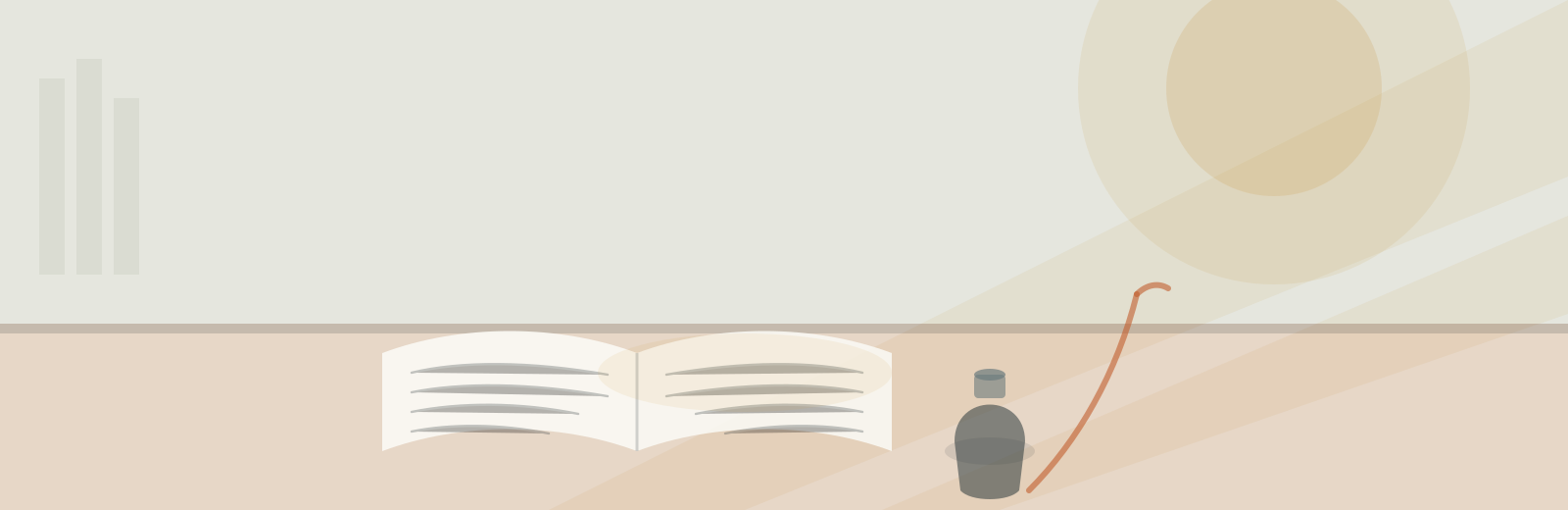
The relationship between an old record and the reader you are today runs in both directions, not one — the central idea of this book, drawn as a band of light crossing between two notebooks. The meaning of written words shifts a little each time you return to them.
Only the facts you call on will speak
In the first lecture, Carr carefully dismantles the comfortable idea that facts assemble themselves into history. Out of countless events, what decides which ones reach the stage is not the events but the person looking at them.
The facts speak only when the historian calls on them. — from the same book
Reading that line, I thought about my own forgetfulness. Proper nouns — people's names, the titles of books — stopped arriving promptly a good while ago. For a long time I took this as nothing but decline.
I see it a little differently now. Inside my head, too, a sorting is going on between what surfaces and what sinks. Rather than only lamenting that sorting, I can move to the side that decides what to call on. In practice, I've started writing three lines before bed about the day just spent. Those three lines become the facts that have earned the right to be called on later.
An unending dialogue between present and past
Carr closes the first lecture by compressing his answer into a single sentence. The past is not luggage in storage; it changes shape as the present keeps working on it.
History is a continuous process of interaction between the historian and his facts, an unending dialogue between the present and the past. — from the same book
If it is a dialogue, then the past stays silent whenever I do.
So I've set aside one day a month to reread my own old records — a blog post from a few years back, or the notebook I kept when I first arrived in Britain. Rereading, I repeatedly find that events I once thought decisive now look trivial, while a scene I dismissed in a single line has stayed oddly lodged in me.
When I was younger, I treated the past as settled. A failure was a failure, a detour was a detour, and you carried them as fixed facts. I no longer think that. Leaving medical school partway through — the meaning I assigned to that then is not the meaning I read in it now. The past hasn't changed; the other party to the dialogue has. Among everything I've noticed about growing older, this is the quietest and the most reliable relief. The hard years are not erased, but the right to rewrite what they meant remains on my side of the table.
The only absolute is change
The fifth lecture examines the idea of an absolute standard in history. Carr argues that no fixed point can be planted in the past or in the present, and quotes another historian on the matter.
For the historian, the only absolute is change. — from the same book
Taking change itself rather than a fixed point as the baseline turned out to apply directly to how I keep records of my own body.
Lately I notice my grip has weakened in small ways — a jar lid that won't turn. In the past, one stubborn lid would have been enough to dampen the whole day. Now I log that single instance as nothing more than that day's reading, and hold off on any judgement until I can see several months of readings in a row. Once I stopped rising and falling with each individual number, the whole business became remarkably lighter.
Buddhism speaks of the impermanence of all things. At this stage of life, that strikes me less as a lament than as practical advice: build change into your calculations. Each morning I place a small moxa cone on the zusanli point below the knee. Rather than scrambling once something has gone wrong, I say one word each day to a body that never stops changing.

The same river, and yet the water is never the same for a moment — the book's idea of change as the only standard, drawn as one river shifting colour as it runs. I try to read my daily numbers as a current rather than as single points.
There is no individual apart from society
The second lecture takes up the relationship between the individual and society. Using Robinson Crusoe as his example, Carr shows that the very premise of a person detached from society doesn't hold together.
The individual apart from society would be both speechless and mindless. — from the same book
Admitting that what I take to be my own thinking is largely a recombination of things I received came as a relief rather than a blow.
Living between Britain and Japan has sharpened this. Walking through a British town, you pass blue plaques on the walls recording who lived where and between which years; parish churches keep registers of baptisms and burials going back centuries. It is a culture that fixes history in stone and paper. In Japan, the shrine at Ise is rebuilt every twenty years. The building itself becomes new, and what is handed on is the craft and the procedure. Neither approach is better than the other, but the philosophies of preservation are entirely different. Noticing that contrast has been an unexpected dividend of keeping a foot in two countries.
What I write here is, in the end, a restatement of things I received from others. Even so, rather than aiming for replies, I hope that the simple existence of the record might become a small light for someone.
What is acquired passes from one generation to the next
Still in the fifth lecture, Carr draws a firm line between biological evolution and the progress a human society accumulates. What is transmitted by inheritance and what is transmitted by learning are not the same thing.
History is progress through the transmission of acquired skills from one generation to another. — from the same book
Read another way, the continuation of life is not about an individual lasting longer, but about the passing-on never breaking.
The raspberries in the garden make the logic visible. A second-year cane fruits and then dies back, but by then new shoots are already coming up from the roots. As canes, last year's growth and this year's shoots are entirely separate things. Yet the flavour of the fruit, and the tendency to lean in the wind, carry straight over. The individuals are replaced; what was acquired remains.
I have no answer to where our lives come from or where they go. What I have gained is a sense of being partway along something: receiving what was handed over, working on it a little, setting it down for whoever comes next. Even as memory fades, what is written down can still be passed on. That is why I keep writing.

The cane that bore fruit dies back, and next year's shoots are already rising beside it — what carries over is not the cane but the qualities the plant has acquired. A corner of the garden standing in for what passes between generations.
Goals appear along the road, not before it
In his discussion of progress, Carr rejects the notion of an automatic march towards a predetermined goal. He then restates what he does believe progress to be.
Belief in progress means belief not in any automatic or inevitable process, but in the progressive development of human potentialities. — from the same book
Goals don't descend from outside; they emerge along the road you are already walking. That ordering applies neatly to worrying about money.
During my working years I was preoccupied with an externally supplied figure: how much one needs for retirement. Now I work the other way round. I record what living has actually cost, and estimate the coming year from that. Simply giving up on setting the target first has taken much of the sting out of being chased by numbers.
I notice a British–Japanese difference in how investing is learned, too. In Britain, the idea of drawing dividends over a long horizon is embedded at the household level, and families who held the same holdings across generations are unremarkable. In Japan, cash and deposits still make up a high share of household assets, and the experience of holding something volatile for a long time has had less chance to accumulate across generations. Neither is right or wrong — but Carr's transmission of acquired skills is clearly at work in how money gets handled, too.
The same shape of answer serves for questions about happiness and about what is good. Rather than measuring myself against an absolute standard placed outside, I make the day's choices and confirm the outline afterwards. Whatever counts as good for me is nowhere but in the accumulation: the morning moxa, one circuit of the garden, three lines written down.
An observation of my own — the reader is a historian too
What follows isn't in the book; it's what I wanted to add having finished it.
Carr wrote about the historian on the writing side selecting facts. But the reading side must be doing exactly the same thing. Anyone reading this will call on a few of the sentences here and let the rest go past. That seems right to me.
So I try not to close my pieces off too neatly. I don't think my practice becomes anyone else's answer, and it shouldn't. If I leave the materials as they are, readers will reselect them in their own contexts. Thinking of it that way has taken some of the strain out of writing.
And yet it moves
At the end of the book, Carr declines the label of pessimist and closes his lectures by borrowing a line from a great scientist.
And yet — it moves. — from the same book
History, the body, daily life: all of it keeps moving regardless of how I feel about it. With something in motion, staying in dialogue makes more sense than issuing a fixed verdict. That, in the end, is what I carried home from a classic of historiography. Choose the facts to call on, keep talking with the past, tend a body on the assumption that it changes, and pass on what was handed to you. None of it is remarkable, but as a frame for building a quiet day, it feels sturdy enough.
The book I mentioned here:
E. H. Carr, What Is History?
(As an Amazon Associate I earn from qualifying purchases.)Other books you might like
You're welcome to take a look.
EAST TO WEST: The Heart of Haiku, the Light of Scripture
The words of haiku and the light of scripture look a little different each time you return to them, years after they were written. This was my father-in-law's final work.
View on AmazonCataract Surgery-A Memoir: Double cataract surgery in Osaka, Japan
Written in the same spirit as this book's "the only absolute is change" — a memoir of facing eyes that kept changing, day by day.
View on AmazonSushi Business in Britain: the complete four-volume series
A novel series following thirty-five years in the British sushi trade, from apprentice to factory manager to a small sushi school.
View on AmazonAbout the author — why a man who watched two world wars called himself an optimist

The lectures behind this book were delivered at Cambridge between the winter and spring of 1961. Winter trees and an unfinished manuscript stand in for the atmosphere of the place where a man who had watched two wars and a revolution still called himself an optimist.
Edward Hallett Carr was born in London in 1892 and died in 1982. After reading classics at Trinity College, Cambridge, he joined the Foreign Office in 1916 and spent some twenty years as a diplomat. He attended the Paris Peace Conference of 1919 as a member of the British delegation. That he stood in the room where history was being made before he became a scholar is not a detail to skip past when reading this book. Facts do not lie about neutrally; they are given shape by someone's selection and someone's negotiation — and he watched that happen at close range as a young man.
Leaving the Foreign Office in 1936, he took a chair in international politics at a Welsh university. The Twenty Years' Crisis, published in 1939, exposed how thoroughly the interwar order had been draped in idealistic language, and it remains a classic of international relations. During the Second World War he wrote leaders as an assistant editor at The Times, and afterwards he embarked on the great labour of his life, the fourteen-volume A History of Soviet Russia. From 1955 he was back at Trinity College, where he spent his later years.
Set out like that, the range of the era he lived through is startling. He was born at the close of the Victorian age, when reasons to doubt progress were still few. Then came the First World War and the Russian Revolution in his youth, and the Depression, the Second World War, the Cold War and decolonisation in his middle years. Many intellectuals of his generation came out of that experience concluding that progress had been an illusion all along. In this book he works through his contemporaries' pessimism, naming names as he goes.
What interests me is that Carr nonetheless described himself as an optimist. His optimism, though, was nothing like a belief that things improve if left alone. Human possibility widens only through the nerve to question existing assumptions and remake them — a conditional optimism with a spine. That is exactly why, in the closing section, he takes issue with one cautious contemporary after another.
As a man, Carr was frankly combative. His treatment of Soviet history drew repeated criticism, in his lifetime, for being too indulgent towards the regime; the suggestion is that a temperament inclined to challenge established frameworks sometimes softened his judgement of what he was studying. So when reading him, the right move is not to take his arguments at face value but to keep asking what era produced him. That, I think, is the attitude the book asks of its readers — after all, its own advice is to study the historian before you study the facts, and that advice must apply to Carr himself.
The edition I read is the 1962 Japanese translation by Kitaro Shimizu; a newer Japanese translation has since appeared as well, and the two read quite differently.