About this cucumber log
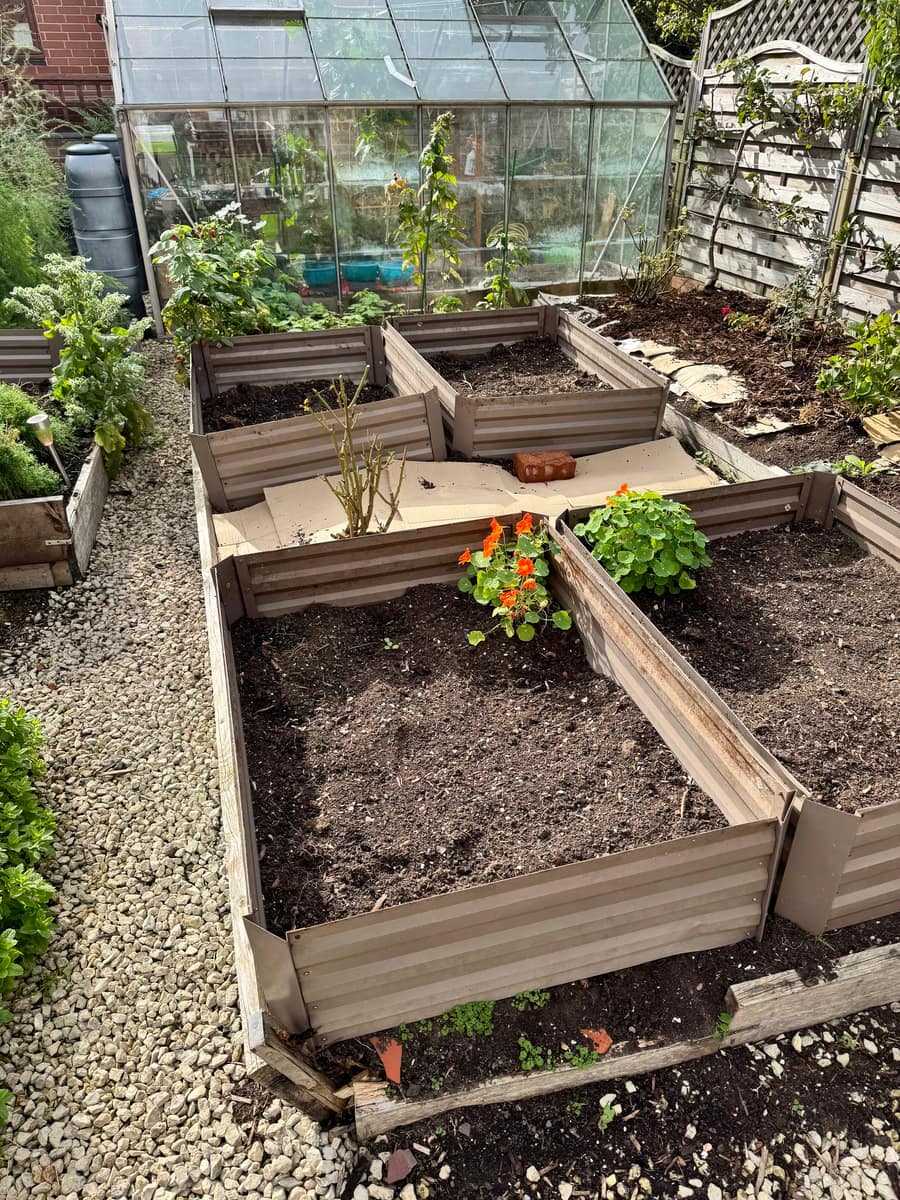
This is a cucumber growing log, split out from the seasonal care plan article. I'm growing four varieties and eight plants in our greenhouse raised bed (2 Carmen, 2 Telegraph, 2 Marketmore, 2 Gherkin). As of July 2026, Carmen, an all-female variety that needs no pollination, was the first to fruit, and the other varieties are catching up. I'll add monthly updates here.
Progress report (July 2026): Carmen thriving, the others catching up
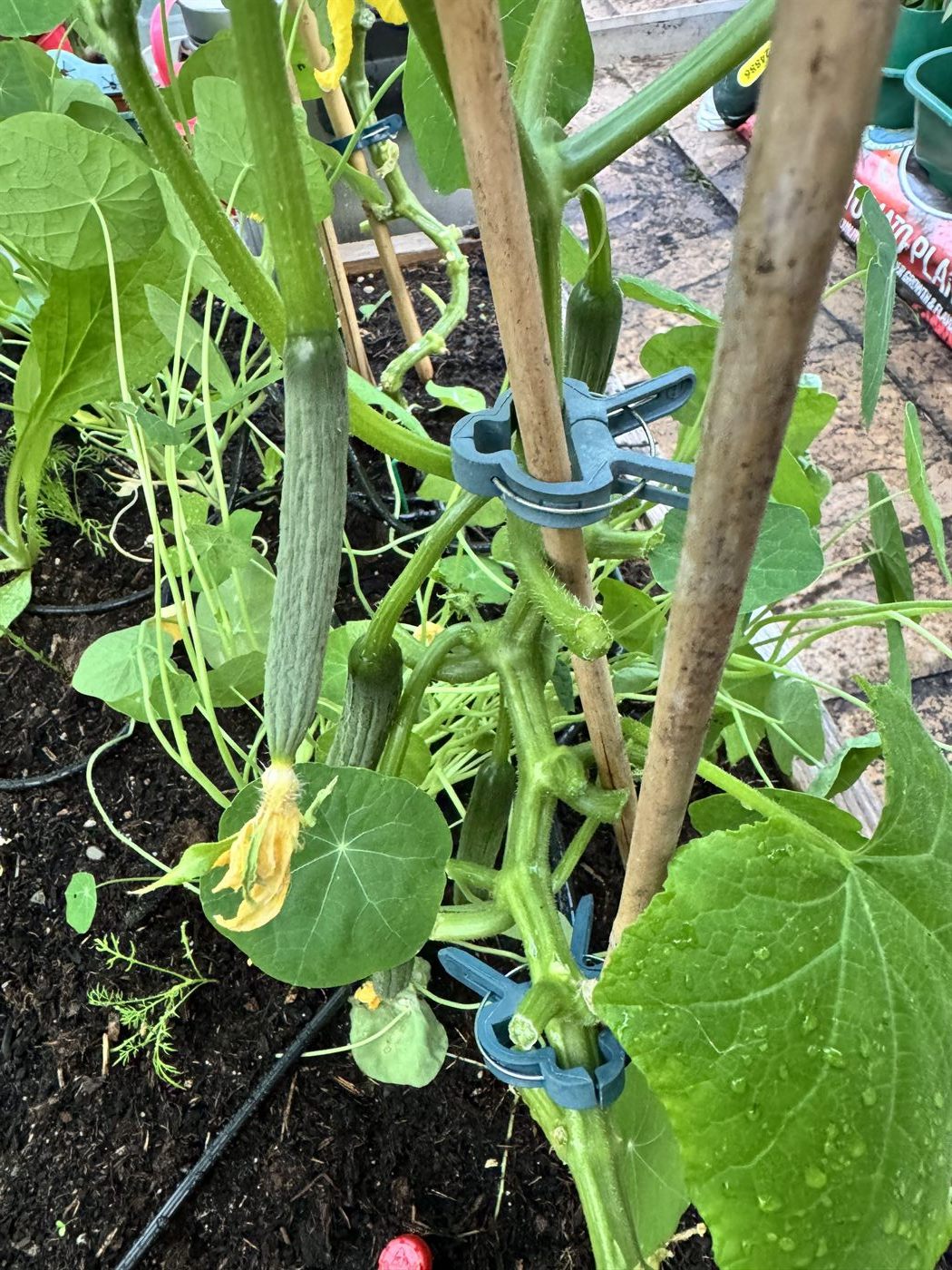
This season I planted four varieties in the greenhouse raised bed. Carmen, an all-female variety that needs no pollination, was the first to fruit for me, and I've already picked five cucumbers of about 20cm. I've been feeding with Tomorite (a high-potassium tomato feed) twice a week, and I've also removed the tendrils and cleared the stems and leaves below 25cm at the base.
I'll be honest — at first I was a little worried. Only one Carmen plant had produced anything, and I wondered whether the other three varieties would really fruit at all. But when I looked more closely, I found Telegraph had good fruit of around 15cm coming along, and Marketmore and Gherkin had female flowers and small young fruit too. My worry turned out to be for nothing. Carmen was simply early because of its nature (all-female, parthenocarpic); the others produce male flowers first and then female flowers, so they just seem to fruit a little later.
Telling female flowers apart — which ones become fruit
When I was fretting over whether the other plants would fruit, the thing that helped me most was learning to spot a female flower. Once I tried it, it was very simple — you just look behind the flower.
- A female flower (becomes fruit) has a small cucumber-shaped swelling right behind it. The "baby fruit" is there even before pollination — that's the giveaway.
- A male flower (doesn't fruit) has just a thin stalk behind it, with no swelling. Its job is to produce pollen.
Carmen is all-female, so every flower has a tiny fruit behind it. Telegraph, Marketmore and Gherkin do produce male flowers, but there's nothing to worry about. Gherkin self-pollinates and will fruit on its own, and Marketmore gets pollinated naturally by insects and the air. Only Telegraph turns bitter if pollinated, so I've heard — so when I find a male flower (one with no swelling behind it) I pick it off. As long as a plant is carrying female flowers, it will fruit sooner or later. Once I understood that, I felt a lot more relaxed about it.
What I'm doing to keep the plants healthy and cropping well
To keep all eight plants healthy and productive, here's what I'm trying to do at the moment.
- Pick young and often. I'm picking at 15–18cm, on the early side. If I leave them too long and let them get too big, the plants seem to tire and slow down on the next fruit — so when I'm in doubt, I pick early.
- Never let them dry out. Cucumbers drink and feed heavily because they fruit so well. On top of the drip irrigation, I water morning and evening on hot days. If they run short of water the fruit curls or turns bitter, so I keep an eye on this.
- Keep up the high-potassium feed. I give Tomorite twice a week at the stated dilution. The trick seems to be not to make it too strong — cucumbers are sensitive to salt at the roots, so "weak and often" feels safer and works better for me.
- Keep the air moving. I'm still clearing below 25cm at the base. I take off crowded lower leaves and yellowing leaves as I spot them, to keep powdery mildew away in the humid greenhouse. I've found that keeping water off the leaves matters too.
- Train and pinch out. I tie the main stem to the cane with clips or twine, and remove the tendrils as I spot them. Once the main stem reaches the greenhouse roof, I plan to pinch out the tip so the side shoots carry the fruit.
Monthly care plan, July to October

July is harvesting, picking young and high-potassium feeding; August is peak harvest and disease prevention; September is the wind-down, keeping the plants going and getting ready before travel; October is clearing out and renewing the greenhouse soil. I leave for Osaka around 20 October, so I'd like to have things wrapped up by then.
July (now) I'm picking young at 15–18cm as a rule, and keeping the base cleared below 25cm. I take off the tendrils and (on Telegraph) the male flowers as I go, and feed Tomorite twice a week. I water morning and evening on hot days so nothing dries out. Once the main stem hits the roof, I plan to pinch out the tip. Carmen and Telegraph are fruiting nicely, and I can see female flowers and young fruit on Marketmore and Gherkin too.
For reference, here's the liquid feed I'm using.
- Levington Tomorite Concentrated Tomato Food — the classic high-potassium feed for UK greenhouse growing. It works not just for tomatoes but for cucumbers, peppers and other fruiting crops. I dilute it in water and give it as I water.
(As an Amazon Associate I earn from qualifying purchases.)
August This will probably be the peak of the harvest. All eight plants should be fruiting in earnest, and the gherkins in particular look like they'll need picking almost daily. I'll remove the lower and yellowing leaves as I go, and plan to step the feed up to two or three times a week. Powdery mildew is likely at this time, so I'll try to catch the white powdery signs early and, if needed, treat them with a bicarbonate spray (2g of bicarb per litre of water). I want to ventilate well in the mornings so the greenhouse stays under 30°C.
September Growth should slow as it cools. I'll clear the old leaves and keep feeding twice a week. I plan to pinch out the main stem and switch to the side shoots, and to keep feeding to extend the season if the yield falls. I want to watch the cooler nights and adjust the vents. With my departure for Japan around 20 October coming up, this is when I'll confirm the watering and care arrangements. It's also a time to enjoy the last of the pickings.
October Once the harvest is over, I'll take the plants out. I'll pick every last fruit, wash and store the canes and clips, and clean and disinfect the greenhouse. I plan to replace the compost to avoid growing the same crop in the same soil, and improve it with compost. Overwintering a clean greenhouse is, I'm told, the way to stop disease carrying over into next season. I'd like to have everything tidied up before I leave for Osaka.
Through the autumn I'll keep reporting on the harvest and how the plants are doing.
Other books you might like
You're welcome to take a look.
EAST TO WEST: The Heart of Haiku, the Light of Scripture
Tidying up now for a season not yet here — the kind of quiet care for the future this collection finds through haiku. This is a book my father-in-law left behind.
View on AmazonCataract Surgery-A Memoir: Double cataract surgery in Osaka, Japan
Another new experience at 66 — an honest account of the cataract surgery I went through.
View on AmazonSushi Business in Britain: the complete four-volume series
A novel series following thirty-five years in the British sushi trade, from apprentice to factory manager to a small sushi school. The complete edition offers all four volumes at a better price.