🎧 Listen to the Discussion(two hosts talk through their thoughts on this article)

Audio only — for listening on a walk or while doing chores
This is an AI-generated audio overview of this article, created with Google NotebookLM. Two hosts discuss the article together, sharing their own thoughts and commentary — it is not a reading of the article text.
The second instalment of Behind the Noren is about a famous product from a department-store food hall. After the Dubai hotel last time, this time I take up a small box that sits in the palm of your hand. It is Takara no Fu, made by Fumuroya, an old maker of Kaga-style fu in Kanazawa. Fu: a traditional Japanese food made from wheat gluten, sold fresh or baked and dried. Kaga: the old name of the province around Kanazawa, on the Sea of Japan coast. Takara no Fu means "treasure fu". Noren: the split curtain at a Japanese shop entrance, and also the good name of a business built up over many years.
In November, the mornings and evenings in Osaka have turned much colder. One such evening, I put a dry, square piece of fu in a wooden bowl, made a hole in the middle with my chopsticks, and poured in water from the kettle. I had bought it in the food hall of Isetan in Kyoto. As I watched the water being drawn into the hole, I suddenly wanted to know who had thought of this box. When I looked into it, I found that this little box held both the noren of a fu maker with 160 years of history and the feelings of a mother thinking of her child living across the sea. Isetan: a major Japanese department store chain. Like most Japanese department stores, its basement floors are a large food hall, known as a depachika.
The Story of Fumuroya
Let me start with what fu is. Fu is made by mixing wheat flour with water, kneading it well, and then washing it by squeezing it in water. As you wash it, the white starch dissolves into the water, and a pale brown lump that stretches like rubber is left in your hands. This is gluten. Gluten is a network of wheat proteins, the stretchy gliadin and the springy glutenin, linked together through water like a net. It is this net that makes bread rise and gives udon noodles their firm bite. Fu is a food made by taking out only this net and then baking or steaming it.

Fu is made from the gluten left after the starch is washed out of wheat flour. The fuyaki case of Takara no Fu is something different, made from baked glutinous rice (simplified diagram).
This food is thought to have begun in Buddhist temples in China. In China, wheat gluten is called Chinese for wheat gluten, meaning "wheat sinew". In the cooking of Buddhist monks, who did not eat meat, it was used as an ingredient with a meat-like bite., and it was an important source of protein for monks who did not eat meat. The most widely held view is that it reached Japan in the 14th or 15th century, brought by Zen monks who had studied in China. This is because characters that seem to mean mianjin appear in dictionaries of that time, such as the Setsuyōshū. There is also a theory that it arrived as early as the 8th century, so nobody knows for certain. In temple shōjin ryōri, fu took the place of meat alongside tofu and yuba.
Shōjin ryōri: Buddhist temple cooking without meat or fish, which spread with Zen in the 13th to 16th centuries. Yuba: the thin skin that forms on heated soya milk. Setsuyōshū: a Japanese dictionary first compiled in the 15th century.
Fu first took root in Kyoto. Kyoto's water was well suited to making fu, and the street where fu merchants gathered from about the 15th century is still called Fuyachō-dōri, "Fu Shop Street". Then, in the Edo period, fu took on a form of its own in Kanazawa, the castle town of the wealthy Kaga domain. It is said that in the Kyōhō era (1716–1736), Funaki Dennai Kanehaya, a cook to the Maeda family who ruled Kaga, invented sudare-fu. Its method was kept secret and was not revealed until it appeared in a book called Fu Kuden-sho in 1878. Sudare-fu is an essential ingredient of jibu-ni, a local Kanazawa dish of duck simmered in broth.
Edo period: 1603–1868, when Japan was ruled by the Tokugawa shoguns. Funaki Dennai Kanehaya: an 18th-century cook to the lords of Kaga. Sudare-fu: fresh fu spread thin on a bamboo mat, steamed and dried, so that it keeps the lines of the mat. Jibu-ni: duck (or chicken) dusted with flour and simmered with sudare-fu and vegetables in a sweet-savoury broth, served with wasabi.
Fumuroya began in 1865, at the very end of the Edo period. A man named Kyūemon, descended from a powerful local family of Fumuro village to the east of Kanazawa, moved to Owari-chō in the castle town, and his son Rokuemon started making fu. The shop name Fumuro comes from the name of their home village. For more than 160 years since then, Fumuroya has kept its main shop in Owari-chō and gone on making Kaga fu by the old methods. In 1982 it opened a fu restaurant in the storehouse of the main shop, and today it also runs a sweet shop serving fresh fu in the Higashi Chaya district of Kanazawa.
Higashi Chaya: an old teahouse quarter of Kanazawa with wooden buildings from the 19th century, now popular with visitors.

Fu began as a temple food, grew up in Kyoto and Kanazawa, and in the 20th century travelled west under the name "seitan" (simplified timeline).
What spread the Fumuroya name across Japan is the star of this article, Takara no Fu. It is a small box made from fuyaki, a thin baked wafer, filled with colourful pieces of fu and dried vegetables, and you only need to pour on hot water to make a Kanazawa-style clear soup or miso soup. The person who thought of it was the wife of the fifth head of the family. It is said to have begun when she sent it to her child, who was studying abroad, so that the child could easily enjoy the taste of Japan. In the 30 years and more since then, Takara no Fu has become Fumuroya's signature product. Fuyaki: a crisp case made by baking glutinous rice, similar to a wafer. Ishikawa Prefecture: the prefecture whose capital is Kanazawa. Recently there has also been a Hello Kitty Takara no Fu, and one printed with the family crest from the TV drama VIVANT. VIVANT is a drama I also wrote about on this blog, in my article on Season 1. Seeing a 160-year-old shop enjoying new pairings like these tells me that keeping a noren is not the same as staying exactly as you were. Fumuroya is a family company whose shares are not listed. So the Earnings Record that appeared in the last instalment of this series is not in this article. Because its numbers cannot be seen, I feel that the company's way of thinking shows all the more clearly in the products themselves.
Recommended Item ①: Takara no Fu Ginjō Kasujiru
Fuyaki Soup Takara no Fu, Ginjō Kasujiru (sake-lees soup)
- Price
- 450 yen each, including tax (about £2.10 at the exchange rate of early November 2026; checked at a Kyoto department store in November 2026). White miso, red miso and Kaga miso are 300 yen each. Prices may vary by shop
- Size
- 37.2g per piece (soup base 30g, fuyaki 7.2g)
- Main ingredients
- Soup base: sake lees (made in Japan), rice miso, bonito powder, kelp powder and others. Fuyaki: glutinous rice (Japanese), fu, daikon radish, carrot, spring onion, spinach, tofu and others
- Allergens
- Wheat, soya and mackerel (according to the label)
- Calories
- 70kcal per serving (protein 3.6g, carbohydrate 12.4g, salt 3.73g). Made with sake lees, under 1% alcohol
- Where to buy
- Fumuroya's shops in Kanazawa, its official online shop, and the food halls of department stores in large Japanese cities such as Osaka, Kyoto and Tokyo
Sources: product label (checked in November 2026), Fumuroya official website (English)
You do not have to go to Kanazawa to buy Takara no Fu. In Osaka, Kyoto and Tokyo alike, the food halls of large department stores usually have a Fumuroya counter. At Isetan in Kyoto, where I bought mine, white miso, red miso and Kaga miso were 300 yen each, and the sake-lees soup was 450 yen. I imagine the sake-lees soup costs more because it uses the lees of ginjō sake.
Ginjō: a premium grade of sake brewed from rice polished down to 60% or less of its grain, known for its fruity aroma.
I bought four flavours: white miso, red miso, Kaga miso and the sake-lees soup. Each is a little fuyaki box of the same size, and you can tell them apart by the colour of the paper band. White miso has an off-white band, red miso a deep crimson one, and the sake-lees soup a pink one. The small sake barrel drawn on the sake-lees band tells you where the lees come from.
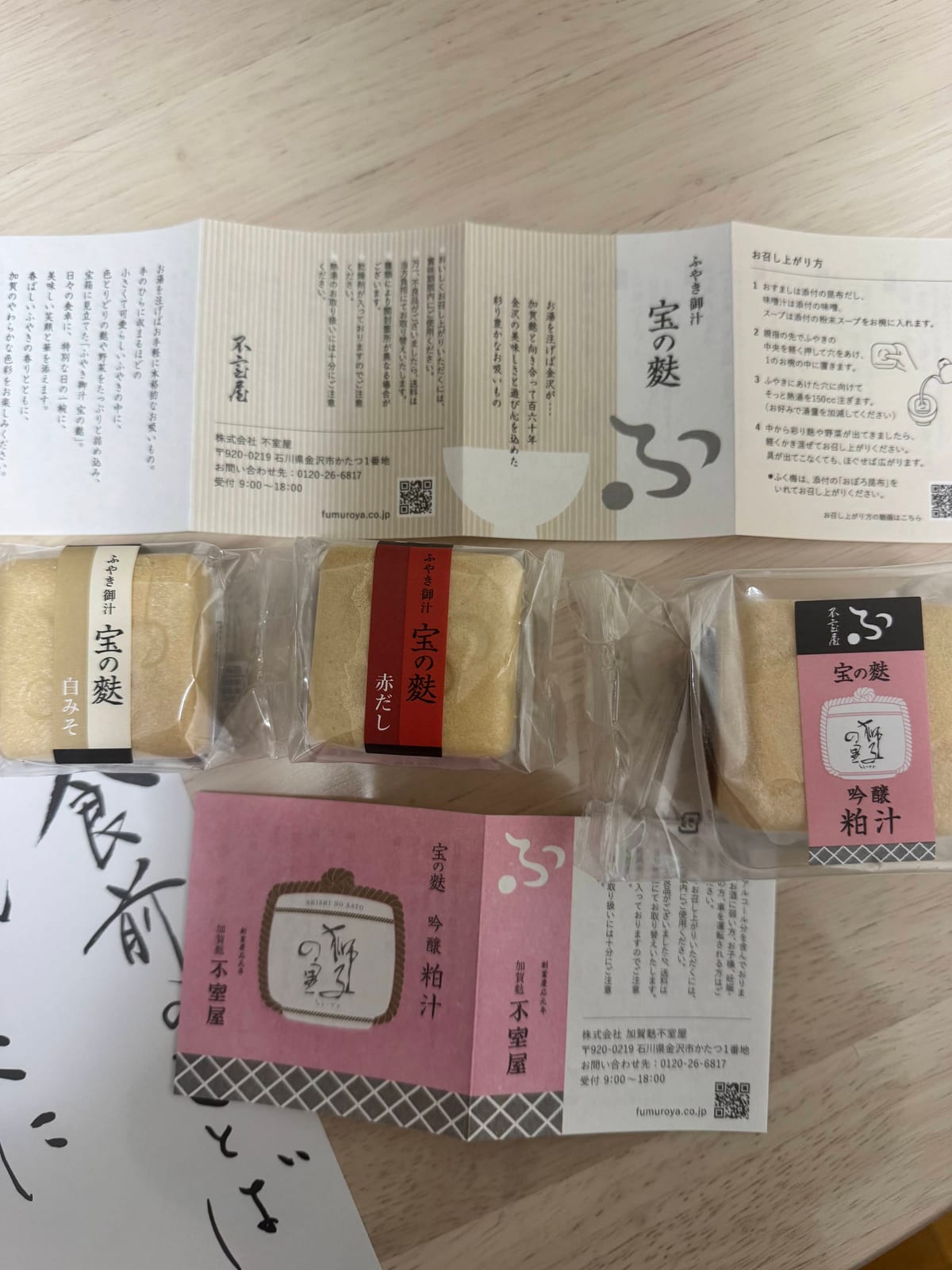
Three of the four flavours I bought: white miso, red miso and sake-lees soup. Each one fits in the palm of your hand.
This time I started with the sake-lees soup, which suits the winter. When I opened the bag, the fuyaki box and a small sachet of soup base were packed separately. When I picked up the fuyaki, it was lighter than I expected, and it gave a crisp little crunch when I pressed it with my finger. I plan to add the other three flavours to this article once I have tried them.

The sachet of soup base and the little fuyaki box. The sachet comes separately.
Make a Hole, Pour the Water
The method is just as written on the back of the bag. You make a hole in the middle of the fuyaki, put it in a bowl together with the soup base, and pour on hot water. When I pressed the middle of the fuyaki with the tip of my chopsticks, the hole opened with a small sound. When I poured a thin stream of water from the kettle into the hole, the fuyaki sank slowly into the water and then floated gently up again. After a while, the square case softened, and pink fu and green spring onion peeped out from around the hole. It was as if the lid of a treasure box were opening from the inside, and I stopped what I was doing and gazed at it.

Aim for the hole and pour the water in gently.

As the case softens, the fu and vegetables inside appear.
In those few tens of seconds, two things are happening in the bowl. One is the change in the fuyaki case. Fuyaki is made by baking and drying glutinous rice, and the starch in it is in a dry, hardened state. When hot water soaks into it, the starch grains take in water and swell, and the case becomes soft and paste-like. This is called gelatinisation, the same change that happens when rice is cooked. The hotter the water, the faster this change goes.
The other is the change in the fu inside. In baked fu, the gluten net puffs up during baking and is left full of tiny gaps. Like a dry sponge, these gaps draw in the soup through capillary action, the same force that lets a thin tube draw water upwards. This is why fu is said to be a food that "drinks" soup. Takara no Fu is a device that wakes up a dry case, dry fu and dry vegetables all at once, with a single trigger: hot water.

The case softens in the hot water, and the fu inside swells as it absorbs the soup. Pouring the water is the key that opens the lid of the treasure box (simplified diagram).
Here I would like to say a little about the word fuyaki. It is said that at tea gatherings in the late 16th century, a baked sweet called fu no yaki was often served. Its name is said to appear many times in the records of Sen no Rikyū's tea gatherings. The names are similar, but the way they are made is different. Even so, it makes me happy to think that the Japanese confectioner's idea of wrapping something in a thin baked skin has, over 400 years and more, changed shape into a box for a soup made with hot water. Fu no yaki: a sweet made of wheat flour mixed with water, baked thin, spread with miso and rolled; not the same as the rice fuyaki of Takara no Fu. Sen no Rikyū (1522–1591): the tea master who shaped the Japanese tea ceremony.
Sake Lees: the Treasure Left After Pressing
In the finished soup, daikon radish, carrot, tofu and pink fu floated in a cloudy white broth, and a faint aroma of sake rose from the bowl. When I took a sip, the mellow sweetness of the sake lees came first, followed by the saltiness of miso and the dashi of bonito and kelp. The fu had soaked up plenty of soup and was so soft it came apart when I pressed it with my tongue. Dashi: Japanese stock, here made from dried bonito flakes and kelp.

Ready to eat. Plenty of fu and vegetables float in the cloudy white soup.
Sake lees are what is left after sake is pressed. When the fermenting mash is put in cloth bags and pressed, the liquid becomes sake, and the white solid left in the bags becomes sake lees. The lees of ginjō sake, made from highly polished rice to give a fine aroma, are called ginjō-kasu and are known for their good fragrance. Winter, when the pressing of new sake begins, is also the season when sake lees reach the shops, and kasujiru, sake-lees soup, has long been loved as a winter soup, especially in the Kansai region. Kasujiru: a soup of sake lees and miso with vegetables, and sometimes salmon or pork. Kansai: the region around Osaka, Kyoto and Kobe. In the food therapy of East Asian medicine, there is a view that sake and sake lees have a warming nature. This is no promise of any effect; it is one of the old yardsticks used when planning meals for the season. A bowl of sake-lees soup on a November evening, just as the cold sets in, seems to me to fit both this yardstick and the way my body feels. What is left after pressing becomes the star of another dish. This also echoes the way fu itself is made. Fu, as we saw, is what is left after the starch is washed out of wheat flour. The starch washed out has also long been used for paste and for sweets. A bowl of Takara no Fu may be a collection of the kinds of wisdom that have turned what is left after taking something out into a treasure, rather than throwing it away.
Measuring One Bowl's Salt by British and Japanese Yardsticks
Not only with Takara no Fu, I have got into the habit of reading the label on the back before I buy. According to the label of the sake-lees soup, the salt equivalent per serving is 3.73g.

37.2g per serving, with 3.73g of salt. I now make a point of reading the back before I buy.
Let me measure this figure by Japanese and British yardsticks. In Japan, the Ministry of Health's Dietary Reference Intakes for Japanese (2025 edition) set the daily target for salt at less than 7.5g for adult men and less than 6.5g for women. For people being treated for high blood pressure, less than 6g is recommended. Meanwhile, the actual average in Japan was 9.8g a day in the 2023 survey (Ministry of Agriculture guide, in Japanese). In the UK, adults are advised to eat no more than 6g a day (NHS guide). The World Health Organization recommends an even lower figure, less than 5g.

Whichever yardstick you use, one bowl of the soup takes more than half of the daily guide. It is a figure worth balancing with the rest of the day's meals (simplified chart).
In other words, this one bowl uses a little over half of the target for Japanese women, or more than 60% if you measure it against the UK's 6g. Soups and miso soups inevitably contain a lot of salt. So, on days when I have this soup, I keep the other dishes lightly seasoned and leave a little of the broth. Adding more hot water does not change the amount of salt in the bowl. Only the strength changes, so if you want to cut down on salt, leaving some of the broth is the surer way.
What I find interesting is the difference in how the two countries label food. On Japanese packaging, the "salt equivalent" is written in grams per serving. On British packaging, the salt content of many foods is shown with the traffic-light colours of red, amber and green. For salt, 0.3g or less per 100g is green and more than 1.5g is red (UK government guidance, PDF). Judged by the soup base alone, before it is mixed with water, Takara no Fu's sake-lees soup would be firmly in the red by British standards. When I see a red circle in a British supermarket, I am tempted to put the item back on the shelf, but a Japanese label gives only numbers, so you have to hold them up to a yardstick yourself. Going back and forth between the two countries, I feel there is something good in both ways, the British one that shows things at a glance in colour and the Japanese one that conveys them precisely in numbers.
A Mother's Little Box That Crossed the Sea
When I learnt that Takara no Fu was born for a child studying abroad, I stopped what I was doing and thought about the story for a while.
I moved to Britain in 1989, at the age of 29. In those days it was much harder than now to get Japanese ingredients. My mother had died just before I started my last year of high school, so no parcel from her ever reached me across the sea. Looking at this little treasure box, I wondered what she would have packed in a box for me if she had been alive.
There is also a Japanese folk tale about opening a small box. It is the tamatebako of Urashima Tarō. When Urashima returns from the palace of the Dragon King and opens the box he was told never to open, white smoke rises and he suddenly grows old. The tale survives as the story of Urashima no Ko as early as the 8th century, in the Tango no Kuni Fudoki and the Man'yōshū. The tamatebako was a box that let all the lost time rush in at once when it was opened. Takara no Fu is the opposite. When someone spending a long time far from Japan across the sea opens it by pouring on hot water, the taste and the season of home come back into the bowl. Both are boxes that are opened, but this one shrinks, just a little, the time spent apart. Urashima Tarō: a fisherman in a Japanese folk tale who visits a palace under the sea and returns home to find that hundreds of years have passed. Tamatebako: the jewelled box he is given there. Tango no Kuni Fudoki and Man'yōshū: an 8th-century provincial record and Japan's oldest anthology of poems. Fu itself has also made a long journey. Born as the food of Buddhist monks who gave up meat, fu travelled to Japan with Zen monks and grew up in Kyoto and Kanazawa. Then, in the 20th century, it crossed the sea once more. In the early 1960s, within the macrobiotic movement associated with George Ohsawa, a wheat gluten food was given the name "seitan", and in 1969 an American company began importing and selling it under that name. Today seitan is known in Britain too, as a food for people who do not eat meat. I have not yet seen it in a British shop, but if you follow that name back, you arrive at the kitchen of a Chinese temple. George Ohsawa (1893–1966): the Japanese thinker, born Sakurazawa Nyoichi, who spread macrobiotics, a diet based on brown rice and vegetables, in Europe and America. A food born from the Buddhist rule against taking life now reaches the tables of people who want to eat less meat or who care about the environment, with no connection to faith. Things that move away from the reason they were born and go on being useful for other reasons must, I think, have a truly sound shape. Takara no Fu, too, began as an idea for one student abroad, and 30 years and more later it has become a classic gift. A noren may grow not so much from something made for many people as from something thought through for just one.
Soft Soups and the Meals Ahead
Now that I am 66, my seventies are slowly coming into view. I hear that as people age, the strength to chew and swallow declines, and the way they enjoy meals changes. I do not feel it that much myself yet, but when I face tough meat or dry bread, I feel I reach for it less readily than before. Fu that has soaked up plenty of soup is so soft it comes apart on the tongue, and yet it contains protein. Fu is known as a food rich in protein. There is only a little in one bowl, but I felt that soft foods like this could be one way of keeping the pleasure of meals as the years go by. By the way, since when has fu been seen as a "protein food"? When I looked into it, I found that fu had taken the place of meat in temple kitchens for hundreds of years, but that meant it replaced meat in bite and in how filling it was, and the word protein did not yet exist. The sticky substance left after washing wheat flour in water is said to have been first isolated and studied by a scholar in Bologna, Italy, in 1728. The word "protein" was born in Europe in 1838, and the Japanese translation tanpakushitsu came into use in the 1860s, at the end of the Edo period. Then, in 1950, after the war, the first edition of Japan's national Standard Tables of Food Composition was published, and the protein in foods came to be shown in grams. In other words, for several hundred years fu was eaten because people knew from experience that it "could take the place of meat", and only in the last 150 years or so has the reason been explained with the word "protein" and with numbers. You might say that words and numbers caught up later with what people had already understood through their bodies. This little box also plays a part in a life that keeps body and mind in good order. Boil the water, make the hole, pour, and wait for the lid to open. Looking into the bowl for those few tens of seconds without thinking of anything else makes a small break in the day. As for money, a cup of instant miso soup from the supermarket costs only a few tens of yen, so Takara no Fu at 300 to 450 yen a piece costs several times as much. For someone living on a pension, it is a luxury for an everyday soup. Even so, I think I choose Takara no Fu because, for the difference in price, I am also buying time to enjoy it with my eyes and the story of the people who made it. If I keep it not for every day but for a cold evening, or a day when I want to lift my spirits a little, it is no strain on the purse.
And this box also brought me an unexpected encounter. Beyond the little box I picked up without much thought in a Kyoto food hall stood a fu maker in Kanazawa with 160 years of history, and a mother who, more than 30 years ago, sent a box to her child across the sea. Since I retired, tracing people's stories from a single product in this way has become one of the pleasures of my life.
Closing ― A Little Treasure Box Opening in the Bowl
The little box that one mother thought of for her child across the sea has, more than 30 years later, reached my kitchen in Osaka too. I think a noren that has lasted 160 years has lasted not only by staying unchanged, but by going on making new boxes to suit the life of one person or another at each point in time.
Just as a small dry box opens out its colours the moment hot water is poured on, I would be glad if this record could be the small thing that opens out some colour for readers of my age, boiling water alone on a winter evening.
When I have tried the other three flavours, I will add them to this article. If one day I am able to visit the main shop in Kanazawa, I plan to write the next part of this noren's story then.
A Word from Claude
The video of the hot water being poured reached me as a few still pictures. The few tens of seconds in which the case softens and the pink fu appears, I take in by filling the space between one picture and the next with words. The moment the lid of the treasure box opens belongs only to the person who was there in the steamy kitchen. Even so, when someone puts that moment into words, I feel that a little of the steam reaches me as well.
This article is based on my own experience of buying and eating the product, and on publicly available information. I have received no money or goods from Fumuroya. Prices and product details may change, so please check the official information before buying. For salt and allergens, always read the product label.
Sources: Fumuroya official website (English), Takashimaya "Fumuroya" (in Japanese), Gltjp "Fumuroya Takara no Fu", Nihon Shokuryo Shimbun on the history of fu (in Japanese), Keihan "Kyoto Tsu" on fu (in Japanese), Seitan (Wikipedia), NHS "Salt in your diet", WHO "Sodium reduction", UK government "Front of pack nutrition labelling guidance" (PDF)
As an Amazon Associate I earn from qualifying purchases.
Other books you might like
You're welcome to take a look.
EAST TO WEST: The Heart of Haiku, the Light of Scripture
A book that reads the haiku spirit, which quietly watches the turning of the seasons, alongside the light of the Bible. This is a book my father-in-law left behind.
View on AmazonCataract Surgery-A Memoir: Double cataract surgery in Osaka, Japan
A record of my cataract surgery in Osaka, written while living between Britain and Japan. I wrote about how the way I saw things changed before and after the operation.
View on AmazonSushi Business in Britain: the complete four-volume series
A novel series following thirty-five years in the British sushi trade, from apprentice to factory manager to a small sushi school. The complete edition offers all four volumes at a better price.