About this tomato log
This is a tomato growing log, split out from the garden-seasonal-care-plan article. This season I grew nine varieties from seed in our greenhouse — a mix of Japanese seed (Sakata) and UK seed (Premier Seeds Direct) — across three growbags, three plants each, nine in total, all on a single stem. As of July 2026, every plant has grown well, with yellow flower trusses coming one after another and young fruit starting to set. I'll add monthly updates here.
Progress report (July 2026): nine varieties from seed, flowering to fruit set
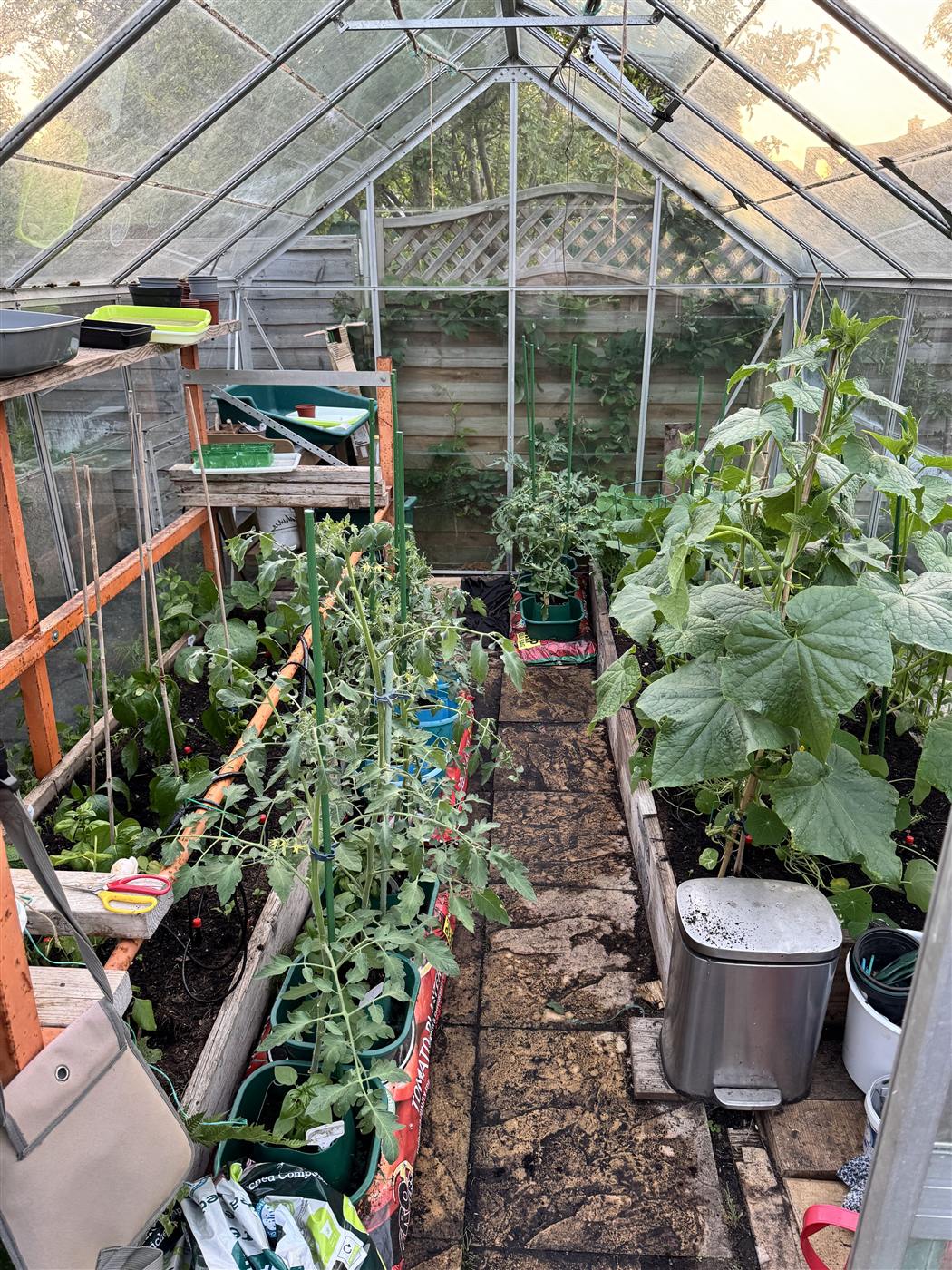
This season's tomatoes were all grown from seed. I've lined up three growbags in the greenhouse, three plants each, nine in total. I'm growing them on a single stem, removing the side shoots as soon as I notice them, and feeding with Tomorite (a high-potassium tomato feed) twice a week. As of July, every plant has put on good height and truss after truss of yellow flowers has come up. The first small green fruit has set too. I'm using the drip irrigation to keep them from drying out.
The plants look tidy and healthy, well trained to canes and clips. I've planted basil and nasturtium at the base — companion plants whose scent helps keep pests away, and a combination I'm rather pleased with. Overall it's a good, steady start heading into the fruiting period.
This season's nine varieties (a Japan–UK mix)
I've numbered the plants from the front of the greenhouse door inwards. Mixing Japanese cherry and medium tomatoes with a range of UK varieties is one of the things I'm looking forward to this year.
Left growbag
- Cindy Sweet, medium red (Sakata) — a sweet medium-sized tomato
- Orange Carol cherry (Sakata) — an orange cherry that fruits in heavy clusters
- Mini Carol cherry (Sakata) — an easy-going red cherry
Middle growbag
- Cherry Sweet Aperitif — highly rated as an intensely sweet cherry
- Cherry Sweet Aperitif (the same)
- Burlesque — a blight-resistant variety
Right growbag
- Purple Calabash — a ribbed purple heirloom (organic)
- Roma VF — a cooking/sauce tomato (organic)
- Maskotka (trailing) — a trailing variety, also good for hanging baskets (organic)
Only Maskotka is a trailing type, so it behaves a little differently from the eight upright single-stem plants. I gather it's fine to support the stems and let it trail naturally rather than force it upright, so I'll see how it goes.
What I'm doing to keep the plants healthy and cropping well
Here's what I'm trying to do to keep all nine plants healthy and productive. Tomatoes have their own concerns, different from cucumbers, which is part of what makes them interesting.
- Keep pinching side shoots (single stem). As I'm already doing, I pinch out the shoots that appear in the leaf joints while they're small. This concentrates the energy into one main stem and improves airflow. All eight plants except Maskotka are grown this way.
- Clear the lower leaves. The leaves near the soil seem to be a way in for disease (blight especially) via splashback. I remove the old and yellowing leaves near the ground to keep air moving at the base. In the photos the lower leaves are close to the soil, so that's something I want to tidy early.
- Keep the watering steady (to prevent blossom end rot). Growbags have a limited root run and dry out quickly, so it's easy to get water shortages and wet-dry swings. I've heard that's the main trigger for blossom end rot (a black sunken patch on the base of the fruit). Giving a consistent amount daily through the drip system and never letting the soil dry right out seems to be the best prevention.
- Keep up the high-potassium feed. Tomorite twice a week at the stated dilution. From August, as fruiting picks up, I plan to go to two or three times a week. It should help the fruit fill out and sweeten.
- Watch for blight. I'm told it's the most feared disease of UK greenhouse tomatoes in summer. Brown lesions on leaves or fruit are the warning sign. Prevention comes down to airflow, clearing the lower leaves, and watering without wetting the foliage. This year Burlesque and Roma VF are the more resistant varieties, which is reassuring. I thin the crowded leaves to let air through.
- Pinch out the top. Once the main stem reaches the top of the cane, or once it has set five or six trusses, I pinch out the growing tip. UK summers are short, and fruit set too high up won't colour by autumn, so I gather it's better to limit the number of trusses and let each one fill out well. September looks like the time for it.
- Help pollination. Tomatoes are self-pollinating, but the still air in a greenhouse can make it harder. I've read that ventilating in the morning to move the air, or gently flicking the trusses to shake them, improves fruit set during flowering.
Monthly care plan, July to October

July is pinching shoots, clearing lower leaves and steady watering to prevent end rot; August is the start of harvest and catching blight early; September is peak harvest, stopping the plants and getting ready before travel; October is picking the last fruit and clearing and renewing the greenhouse. I leave for Osaka on 20 October, so I'd like to have things wrapped up by then.
July (now) I'm keeping up the side-shooting (single stem) and clearing the lower leaves to prevent splashback. I tie the trusses to the cane and keep the water steady to prevent blossom end rot. I feed Tomorite twice a week and ventilate in the morning to help pollination. All nine varieties are now in the flowering and fruit-setting stage.
For reference, here's the liquid feed I'm using.
- Levington Tomorite Concentrated Tomato Food — the classic UK high-potassium feed. It helps with fruit set and sweetness. I dilute it in water and give it as I water.
August The harvest should begin. I'll pick the fruit as it colours up, and keep pinching shoots and clearing lower leaves. I'll keep the watering steady and plan to step the feed up to two or three times a week. Blight is likely at this time, so I want to catch brown lesions early and thin the crowded leaves for airflow. I'll support the trailing Maskotka's stems.
September This should be the peak of the harvest. I want to check daily and not miss the ripe fruit. I'll pinch out the main stem to put the energy into the fruit already set, and I'm considering removing the late top trusses (the ones that won't colour by autumn). I'll keep feeding twice a week. Ripening will slow as the nights cool. With my departure for Japan in late October coming up, this is when I'll confirm the care arrangements.
October I'll pick all the remaining fruit. Green fruit brought indoors will ripen and redden nicely. I'll take the plants out, wash and store the canes, and dispose of or replace the growbag soil (to avoid growing the same crop in it). I'll clean and disinfect the greenhouse and overwinter it in a clean state. I'd like to have everything tidied up before I leave for Osaka.
Through the autumn I'll keep reporting on the harvest and how the fruit colours up.
Other books you might like
You're welcome to take a look.
EAST TO WEST: The Heart of Haiku, the Light of Scripture
The daily habit of checking on something quietly ripening — the kind of small routine this collection finds through haiku. This is a book my father-in-law left behind.
View on AmazonCataract Surgery-A Memoir: Double cataract surgery in Osaka, Japan
Another new experience at 66 — an honest account of the cataract surgery I went through.
View on AmazonSushi Business in Britain: the complete four-volume series
A novel series following thirty-five years in the British sushi trade, from apprentice to factory manager to a small sushi school. The complete edition offers all four volumes at a better price.