Manila Itinerary: 6 Days — Summary
Date: 2020-01-25
The 93-Day Journey: Part 2 — Manila
This is the Manila leg of our 93-day travel adventure. After Japan (Narita, Matsuyama, Osaka), we flew onward to the Philippines.
Full itinerary of countries and cities: London → Narita → Matsuyama → Osaka → Manila → Cebu → Kuala Lumpur → Penang → London
Arriving in Manila
Flying into Ninoy Aquino International Airport (NAIA), we had arranged a hotel pickup in advance — necessary because we didn't yet have a Philippine SIM card and couldn't book Grab on arrival. Pre-arranged pickup cost: 1,250 pesos.
Check-in at Dusit Thani Manila — our base for 5 nights. (See the separate Dusit Thani Manila article for the full hotel review.)

Philippine SIM purchase (Day 1): Bought a local SIM immediately. 850 pesos (~¥1,800) for 30 days: 8GB data, unlimited calls to Philippine numbers, and a local Philippine number.
Day-by-Day
Day 1 — PRA Retirement Visa Application
Visited the Philippine Retirement Authority (PRA) in Makati to begin the SRRV retirement visa application process. The SRRV (Special Resident Retiree's Visa) allows foreign nationals to reside long-term in the Philippines under a retirement status.
Day 2 — Bank Administration
Visited BDO (Banco de Oro) to reactivate a dormant bank account. Philippine bank accounts become dormant if unused for an extended period — reactivation requires in-person attendance at a branch.

Day 3 — Greenbelt, Ayala
Explored the Greenbelt complex in Makati's Ayala Center — the upscale outdoor shopping and dining district. Multiple interconnected gardens, restaurants, and retail areas across Greenbelt 1 through 5.
Day 4 — Massage and Outsourced Laundry
Manila introduction to two essential Philippines services:
Massage: The Mont Albo Massage Hut directly opposite the hotel — 550 pesos/hr for standard oil massage, 650 pesos/hr for traditional Filipino Hilot massage. Compare this to Cebu: 350–450 pesos/hr. Manila is more expensive, but both represent remarkable value by European standards.
Laundry: First time using an outsourced laundry service. Royal Clean in Park Square (behind the hotel): 90 pesos per kilogram, weighed on arrival, prepaid, returned folded the next day. This is the normal approach in the Philippines — washing machines are expensive appliances that most households don't own. Using a laundry service is standard.
Departure: Manila → Cebu
Grab to NAIA Terminal 4: 352 pesos (~¥760). Our total luggage: 5 suitcases and 2 carry-on bags — 94kg in total. A challenge to load, but the driver managed.
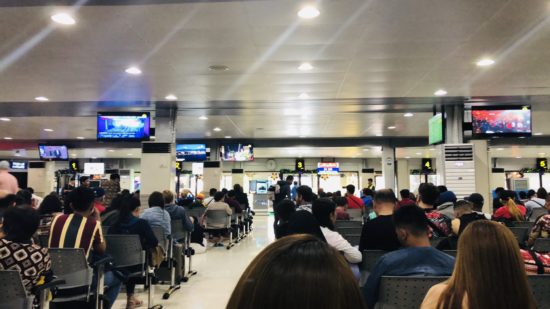
Lunch at the airport: Queued at the busiest food counter in the terminal. Pork rice: 130 pesos (~¥280).
Portable WiFi: Found a Huawei portable WiFi device in the departure lounge that we had been wanting. 1,300 pesos (~¥2,800) for the device. Additional 30-day SIM: 1,300 pesos for 20GB data. Having a dedicated WiFi device means a reliable connection independent of any single local SIM — highly useful for extended travel.
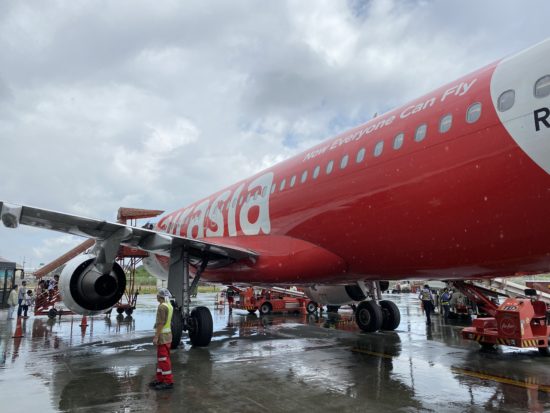
Flight: Aircraft A320-200. Boarded remotely via bus from the gate — rain on the tarmac.
1.5 hours later: Arrived in Cebu. Called a Grab from the arrivals area.
Manila Notes for Visitors
- Grab is the only reliable, honest-price transport option in Manila. Standard taxis frequently quote fixed inflated prices rather than using meters — Grab eliminates the negotiation entirely.
- NAIA has four terminals. Terminal 1: international legacy airlines. Terminal 2: Philippine Airlines. Terminal 3: international budget and some domestic. Terminal 4: domestic budget airlines (Cebu Pacific domestic, Jetstar, etc.). Check your terminal in advance — they are not connected on foot and switching between them requires a bus.
- Traffic in Manila is among the worst in Southeast Asia. Allow 60–90 minutes for airport transfers at peak hours. The 20-minute drive can become 90 minutes in heavy traffic.
- Philippine SIM cards are available in the arrivals hall of all terminals. Buy one immediately on landing — Grab requires a data connection.

Other books you might like
You're welcome to take a look.
EAST TO WEST: The Heart of Haiku, the Light of Scripture
A quiet essay moving between the language of haiku and the light of Scripture. This was my father-in-law's final work.
View on AmazonCataract Surgery-A Memoir: Double cataract surgery in Osaka, Japan
Another new experience at 66 — an honest account of the cataract surgery I went through.
View on AmazonSushi Business in Britain: the complete four-volume series
A novel series following thirty-five years in the British sushi trade, from apprentice to factory manager to a small sushi school.
View on Amazon