Blue Star Dive & Resort — Complete Guide (Part 2)
Date: 2020-03-29
This continues from Part 1. In this second of two parts, I cover the meals at the restaurant (breakfast, lunch and dinner), the staff service, our rating of the hotel, and what the three nights and four days cost us. For dinner, you could order fish caught in the sea in front of the hotel that day and choose how it was cooked, and at the time there was a pizza night every Wednesday. We rated our stay 10 out of 10.
① Blue Star Dive & Resort — Complete Guide (Part 1)
② Blue Star Dive & Resort — Complete Guide (Part 2)
Restaurant
The restaurant and bar occupy the main building's upper level — a partially open terrace with sea views on all sides. A reason to sit down in itself.

Tables have glass tops with a seabed display underneath — sand, shells, and coral fragments sealed under the glass. A cheerful detail.
Breakfast
Served 7:00am–11:00am. Three choices each morning:
American breakfast set: Filipino-style ham (typically frozen, then pan-fried), fried or scrambled eggs, toast, and fruit.

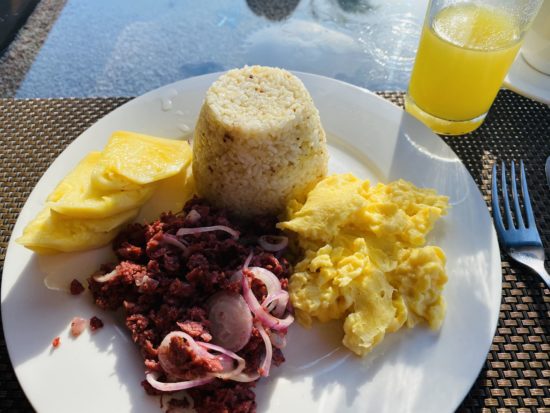
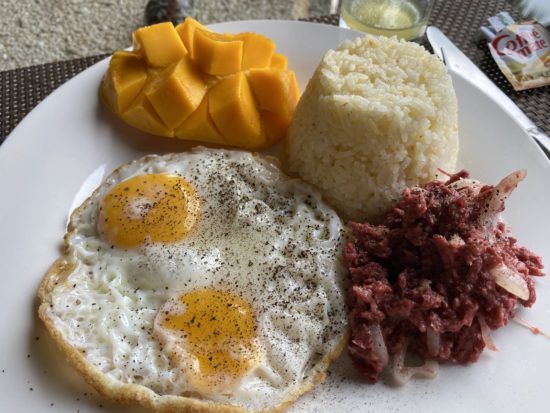
Filipino breakfast (corned beef set): Corned beef stir-fried with onion, garlic rice, and a fried egg. Simple and consistent — the standard Filipino silog combination.
Filipino breakfast (Tocino set): Tocino is a sweet-soy braised pork, served with garlic rice and a fried egg. Sweeter than the corned beef version, equally good with rice.
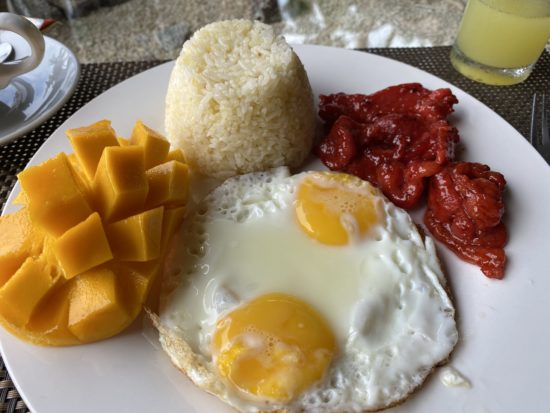
Fruit: Changes daily. On the days we had mango — fully ripe Philippine mango, soft and intensely sweet — nothing else on the table mattered. Philippine mango at this quality has no equivalent in European supermarkets. The flavour difference is categorical.
Lunch
Drinks: Four Seasons Shake (mixed tropical fruit) and Coconut Shake — 150 pesos each. Cold, fresh, and restorative after a morning in the sun.
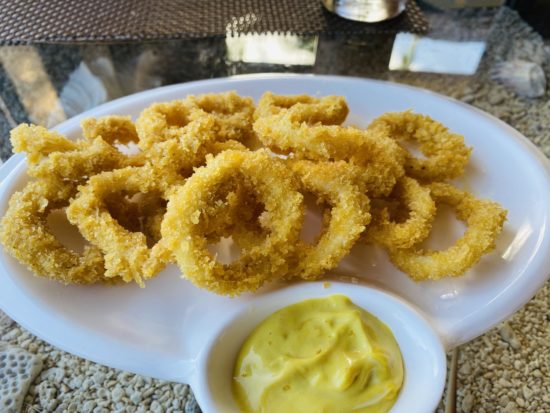
Calamari (fried squid rings): 280 pesos. A consistent order whenever it appears on a menu. The version here: properly crisp, not greasy.

Jambalaya rice: 380 pesos. Spiced rice with mixed protein — an unexpectedly appropriate dish for a tropical resort.
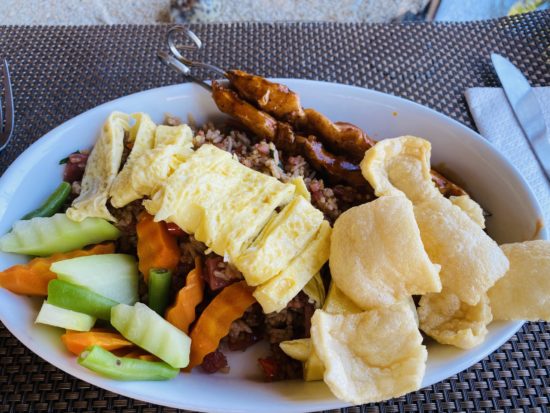
Nasi goreng: 380 pesos. Indonesian-style fried rice with egg and accompaniments — the Southeast Asian comfort food standard.

Rice dishes came with chicken satay on the side: grilled chicken skewers with peanut sauce.
Dinner
Mango chicken salad: 280 pesos. Dressed with a vinegar-forward dressing that cuts through the sweetness of the fresh mango pieces throughout. Balanced and refreshing.

Red snapper — freshly caught that day: We asked about fresh fish; the kitchen had red snapper caught from the reef in front of the hotel that morning. 400g fish for 380 pesos. Ordered grilled (other options: steamed, fried). Served with rice.
Preparation: the fish cavity was stuffed with chopped tomato, onion, and herbs. Served with a Filipino soy and calamansi dipping sauce on the side. The kitchen had removed the skin over the cheek section to make the best part of the fish easy to reach. The flesh: soft, fresh, delicate, dissolving on the tongue. Fish caught the same morning from the same water you snorkelled in that afternoon.
Wednesday Pizza Night
Every Wednesday from 7pm: Pizza Night.

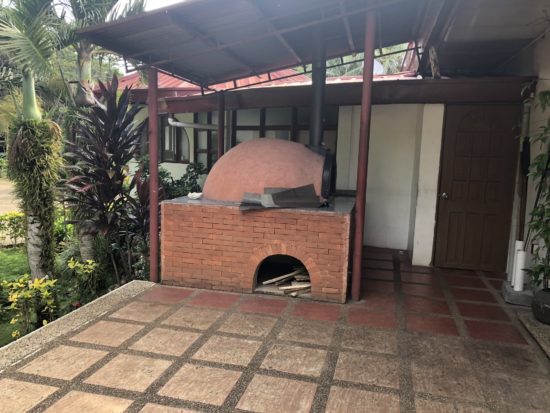
The stone pizza oven stands beside the hotel entrance. The fire was lit at around 9am for a 7pm start — we were surprised how long it takes to get the oven properly hot.
We arrived early and ordered beer and prawn tempura (labelled on the menu as 海老天ぷら — the Japanese name, though the preparation is Filipino-style deep-fried prawn). Extraordinarily crisp, the prawns plump and fresh.

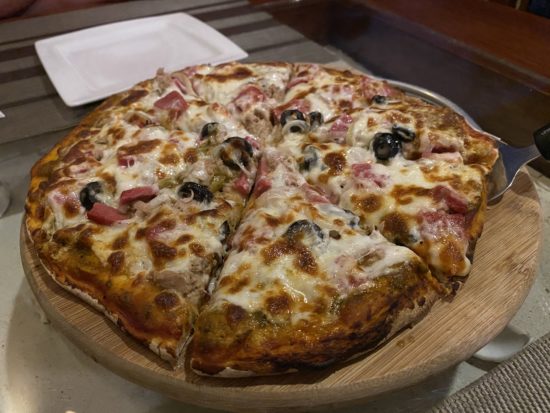
Blue Star Pizza — the house signature: tuna, ham, onion, black olives. Sauce: tomato and pesto (basil, Parmesan, olive oil). Mozzarella cheese. Thin Italian-style crust, generously topped.

Stone oven result: the base is crisp under a deeply loaded topping — the way it should be. In London, we regularly visit Italian family-run restaurants with ovens like this one. Finding the equivalent — at this quality — in a Philippine village of 12 hotel rooms was a genuine surprise.
The Wednesday Pizza Night is also a local institution. The owners and local residents — mostly couples in their 50s and 60s with their families — come for dinner. The restaurant becomes a social occasion: conversation, introductions, unhurried table-sharing. A warm and unexpectedly community atmosphere for a remote resort.


Staff Service
We took the 8:20am ferry from Cebu, left Tagbilaran Port by hotel transfer at approximately 10:25am, and arrived at Blue Star at approximately 12:20pm — well before the standard check-in time. We were shown directly to our room.
Welcome drink: iced tea.
Throughout the stay: smiling, attentive, proactive. Housekeeping completed every day to the same high standard. Diving centre staff consistently friendly and safety-conscious.
Rating: 10 out of 10
Return intention: certain.
For a 3-night stay, we had one full day on the Bohol Island tour, one full day at the resort (snorkelling plus pool and general relaxation), and the arrival and departure days around these.

The people who stay for a week or longer are the diving guests. From what we observed: they are right to.

Total Costs for the 3-Night Stay
| Item | Cost |
|---|---|
| Restaurant food and drinks (3 nights + lunches) | 4,020 pesos (~¥8,600) |
| Snorkelling × 2 people | 1,000 pesos (~¥2,140) |
| Bohol full-day private tour (9am–5pm) | 5,000 pesos (~¥10,700) |
| Hotel transfer Tagbilaran ↔ resort (return) | 5,000 pesos (~¥10,700) |

The resort is two hours from the ferry port — but this distance is precisely what makes it what it is: the sound of the sea and the sound of birds and insects, without any other input. For anyone living in a city, this is the opposite of every daily experience. It works as a reset.
Final Notes
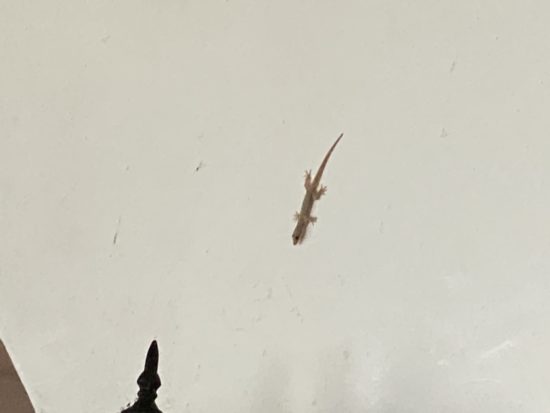
Small gecko lizards emerge in the evening — a few centimetres long, white, waiting near the outside lights for small insects. Their call: a tiny, high-pitched chirp. Entirely harmless and quietly charming.
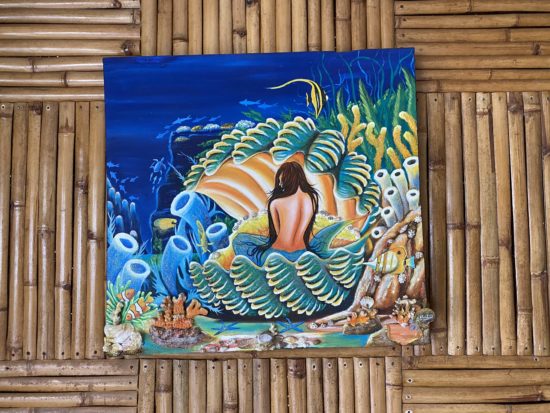
A Santo Niño figure (the Child Jesus) was placed in a quiet corner near reception — not prominently displayed, but present. I felt how faith is part of everyday life here.
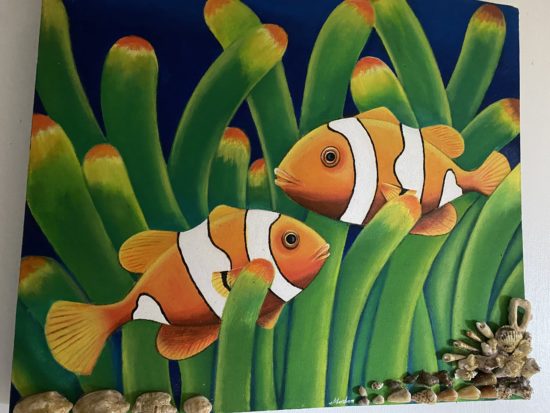
On the restaurant wall: a framed painting of a clownfish in a sea anemone — a nod to what lives in the reef below. The real version is 10 minutes away by banca boat.
Other books you might like
You're welcome to take a look.
EAST TO WEST: The Heart of Haiku, the Light of Scripture
A small devotional figure kept quietly near the door — the kind of unassuming faith this collection finds through haiku and scripture alike. This is a book my father-in-law left behind.
View on AmazonCataract Surgery-A Memoir: Double cataract surgery in Osaka, Japan
Another new experience at 66 — an honest account of the cataract surgery I went through.
View on AmazonSushi Business in Britain: the complete four-volume series
A novel series following thirty-five years in the British sushi trade, from apprentice to factory manager to a small sushi school. The complete edition offers all four volumes at a better price.