Philippines: Bohol Island Sightseeing — Full Day Tour 1/2
Date: 2020-04-06
When we took a 3-night trip to Bohol Island, we spent one full day on a sightseeing tour of the island.
Bohol Island is the 10th largest island in the Philippines, just a 2-hour ferry ride from Cebu Island. It is famous not only for its beautiful sea, but also for its iconic "Chocolate Hills" and as the habitat of the tarsier — the world's smallest primate.
Setting Off on the Bohol Full-Day Tour!
Departed from the hotel at 9am, returned to the hotel around 4–5pm in the afternoon.
It was a private tour just for the two of us using the hotel's vehicle. We asked about tours at the front desk upon check-in and booked it there. On some days, the driver might have airport transfers booked and tours may not be available.
Cost: 5,000 pesos (approximately 10,600 yen / £79) per vehicle for up to 4 people. This price covers only the hire of the minivan. Entrance fees to attractions are not included.
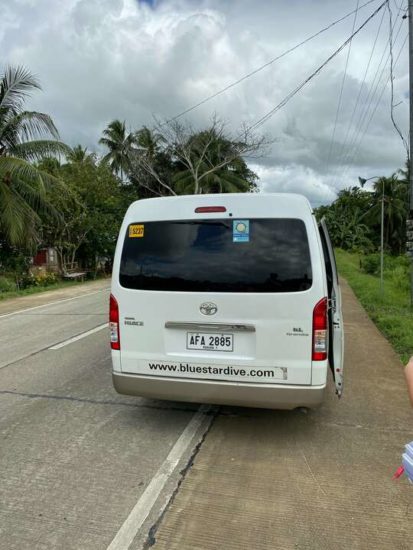
Our driver was Imid, a seasoned 63-year-old local. Born in Agda on Bohol, he had spent 40 years driving taxis and jeepneys in Cebu. Two or three years ago, family matters brought him back to Bohol. His daughter works in housekeeping at our hotel, which is how he came to be a driver there. "There's no traffic like in Cebu, and fewer cars, so driving is much easier," he told us. A rather stylish fellow.

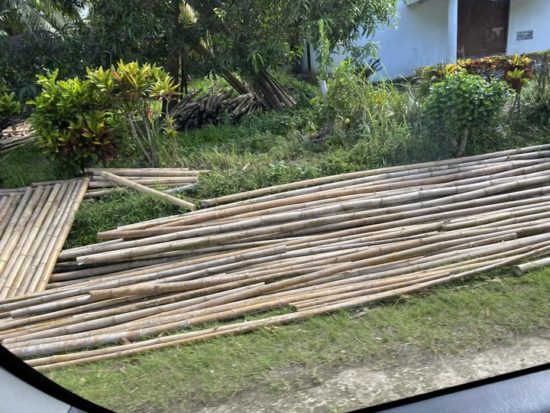
Bamboo Factory
Seen from the car window. This is a place where furniture is made from bamboo grown in the local area. Bamboo is also resistant to rain, making it ideal for outdoor use on verandas and the like.

Rice Fields
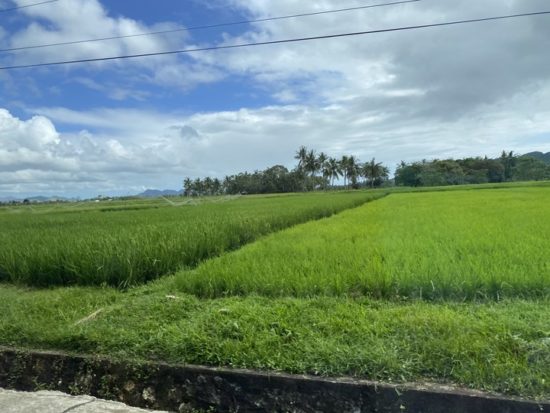
The Philippines, being close to the equator, can harvest rice an astonishing three times a year. The fields use a proper paddy system with water channelled in. Harvesting was taking place in fields that were slightly wet, just before the water had fully drained.
A field mid-harvest.

Fields with rice that had been planted, grown tall, and was now shooting grain.
Newly planted paddies.
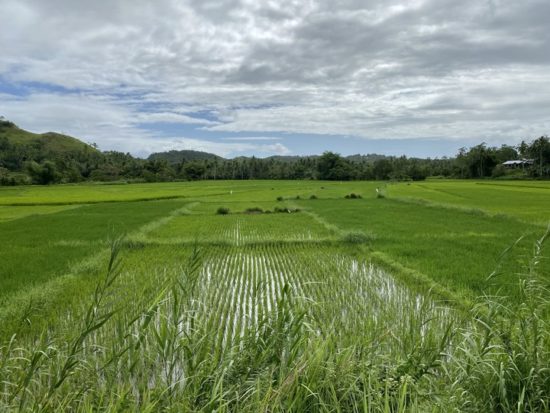
Rice fields at various stages of growth can be found all across the island. Coming from Japan where rice is harvested only once a year, it was quite a remarkable sight. In the Philippines, even McDonald's and KFC feature rice-based meals as their main offerings. Being able to harvest three times a year must be essential for a stable supply of the national staple food.
A set meal of chicken, garlic rice, corn, and coleslaw from KFC in Cebu. Looking around the restaurant, about 80% of customers were ordering rice-based meals.

In this area, fireflies apparently come out in great numbers after dark, making for a beautiful sight. There was also a lake, used to irrigate the rice fields.

There was a small dam, though it had dried up due to lack of rain.

The World's Smallest Primate — the Tarsier: Tarsier Conservation Area
Entrance fee: 100 pesos per person.
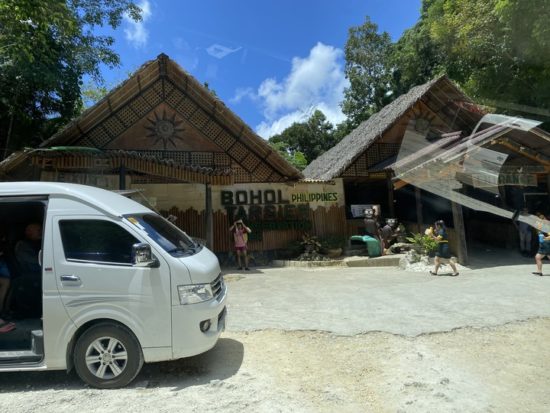
Bohol is home to the tarsier, the world's smallest primate. As their numbers have declined, they are now protected. Weighing just 120g and measuring 8–15cm in body length, they are palm-sized. What stands out most is their enormous eyes, which seem to take up half their face. Their endearingly bewildered expression makes them incredibly popular. We were instructed not to use flash, speak loudly, or approach too closely. They cling to tree branches about 2.5 metres above our heads, favouring shaded spots beneath leaves. They are extremely sensitive to stress and, apparently, some individuals have been known to die from it.
The tarsier photos were taken at maximum zoom, so they are a little soft.
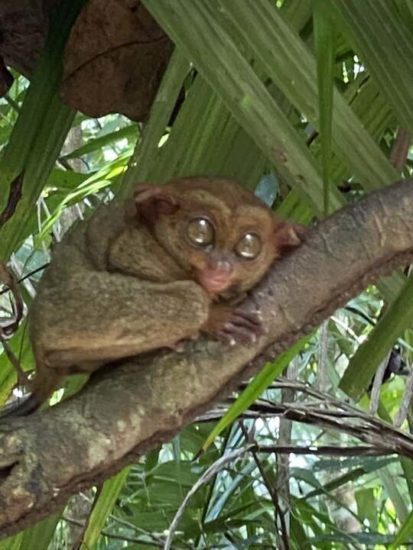
Their fingers and toes are distinctive. Their tail is about twice the length of their body and is bare-skinned, resembling a mouse's tail.
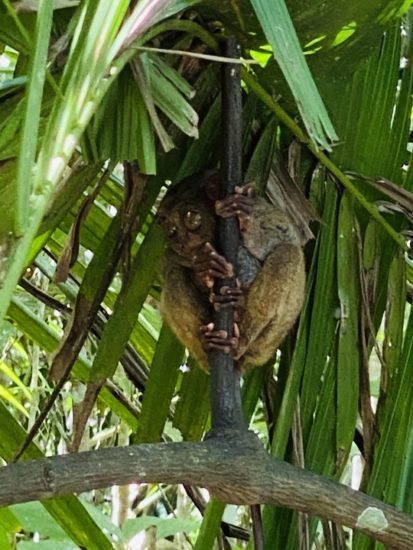
Everyone quietly and gently approached to take a look.
We couldn't help thinking that Yoda, the Jedi Master from Star Wars, might have been modelled on the tarsier.
Chocolate Hills
Located roughly in the centre of the island, the Chocolate Hills are a spectacular sight — about 1,000 cone-shaped hills, each 30–40 metres tall, stretching across the landscape. During the dry season from April to June, the green hills turn brown, resembling chocolate — hence the name. Many shells have been found here, suggesting the area was once a seabed, though the exact formation period and cause remain unclear.
We paid 100 pesos at the entrance to a staff member, who gave us a receipt-like slip of paper — keep it safe.
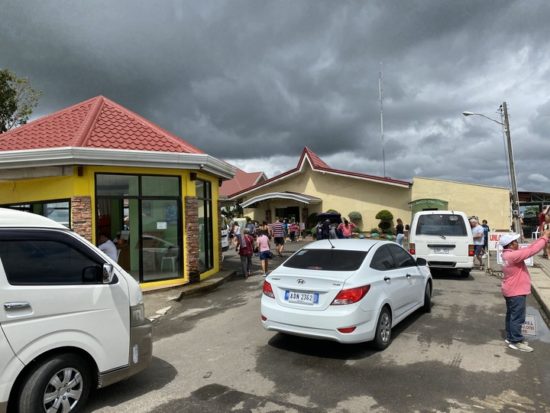
You can drive to the base of the observation tower in the centre of the Chocolate Hills, but from there more than 200 steps await. Vehicles cannot park at the top, so the driver drops passengers off and heads back down.
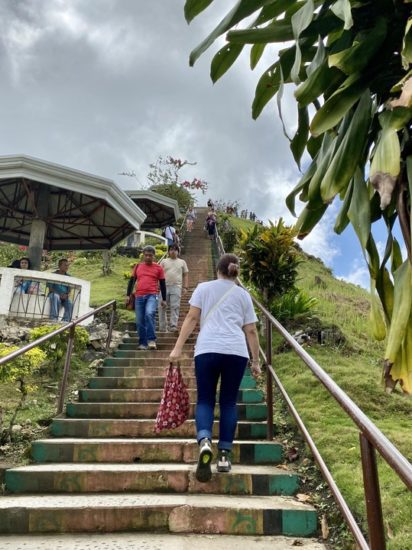
There are several rest spots along the way, so take your time and enjoy the views as you climb.
The view from the very top of the observation platform.
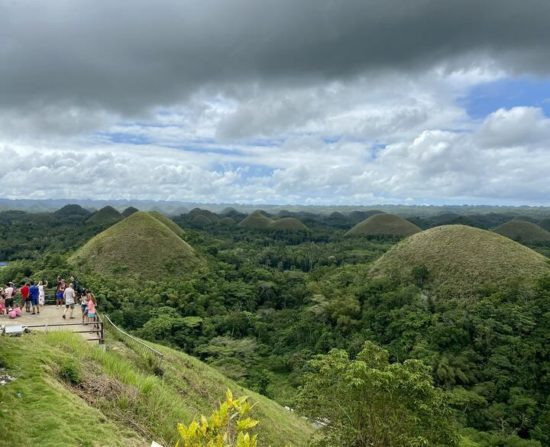
The subtropical forest of coconut palms and banana trees creates a landscape quite unlike any other.

When you return to the car park, show your receipt to the staff member there and they will call the car up by phone. Our driver's name was written on the back of the receipt.
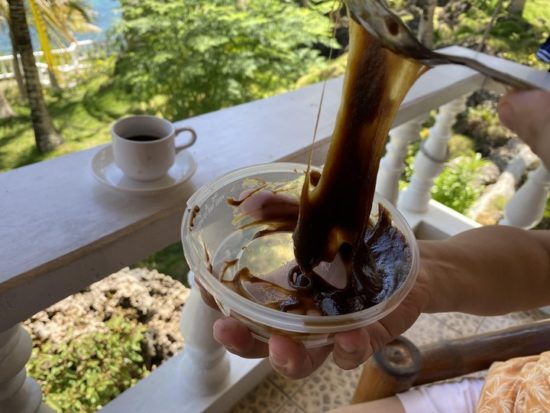
A Bohol souvenir not to miss is "kalamay" — a sticky sweet made from coconut, glutinous rice, and brown sugar, served in coconut shells or plastic containers. It is sweet and delicious.
We bought ours at a place recommended by our driver. Three pieces for 100 pesos.
The driver stopped in the middle of a village market, called out "Kalamay!" and a young man came running over to the car with it. The driver asked the price — 100 pesos for three — and, apparently satisfied with that, we handed over 100 pesos from the back seat and the purchase was complete (laughs).

According to Imid, Bohol locals have strong opinions about kalamay — it has to be from this particular village, or it doesn't count.
Local people apparently spread it on bread, but our husband's favourite way to eat it is straight with black coffee. Highly recommended.
It is wonderfully chewy and stretchy — when you scoop it with a spoon it stretches out, so you twirl the spoon to wrap it up. The flavour is like brown sugar mochi (rice cake), perfectly familiar to Japanese palates.
Other books you might like
You're welcome to take a look.
EAST TO WEST: The Heart of Haiku, the Light of Scripture
A local sweet carrying a village's quiet pride — the kind of small discovery this collection finds through haiku. This was my father-in-law's final work.
View on AmazonCataract Surgery-A Memoir: Double cataract surgery in Osaka, Japan
Another new experience at 66 — an honest account of the cataract surgery I went through.
View on AmazonSushi Business in Britain: the complete four-volume series
A novel series following thirty-five years in the British sushi trade, from apprentice to factory manager to a small sushi school.
View on AmazonContinued in: Bohol Island Sightseeing — Full Day Tour 2/2