I have been living in the UK for over thirty years, but over the past year or so, I have felt first-hand that the social atmosphere has clearly shifted. The struggles faced by the younger generation, divisions over housing, and the resurgence of the view that 'ultimately, it all comes down to personal effort'—this is not news from a distant foreign land, but the reality of the country in which I myself am currently living.
The other day, I watched writer and columnist Mikako Brady discussing the current state of British society on the YouTube programme 'PIVOT TALK'.
PIVOT TALK: 'The Present of British Society' (episode featuring Mikako Brady)
I have also been re-reading her book, It Could Happen Anywhere: Resistance to a World in Decline. Today, whilst reflecting on what was discussed there in my own way, I would like to write about a very personal question: 'So, as a 66-year-old, how do I ensure a fulfilling retirement amidst this atmosphere?'
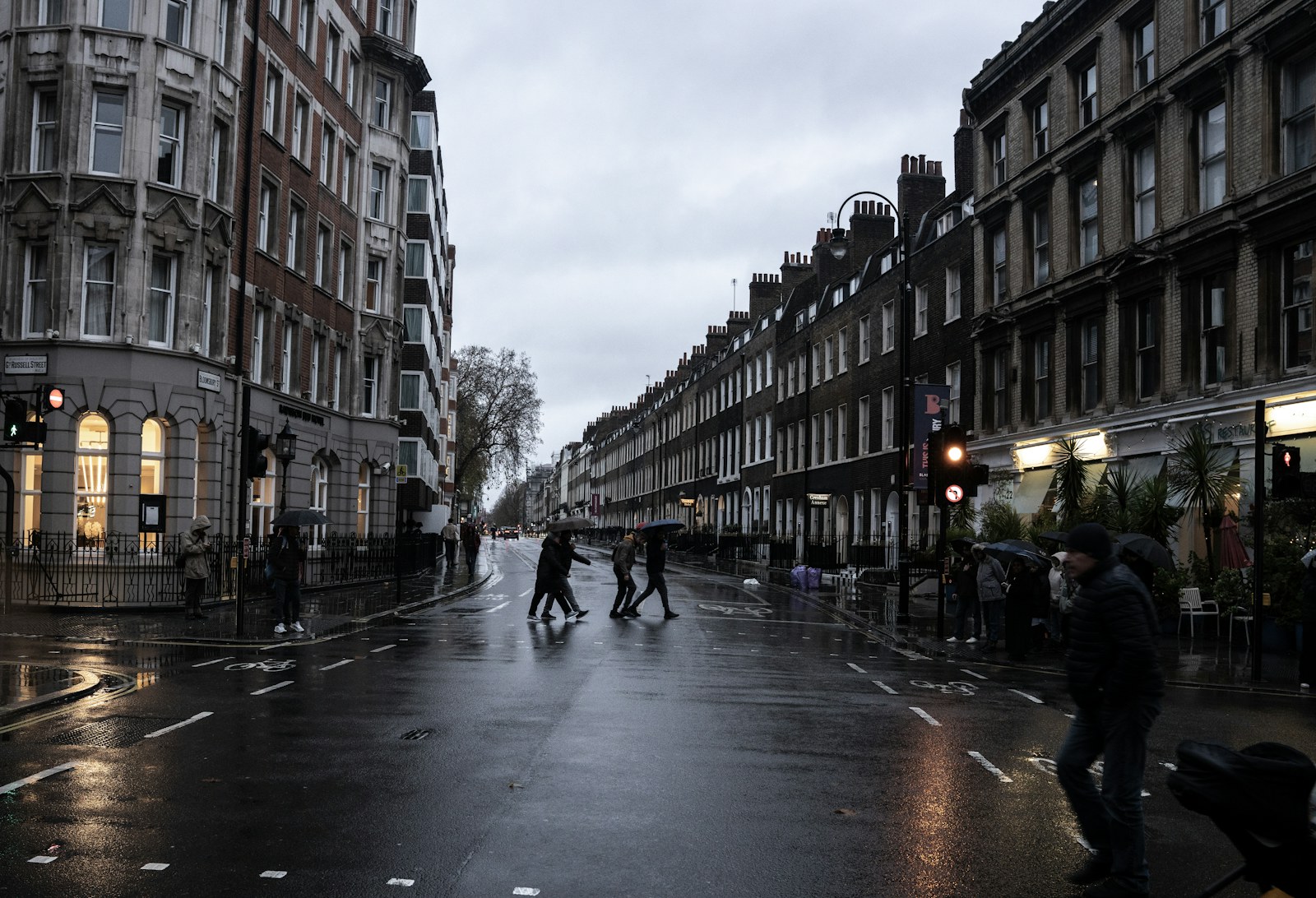
Photo by Priyank Pathak on Unsplash
This is a rain-soaked street corner that seems to symbolise the current atmosphere in the UK.
1. What is happening in the UK right now?
The discussion centred on three main points.
The first is the hardship faced by young people. A generation that experienced the severe lockdown restrictions of the COVID-19 pandemic during their formative years is now struggling with physical and mental health issues, whilst failing to receive adequate public support. This is because, due to years of budget cuts, the UK's National Health Service (NHS) is already stretched to the limit. Yet, it is said that they are met with a view that leans towards the 'personal responsibility' narrative, such as 'young people today are too fragile' or 'they simply lack motivation'.
This issue is not something that is far removed from my wife and me. We have a son who is now 30, and we witnessed first-hand how he struggled considerably after graduating from a local university at the age of 22, as he found it difficult to secure a job. Thanks to a recommendation from a friend from his secondary school days, he is now in his fourth year working from home in an IT-related role at the same company as that friend. I believe our son has been rather fortunate. This is because, amongst his former classmates, there are plenty of highly educated young people—even those who graduated from prestigious universities—who have struggled to find employment and have been forced to give up on the careers they truly wanted to pursue. I have even heard of a job vacancy in London where 400 people applied for a single position. One need not even look at the figures to imagine just how narrow the gateway is.
The second issue is housing. Whilst the number of affordable properties in urban areas continues to decline, properties bought for speculative purposes remain vacant and neglected. The reason for this distortion is that housing has come to be treated not as a 'place to live' but as a 'means of increasing wealth'. The construction of social housing has also been at a standstill for a long time, leaving people with nowhere to turn even when in dire straits.
The third issue concerns where this frustration is directed. Citizens struggling to find housing see the government leasing hotels to accommodate refugees, and this sparks anger: 'Why them, when we are suffering?' Although the root cause should be the shortcomings in housing policy, the anger ends up being directed towards people in a similarly vulnerable position. I believe this is the structure through which social divisions deepen.
A look at the data: young people's 'lack of prospects'
Let us take a brief look at the figures here. According to the UK Office for National Statistics (ONS), in the January–March 2026 quarter, approximately 1,012,000 young people aged 16–24 were classified as 'not in education, employment or training' (NEET), accounting for 13.5 per cent of this age group; this was the first time the figure had exceeded one million since 2013. Although the figure stabilised somewhat in the April–June quarter, standing at approximately 981,000 (13.0 per cent), it remains on an upward trend compared with the same period the previous year.
Meanwhile, in Japan, the equivalent concept of 'young people not in employment' (aged 15–34, part of the non-labour force who are neither engaged in housework nor attending school) stood at an average of approximately 590,000 in 2023, representing around 2.4 per cent of the population in this age group—or one in every 42 people. However, it is important to note that these two figures are based on different definitions. Whilst the UK's NEET category includes the unemployed who are seeking work, Japan's 'young non-workers' are essentially limited to those not actively seeking employment; therefore, a direct comparison is not possible. Nevertheless, it is evident from the figures that the extent to which young people in the UK are facing a dead end is clearly more severe than in Japan.
In terms of housing, approximately 30 per cent of 20–34-year-olds in the UK live with their parents, the highest level in the past 30 years. Among those aged 20–24 specifically, the 2021 census showed that this figure had already exceeded half. Given that first-time buyers are said to take nearly six years on average just to save for a deposit, this figure seems entirely understandable.
As for the outlook, whilst the government has introduced the Renters' Rights Act, which came into force in 2025, and announced large-scale investment in public and affordable housing, the consensus amongst many analysts seems to be that this 'difficulty in leaving the family home' is unlikely to be resolved immediately unless both housing supply and wages keep pace.
2. Why I feel this 'is not someone else's problem' — comparisons between the UK and Japan
Listening to these accounts, I was struck by a strong sense of déjà vu. From the 1990s through to the 2000s, Japan's 'employment ice age' generation was similarly dismissed with the phrase 'personal responsibility'. Whilst the background in the UK today differs from that of Japan at the time, the resurgence of an atmosphere that 'blames structural problems on individual weakness' is strikingly similar.
On the other hand, there are differences too. In Japan, lifetime employment and community ties—albeit weakened—still remain in some areas as a social safety net, whereas in the UK, where property speculation has progressed to such an extent, the 'lack of options' for the younger generation appears to be more directly linked to a crisis in their daily lives. Living whilst travelling back and forth between the two countries, I am struck by how, even with the same 'personal responsibility' narrative, the foundations upon which it rests differ.
3. So, what can I, at 66, do?
I will leave the summary of the discussion there; from here on, these are my own reflections.
Photo by Michael Afonso on Unsplash
An image evoking a moment of quiet reflection on one's own life.
As a parent, how should one deal with a child who cannot leave the nest?
As a parent, it is painful to see a child struggling to become independent. There is always a tug-of-war between the desire to lend a helping hand and the wish for them to stand on their own two feet. Here is what my wife and I have learnt so far:
Firstly, if you are providing financial support, it is important to set a 'time limit and a specific purpose'. This is because endless financial assistance can, in the end, delay the moment when your child becomes independent. 'A portion of the rent for just one year' or 'just the cost of obtaining a qualification'—clearly defining the scope of the support gives our child the impetus to consider their next step.
Secondly, act as a bridge for information and connections. Our son secured his current job not only through his own efforts but also thanks to a 'connection'—an introduction from a friend. As parents, there is not much we can do directly, but maintaining a wide network of contacts ourselves through our local community and work ultimately leads to opportunities for our child. I feel that meeting people of various generations at sushi classes is certainly not a waste of time in this regard.
Thirdly, we must avoid bringing the 'personal responsibility' mindset into the home. Precisely because we are a generation that experienced the 'employment ice age', we are tempted to say, 'You just need to try harder', but as we have seen in this article, much of the hardship faced by young people stems from structural problems. If even parents corner their children by holding them solely responsible, they risk depriving them of their last safe haven. We are currently discussing how to strike the right balance—neither rushing them nor leaving them isolated.
Treating money as a 'foundation' rather than a 'speculation'
Observing the UK housing crisis has reminded me once again that assets are, first and foremost, 'a means of supporting one's livelihood' rather than merely 'something to be increased'. I myself have been investing in property and shares since 2015, but my aim is not to chase capital gains; rather, it is to provide an additional layer of support for my living expenses in old age, as relying solely on my pension feels precarious. Precisely because we live in an era where the future is hard to predict, due to inflation and political turmoil, I feel that the best defence—in the long run—is to avoid getting caught up in speculative fervour and to stick to a plan of 'drawing down while holding on for the long term', however unassuming it may seem.
Creating a system for yourself to avoid isolation
Behind the isolation experienced by young people lies the absence of a place they can rely on. This is not just an issue for young people; the same applies to us in the older generation. Once you retire and spend more time at home, your interactions with others decrease at an astonishingly rapid pace.
That is precisely why my wife and I continue to run our sushi classes. Over the course of three hours, whilst teaching sushi-making, we meet students from various generations and engage in conversations that go beyond just cooking to include personal matters as well. Even though we are in the role of teachers, I genuinely feel that these conversations themselves are a great source of inspiration for us and are broadening our horizons. This is because isolation is not a matter of 'how long one spends alone', but rather a question of 'whether there is someone to turn to when in trouble'.
Photo by Haberdoedas on Unsplash
This image depicts down-to-earth connections.
Do not drive yourself into a corner with 'personal responsibility'
Finally, and I believe this is the most important point, we must avoid framing the decline in our physical strength and memory as a matter of 'personal responsibility'. Just like the hardships faced by young people, age-related decline is, in many cases, not a matter of a person's lack of effort, but rather a structural issue (relating to social security, the healthcare system and the economic environment). That is precisely why I continue to keep a record of my experiences on this blog. I do not hide the fact that I am growing weaker, yet I do not stop there; I simply and matter-of-factly write down 'what I managed to do today'. I believe that this, in itself, serves as a modest act of resistance to avoid being swallowed up by the notion of 'personal responsibility'.
In conclusion
I believe that what is happening in the UK is not merely an event in a distant country; it is something that can happen to anyone, young or old, in any society. That is precisely why I feel, once again, that a secure retirement is not something that someone else will provide for you; rather, it involves gradually building, with your own hands, a financial foundation, a network of support, and a mindset that does not push you to the brink.
Other books you might like
You're welcome to take a look.
EAST TO WEST: The Heart of Haiku, the Light of Scripture
A quiet book to return to after this kind of big-picture look at world affairs. This was my father-in-law's final work.
View on AmazonCataract Surgery-A Memoir: Double cataract surgery in Osaka, Japan
Another record of a milestone I went through after turning 66.
View on AmazonSushi Business in Britain: the complete four-volume series
A novel series following thirty-five years in the British sushi trade, from apprentice to factory manager to a small sushi school.
View on AmazonThese are thoughts prompted by the book listed below.
It Could Happen Anywhere: Resistance to a World in Decline (by Mikako Brady / Bungeishunju) (Kindle edition) Hardback edition
(As an Amazon Associate, 'Adventures from the Age of 60' earns from qualifying purchases.)