🎧 Listen to the Discussion(two hosts talk through their thoughts on this article)
This is an AI-generated audio overview of this article, created with Google NotebookLM. Two hosts discuss the article together, sharing their own thoughts and commentary — it is not a reading of the article text.
The Day the Road Disappeared
In 1985 I left the medical faculty of a Japanese national university. I still remember walking back up the hill to my lodgings, having closed the door on five years of study. I was walking, and yet it felt as though the road were vanishing from under my feet.
Why did it feel that way? Because until then, a road had been something already laid down, something I simply walked along. On the day I enrolled, my graduation six years later and the training that would follow were already drawn as a line on a map. To drop out was to erase that line. And what was left afterwards was not a road at all. It was just soil.
Now, at sixty-six, I have been rethinking that feeling. Perhaps the road had not disappeared. Perhaps it had simply not been walked yet.
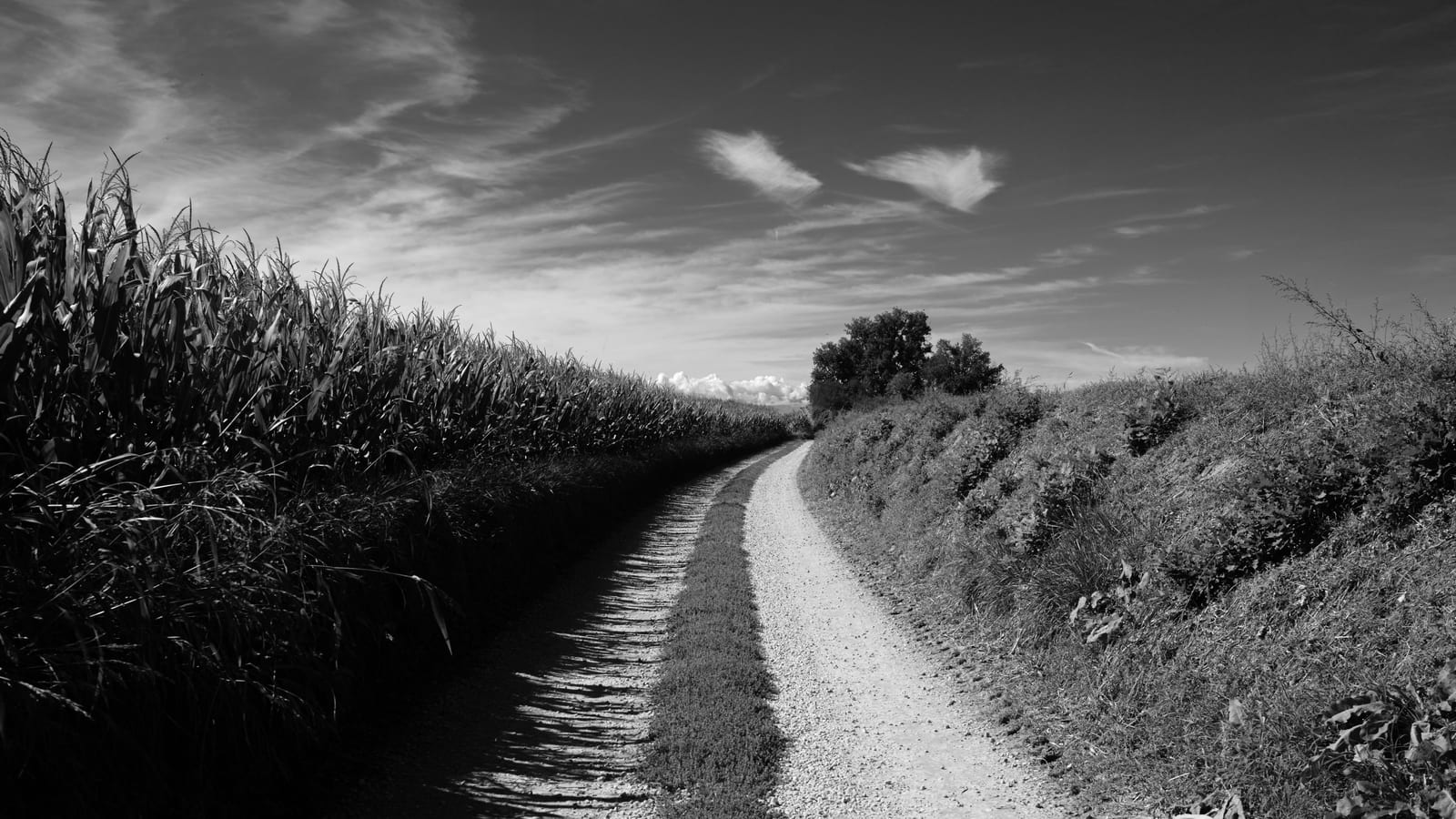
This line has the shape of a road only because someone walked it again and again. Had no foot ever touched it, it would still be plain field. What I lost in my twenties was probably the line, not the soil.
Photo by Marco Cavallera on Unsplash
Finding "Cantares"
The words that gave me that second reading came from a Spanish singer, Joan Manuel Serrat, and a song called "Cantares." It opens his 1969 album Dedicado a Antonio Machado, poeta.
The lyric grows out of a piece from Antonio Machado's sequence "Proverbios y cantares," published in Campos de Castilla. I will not quote the words themselves, but the thought at the centre of them runs like this. Walker, your footprints are the road, and there is no road but that. The road comes into being only through walking, and when you look back, all you see is a path you will never tread again. Machado then goes further: even that path fades, the way a ship's wake fades on the sea.
Serrat added verses of his own, about Machado himself. The poet's last stop was a grey seaside town, and he died there with nothing. And still the tracks he left did not disappear. That, in substance, is what Serrat sings, in a soft and unhurried voice.
I came to the song late. After retiring, I was rereading Shiba Ryōtarō's Kaidō o Yuku ("Travels Along the Highways"), and I began to wonder what the Japanese word kaidō would be in Spanish. That question led me to the word camino, and camino led me here. A book brought me a song.
The sound itself is quieter than you might brace yourself for. It moves in an unhurried three. A guitar sets down a few chords, and then Serrat comes in at roughly the volume you would use to speak to someone sitting beside you. Strings and voices gather in the middle section, and then withdraw again. The whole song runs a little over three minutes.
If you would like to read the Spanish lyric itself, you will find it on the album page at LETRAS.COM. Searching for "Joan Manuel Serrat Cantares" will bring up the 1969 recording from Dedicado a Antonio Machado, poeta.
Antonio Machado, the Poet
Antonio Machado was born in Seville in 1875. At eight he moved with his family to Madrid, where he studied at the Institución Libre de Enseñanza. That school was unusual for Spain at the time: instead of drilling pupils, it took them outdoors and asked them to look with their own eyes. I do not think it is a coincidence that his poems are so full of the particular names of soil and stone and trees.
He lived through a period when Spain was sliding downhill. In 1898 the country lost the war with the United States, and with it Cuba and the Philippines. A nation that had thought of itself as an empire was told, plainly, that it was a poor agricultural country on the edge of Europe. The writers who refused to look away from that pain became known as the Generation of '98, and Machado was one of them. What they shared was a decision to stop expanding outwards and to look instead at the dry ground of their own country.
In 1907 he took a post teaching French in Soria, an inland town. There he met Leonor Izquierdo, then fifteen, and married her in 1909. He was thirty-four. In 1912 Leonor died of tuberculosis. They had been married three years.
Buddhism has a term for this: aibetsuriku, the suffering of being parted from those we love. In the middle of that suffering Machado left Soria for Baeza in the south, and there he finished Campos de Castilla. That the line "the road is made only by walking" came from the hand of a man who had just buried his wife feels very heavy to me. Because it is not encouragement. It is a statement of resolve made after admitting that there is nothing ahead — and putting one foot out anyway.
In his last years he stood with the Republic. As the civil war closed in he fled Madrid for Valencia, then Barcelona, and in 1939 crossed the Pyrenees to Collioure in France. He died there about a month after arriving, aged sixty-three. His mother, who had travelled with him, died three days later.
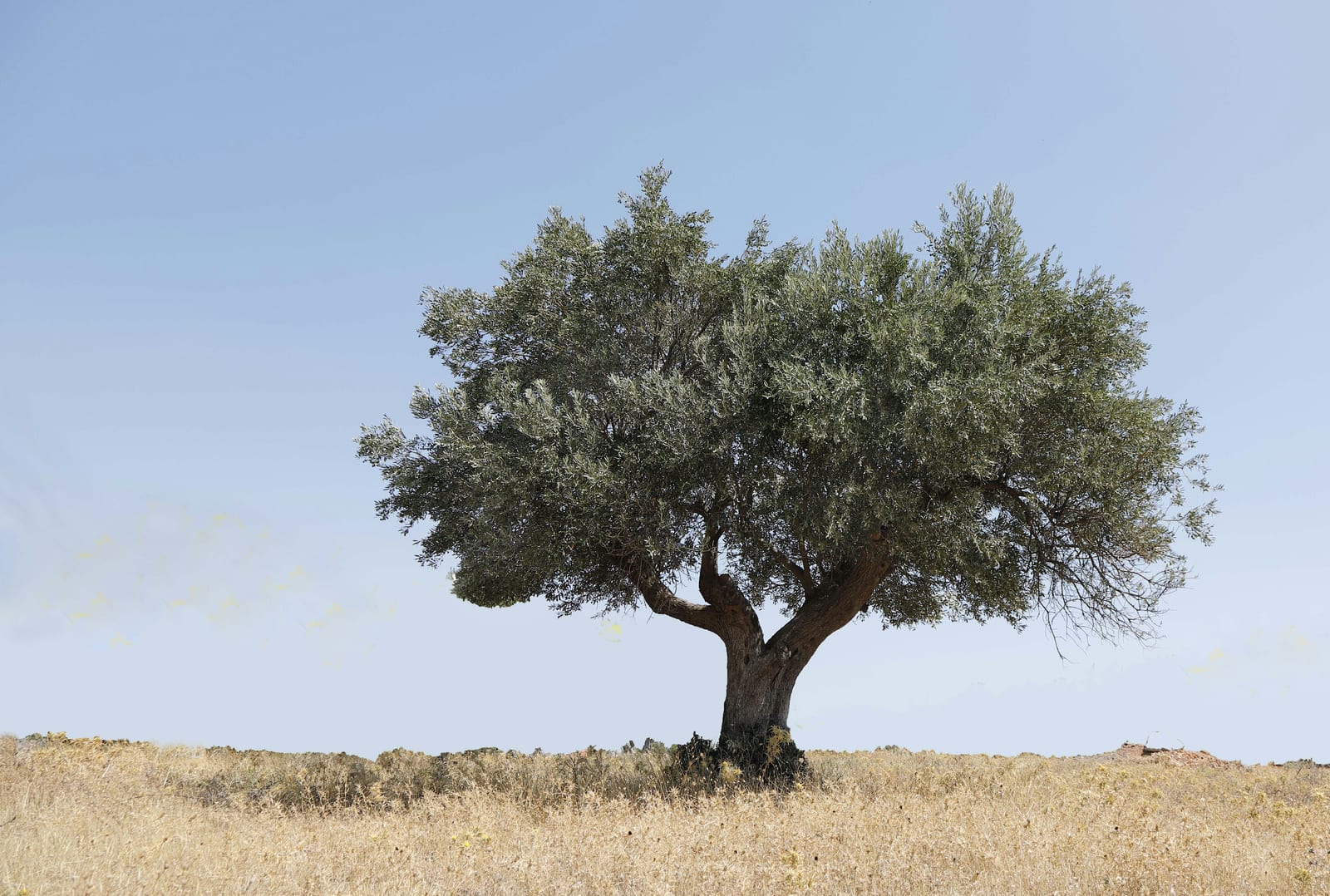
The Castilian land Machado walked is not generous. There are many stones, little water, and the trees stand well apart. I think his poems so often begin with a description of thin soil because he believed that was the only place the truth was kept.
Photo by Vasilis Caravitis on Unsplash
Joan Manuel Serrat, the Singer
Joan Manuel Serrat was born on 27 December 1943 in Poble-sec, a working-class district of Barcelona. His father, Josep, was a Catalan anarchist connected to the CNT trade union. His mother, Ángeles, came from Aragón. Both Catalan and Spanish were spoken in that house, and I would say that fact decided the shape of his working life.
He did not come out of a conservatoire. He qualified as an agricultural technician. A man trained to measure soil and crops later became the singer of Machado, the poet of soil — for a coincidence, that is rather well arranged.
In the mid-1960s he appeared within the Nova Cançó, the movement of singing in Catalan. Under Franco, Catalan had been pushed out of public life, so to sing in it at all was to take a position. In 1968 he was chosen to represent Spain at the Eurovision Song Contest, and withdrew when he was told he could not sing in Catalan. Massiel went in his place and won. A young singer gave away the largest opportunity of his career for the sake of a language.
The following year he released the Machado album — in Spanish. The man who had walked away from an international stage to protect Catalan spent the next year singing a Castilian poet with everything he had. That swing is, to me, the essence of Serrat. What he wanted to defend was not one language or the other, but the principle that a language cannot be taken away from people.
In 1975 he criticised executions carried out under the regime while touring in Mexico, and could not return home. He came back in 1976, after Franco's death. He went on singing in both languages and became a voice heard across generations throughout Latin America. In 2022 he brought his long touring life to a close with a farewell tour.
The distinctive thing about his voice is that it never strains. He delivers Machado's heavy lines at roughly the volume you would use to speak to someone in your kitchen. And that matters, because a poem sung grandly becomes a Fine Thing, and a Fine Thing drifts away from the life of the listener. He avoided that. As a result, for tens of millions of Spanish speakers this poem is not something in a textbook. It is something you can hum.
Cañada Real: When a Line Drawn by Sheep Became Law
Whenever I hear this song, I think about Spain's cañadas reales, the royal droving roads.
Since the Middle Ages, Spanish shepherds have moved their flocks the length of the country — high northern pastures in summer, warmer southern ground in winter. Tens of thousands of sheep walking the same line, year after year. Nobody designed that line first. Sheep and men trod it repeatedly, so the ground compacted, the grass thinned, and a track remained. Centuries later the crown acknowledged those tracks, fixed their width, and protected them in law as rights of way.
I think this shows something essential about what human beings actually do. Institutions do not create roads. Institutions confirm, after the fact, the tracks that have already been walked. A medical licence looked to me, in my twenties, like a road that existed in advance. So did a career in the Japanese food trade. But once I had walked them, the order turned out to be reversed. The institution exists because people walked; people did not walk because the institution existed.
If that is so, then it is entirely normal for there to be no road when you begin something new at sixty-six. There was no road in the shepherd's first year either.
Shiba Ryōtarō's Highways and the English Footpath
What strikes me every time I reread Shiba Ryōtarō is that he treats a highway not as a line but as an accumulation of people. For him a kaidō is layer upon layer of the merchants, monks and soldiers who passed along it; the ground itself interests him rather little. The pilgrimage routes of Shikoku are the same. Those paths are paths because of how many feet have been on them.
What surprised me after moving to Britain is that here, this is not a literary metaphor. It is a matter of law.
An English public footpath may cross private land, and if people have walked it for long enough, that use is recognised as a right of way and recorded on a map. You often see a thin trodden line running dead straight through the middle of a wheat field. That is not the landowner's kindness. It is a right — and if people stop walking it, the right fades away. In other words, in England a road continues to exist by being walked.
It is Machado's line implemented as statute. Where a Japanese highway is honoured as the memory of having once been walked, an English footpath demands that it be walked now. I like this difference, because the second is far harsher towards old men, and far kinder. A road nobody walks disappears. So walk it today.
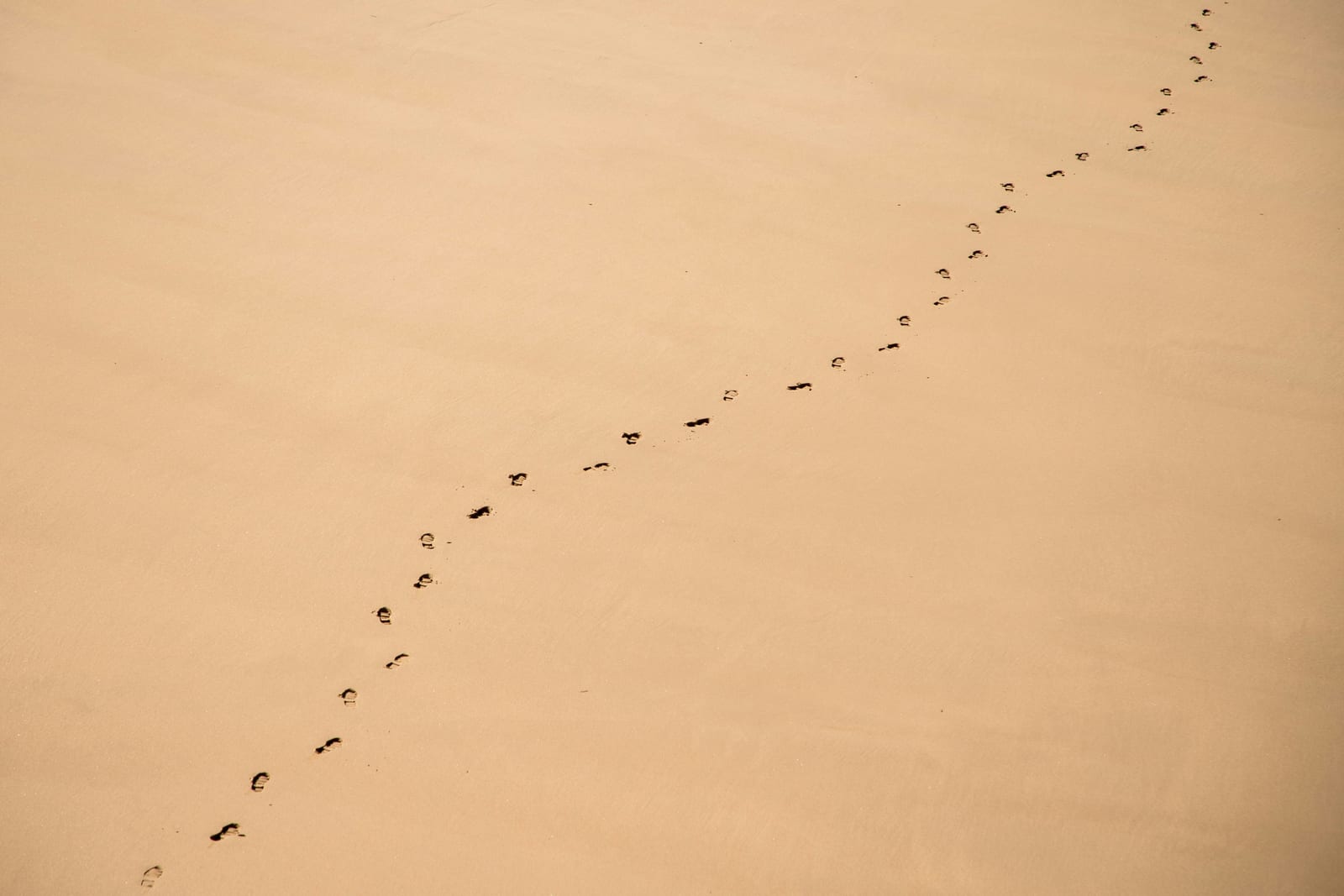
Only the person who walks can leave footprints. And on sand they will be taken by the tide. Even so, the fact of having walked is not erased — that, as I understand it, is what the song is saying.
Photo by Maxime Horlaville on Unsplash
How a Song Keeps My Body and Mind in Order
Let me be honest about the body first.
The clearest change since turning sixty-six is my stride. It is not that I cannot cover the distance. It is that each step has become shorter. Walking the lane outside our house in England at what feels like my usual pace, I now take more steps to reach the same telegraph pole. Noticing that was a genuine blow.
So I began taking "Cantares" out with me on the morning walk. The song is not fast. It moves in an unhurried three, and it does not push. Walking with it in my ears, my stride naturally lengthens to meet the beat. If I try to walk quickly my knee complains; if I try to walk widely, oddly, it does not. That makes sense, because speed loads the joint, whereas stride length is a question of how the hip and trunk are used.
Alongside that I keep up my sennenkyū moxibustion. Twice a week I treat zusanli (ST36), about four finger-widths below the kneecap on the outer side of the leg. A little warmth through that point after walking changes how I get up the next morning. As someone who studied oriental medicine, I had long known that this point was traditionally treated as the walker's point. But I only confirmed it on my own legs in my sixties. It took forty years for the knowledge to become experience.
The mind is simpler. This song tells me I only need to walk today's portion. Much of the anxiety of later life comes from running ahead to worry about a road we have not reached. When a song states flatly that there is no road ahead, the thing you were worrying about simply stops being there.
Why I Spend Money on Songs
Spending money on music while living on a pension carries a certain guilt.
In my case the spending is modest. A subscription for listening to Spanish-language music. Translated volumes of poetry. Parallel-text editions for checking the original. And the weight books take up in the luggage that travels between Japan and Britain. None of it is cheap, and none of it produces anything. It is not like the rosemary in the garden, which I can at least cut and cook with later.
I keep spending it because it raises my speed of understanding. At sixty-six I cannot come close to my twenty-year-old self in the speed of learning something new. But the speed at which I reach the bottom of a single thing is clearly faster than it used to be. That is because I now carry an enormous quantity of material to compare against. I do not need anyone to explain to me the line Machado wrote after losing his wife. I have simply lived enough years to know it.
That experience of understanding quickly and deeply cannot be bought. But the doorways to it — one album, one book of poems — do have prices on them. What I am paying is an admission fee. What happens inside is decided by my own life, which I already own, and which is free.
So I think of this spending less as consumption and more as the account-opening fee for collecting interest on sixty-six years of tuition I have already paid.
The People a Song Brings to Me
Three encounters this song has brought me over the past year.
The first is a librarian at our local library. I asked whether they had any parallel-text Spanish poetry, and she said they did not, but that she could request it through the county lending scheme — and three weeks later, she had. When she handed it over she said, "I don't know this poet, so tell me what's in it when you've read it." The next time I went in, we talked for about five minutes. Her job is to lend books, not to collect opinions about them. She asked anyway.
The second is the owner of a second-hand record shop I wandered into while staying in Osaka. He laughed when he saw me at the Spanish folk section and said nothing there ever moved. Then he spent twenty minutes telling me about the Latin American singers he had listened to as a young man. I bought nothing, and he stayed cheerful to the end.
The third is a reader. In a letter I received some time ago about this series, there was a line saying that the songs are not audible in these articles, and yet somehow they are. I still remember that sentence.
What all three have in common is that none of them was a transaction. The librarian spent time that did not count towards lending figures, the shop owner spent time that produced no sale, and the reader was not asking for a reply. I suspect that the richness of relationships in later life comes down to how much of this non-transactional time there is. In my twenties I treated time as investment, so I would have called all of this waste. Now I cannot think of anything else worth as much.
Melody as an External Drive for a Failing Memory
Here is one thing I have worked out for myself about this song.
I am aware that my memory is declining. Names do not arrive. A book I have read is reduced to an outline within a week. This is a definite change that arrived in my sixties.
And yet I do not forget the melody of "Cantares." I barely speak Spanish, and still the opening comes out of my mouth unbidden. And when the melody arrives, the meaning comes up hanging from it.
Machado's poem was originally something to be read in silence. Memory stored by reading degrades quickly in me. But when Serrat set it to music, the same content was converted into a hummable format — and memory in hummable format has barely degraded in me at all.
So I think Serrat did more than popularise a poem. He converted the poem into a storage format that is resistant to ageing. Before humanity had writing, long stories were preserved as song, and this must be why: it was a technology for making memory portable by people whose memories were weak.
I can use this in practice. Anything I want to keep, I no longer write as a sentence. I cut it into a short shape with a rhythm. Garden procedures, my own rules for investing — broken into five and seven syllables, they stay put surprisingly well. At sixty-six, I have stopped treating my head as a high-performance machine and started treating it as a machine that will carry things a long way if you put a tune on them.
The Same Song, Heard at Twenty and at Sixty-Six
If I had heard this song in my twenties, I think it would have made me angry. Telling me there is no road is no help; I am looking for the road. What I needed, right after leaving medical school, was to be told where to go — not that going would make the road.
At sixty-six I receive the same line as something else entirely. It was never about destination. It was about responsibility. If there is no road ahead, then no direction is a mistake. And the line that appears behind me is mine, because I drew it, so it is mine to answer for. What I wanted at twenty was absolution. What I received at sixty-six was ownership.
This is not an argument that age is better than youth. It is only that this particular reading is available to someone who has actually walked a long way. Being able to read something in a way I could not read it when young — that is a clear gain, and it came from getting old.
And I think about what remains. My distance is certainly shorter than it was at twenty. But short is not the same as dull. If anything, a road you know is short is walked at a higher resolution, step by step. When I go back to Osaka this winter, I have decided to choose the alleys I have not yet walked. I want to visit Taiwan. I intend to add one more rosemary to the garden next year. None of these are large plans, and that is the point. A large plan draws the road in advance; a small one only makes as much road as you have actually walked.
One last word about this series. I do not write these pieces to encourage anyone. If someone of about my age reads this and thinks only, "there is someone walking a little way ahead," that is enough. No reply is needed, and no comment. I will keep writing at my pace, so please, at yours, come past now and then.
The one Machado book mentioned in this article is below.
Antonio Machado, Border of a Dream: Selected Poems of Antonio Machado (trans. Willis Barnstone, Copper Canyon Press) — Paperback / Kindle
(As an Amazon Associate I earn from qualifying purchases.)
Other books you might like
You're welcome to take a look.
EAST TO WEST: The Heart of Haiku, the Light of Scripture
Machado's line that a road is made only by walking, and this book's own way of holding "now" through the language of haiku and scripture, meet in a similar place. This was my father-in-law's final work.
View on AmazonCataract Surgery-A Memoir: Double cataract surgery in Osaka, Japan
Another account of a new experience I went through at sixty-six.
View on AmazonSushi Business in Britain: the complete four-volume series
A novel series following thirty-five years in the British sushi trade, from apprentice to factory manager to a small sushi school.
View on Amazon