Corresponding episode: September 2026 issue, Part 1, ④
Source: Speaker: Yoshinori Kitano, Host: (varies by episode, credited simply as "Host"), Source: Direct Publishing, "Power Game" Original discussion: September 2026 issue, Part One, "World Affairs Behind the Headlines", "④ Britain Becoming 'Japanified'" (released on the 1st)
Summary page: https://dpub.jp/products/13151992/summary/ (Japanese language)
Index page: https://dpub.jp/products/13151992/index/ (Japanese language)
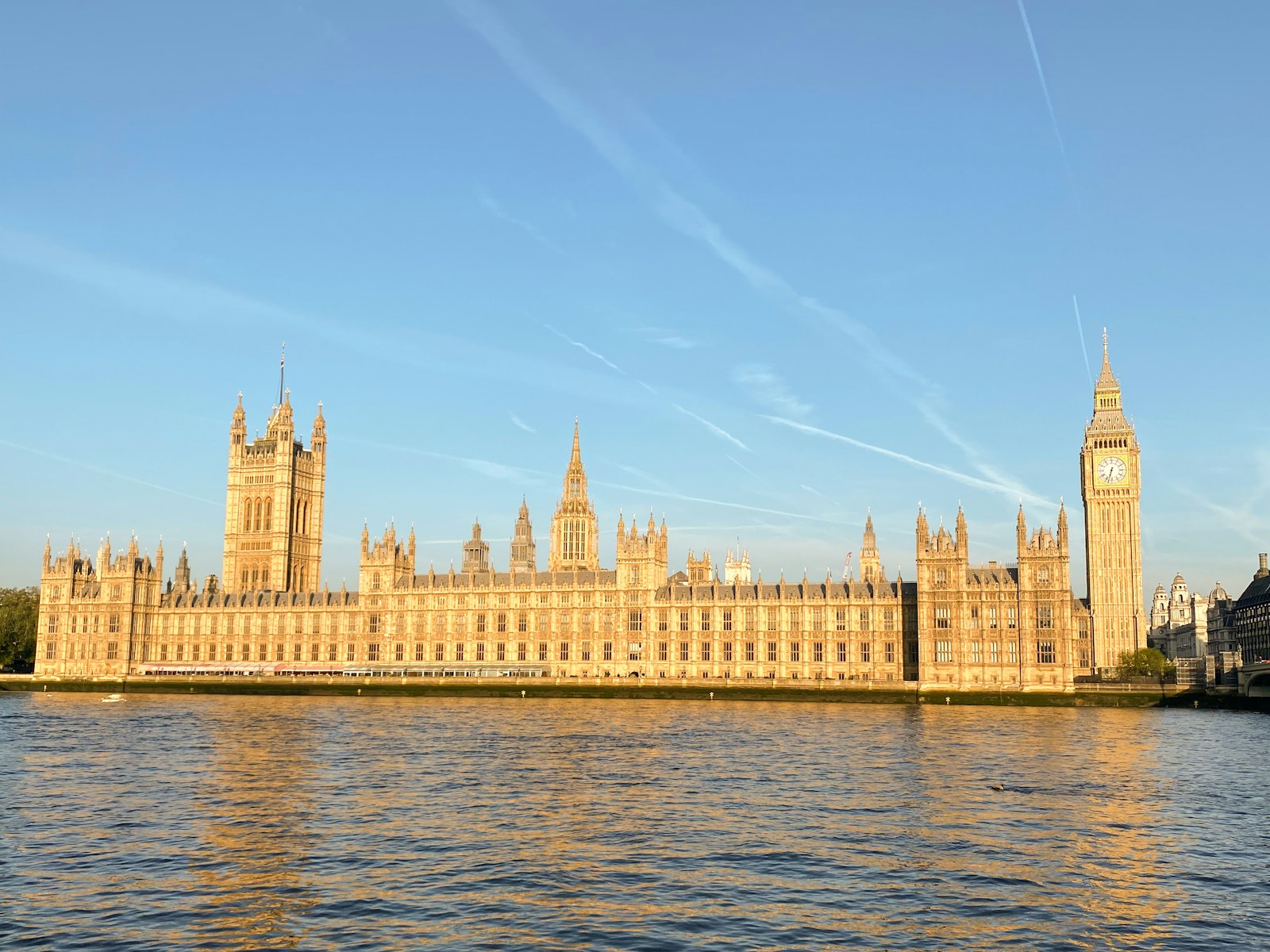
The Palace of Westminster in the early morning. The stage of British politics stays where it always was; it is only the people sitting on it who keep changing. That contrast is where this piece begins. (Photo: Linda Gerbec / Unsplash)
Britain Becoming "Japanified" Was Meant Ironically
When I first heard the phrase "becoming Japanified", I assumed it referred to politeness and cleanliness. In fact, the meaning was the opposite: it was an ironic way of describing a country whose prime minister changes almost every year. On 22 April this year, Andy Burnham of the Labour Party took office as Britain's new prime minister, yet the change barely made the news, at home or abroad. The same mood that once surrounded Japan, when people used to joke that there was no need to remember the Japanese prime minister's name, now hangs over Britain.
Burnham was born in 1970 and is a lifelong Labour Party member, having joined at the age of fourteen. He was first elected to the House of Commons in 2001, and later served as Secretary of State for Culture, Media and Sport and then as Secretary of State for Health. From 2017 he spent nine years as Mayor of Greater Manchester. After returning to the House of Commons in June 2026, he rose to the top at remarkable speed, becoming Labour leader within a month and prime minister on 22 April. He is now Britain's fifth prime minister of the 2020s, following Johnson, Truss, Sunak and Starmer. That pace of turnover is oddly similar to Japan's own run of five prime ministers over the same period — Abe, Suga, Kishida, Ishiba and Takaichi.
Even so, frequent turnover does not always mean being forgotten. Prime ministers who served relatively long terms, such as Nakasone, Koizumi and Abe, managed to build real personal trust with other world leaders. By the time Starmer took office, however, he was criticised for lacking presence, seeming merely to follow the lead of the French and German leaders.
I have thought about why this happened. There is probably more than one reason, but a major one, I believe, is that frequent turnover itself breeds distrust abroad — the sense that any promise made to today's prime minister might mean nothing once the next one arrives. From the point of view of a foreign leader, even a hard-won agreement with a short-lived prime minister could be worthless within a few months, once their counterpart changes. Seen that way, it would make more diplomatic sense to align with France or Germany, where the political ground is comparatively stable.
Another likely reason is that the government was simply too occupied with domestic troubles to take the lead abroad. If most of a government's political energy goes into responding to a rising right-wing party and trying to stop its own approval ratings from collapsing, there is little energy left to set out an independent foreign policy and see it through. On top of this, since Brexit, Britain has been outside the EU, the main forum where European policy used to be coordinated, and has lost the leading role in European debate that it once held. I suspect this lack of presence has less to do with any one prime minister's ability, and more to do with several of these factors coming together at once.

A monochrome desk globe. I chose it to suggest how, each time a government changes, relationships with other countries have to be rebuilt almost from the beginning — nothing quite accumulates. (Photo: Krzysztof Hepner / Unsplash)
Support Shifts to the Right — Shaky Policy and Diplomacy
The main reason the Starmer government collapsed after only two years was the rapid rise of the right-wing Reform UK party. It took first place in an April opinion poll with twenty-six per cent support, and went on to win a landslide victory in the local elections held in May, taking 1,496 seats from Labour. Behind this lies the war in Ukraine, which has pushed up energy prices and inflation and put a heavy strain on national budgets. A simple complaint — that this money should go to people struggling at home first — has been boosting support for parties such as France's National Rally and Germany's AfD, much as it has for Reform UK. The same pattern lies behind the rise of Japan's Sanseito party and the arrival of the Takaichi government.
The Burnham government has set out an expansionary, broadly left-leaning programme: devolving power away from London, bringing water and energy more firmly under public control, building social housing, raising the income tax threshold, and considering a wealth tax. On immigration, however, it has felt compelled to promise reductions in numbers. In foreign policy, it continues a pattern of swinging between Washington and Beijing: Britain's decision to join the China-led AIIB in 2015, seen in Washington as a betrayal; growing distrust of China after Hong Kong's national security law in 2020; and renewed friction with the United States since President Trump returned to office in 2025. As for Japan, described as a "middle power" that shares Britain's commitment to freedom and democracy, no great change seems likely for now.
Japan and Britain: Why Do Prime Ministers Change So Often? — What the Two Countries Share, and Where They Differ
Listening to this discussion, I felt that the short tenures of prime ministers in Japan and Britain have differences that are just as striking as their similarities.
The similarity lies, above all, in the political system itself. Both Japan and Britain are parliamentary democracies, where the prime minister is chosen not by a direct vote of the public but by their own party selecting a leader. This means a prime minister can be replaced simply by losing support within their party, without ever facing the voters directly. Under a presidential system, such as that of the United States or France, a president generally stays in office for a fixed term regardless of how unpopular they become. I believe this feature of parliamentary government is the underlying reason both countries see such rapid turnover. On top of this, rising prices and worries about the future have fuelled right-wing, populist movements built around the idea of putting one's own people first, and these movements are squeezing the traditional governing parties in both countries — Reform UK in Britain, Sanseito in Japan.
The differences, though, are just as worth noting. Britain's recent turnover of prime ministers is a fairly new phenomenon, triggered by a string of crises in the last few years — the turmoil after Brexit, the Covid-19 pandemic, and the inflation brought on by the war in Ukraine. Until quite recently, it was entirely normal for a British government to last around a decade, as it did under Margaret Thatcher and Tony Blair. Japan's case looks different in kind. There, the underlying cause is more structural and long-standing: the Liberal Democratic Party's long dominance, whether governing alone or in coalition, has meant that prime ministers change frequently because of power struggles between factions inside the party itself. Both countries share the pattern of a change in the person at the top without the opposition ever taking power, but I think the two differ in what actually drives that change: in Britain's case, a response to crisis; in Japan's case, a long-standing habit born of internal party politics.
What This 66-Year-Old Took From It All — Trust as a Kind of Compound Interest
Listening to this discussion, I found myself thinking back over my own thirty-five years. From my first job in a Japanese restaurant in London in 1989, through a Japanese supermarket in Colindale, a food factory in Acton, and eventually my own company, it always took years, at every stage, before I had partners and colleagues I could genuinely trust. Nobody commits wholeheartedly after one or two meetings. It is only after staying in a relationship with the same people, year after year, that a real sense of "I can leave this to them" finally takes hold. I have felt exactly the same thing in property and share investing: people who resist the urge to switch positions frequently, and who can simply wait for compounding to do its work, tend, in the end, to do better than those who chase the next opportunity.
Britain's rapid turnover of prime ministers looks to me like precisely this problem — relationships being reset again and again, before the compounding has any chance to begin. Reaching the point where two leaders can meet, skip the small talk, and get straight to substance clearly takes real years of contact. And I do not think this is only true in politics. The same logic applies to a marriage, to a long friendship, and to the relationship one places with whoever manages one's money in retirement. Swapping partners frequently rarely serves us as well as staying the course with one relationship, minor frustrations and all. At sixty-six, that feels truer to me than ever.

An old oak that has grown over many decades. It reminds me that trust, like a portfolio, is never built quickly — it grows only in proportion to the time invested in it. (Photo: David J. Boozer / Unsplash)
Closing Thoughts
"Japanification" is a phrase that, in its usual sense, points to courtesy and tidiness, yet here it was used, somewhat ironically, as shorthand for a revolving door of short-lived governments. Even so, just as Japan once had a prime minister as long-serving as Abe, there is no reason to assume Britain could not see a similar shift in future. For those of us living out our later years, perhaps what matters most is not to be swept along by the constant churn of world news, but to keep tending, patiently and over time, to the relationships closer to home — family, friends, and whoever we trust with our money.
Other books you might like
You're welcome to take a look.
EAST TO WEST: The Heart of Haiku, the Light of Scripture
A book I find myself returning to for quieter words, after thinking through why one steady relationship tends to matter more than frequent change. This was my father-in-law's final work.
View on AmazonCataract Surgery-A Memoir: Double cataract surgery in Osaka, Japan
A record of finding a doctor and a system I could trust, built over years of moving between Osaka and Britain.
View on AmazonSushi Business in Britain: the complete four-volume series
A novel series following thirty-five years in the British sushi trade, from apprentice to factory manager to a small sushi school.
View on AmazonAbout the Source
This post reflects my own personal thoughts, prompted by a paid conversation segment (a paid subscription episode, hosted by Yoshinori Kitano) — from "Power Game," a subscription programme run by Direct Publishing — that I purchased. It is not a reproduction of that content, but my own personal reflections and thoughts prompted by it.
About Yoshinori Kitano An international affairs analyst. A graduate of the Faculty of International Relations at a Siberian university in Russia, he publishes ongoing analysis of world affairs through his newsletter, the "Russia Political and Economic Journal". Website: rpejournal.com
You can find details of the "Power Game" programme Mr. Kitano teaches here (Japanese language).
More in this series (September)
- A Country Where You Can Buy "a Whole House" Simply by Writing the Amount on a Piece of Paper — Protecting Your Retirement Assets Through the 75-Year History of the US Dollar's Rise and Fall(a read on the dollar's history and the challengers that followed, Part 2, ①②)