Corresponding episode: August 2026 issue, Part 1, ①②③
🎧 Listen to the Discussion(two hosts talk through their thoughts on this article)
This is an AI-generated audio overview of this article, created with Google NotebookLM. Two hosts discuss the article together, sharing their own thoughts and commentary — it is not a reading of the article text.
Over the past few posts, I've written about three conversations featuring Yoshinori Kitano, exploring world affairs: India's rise, the internal frictions within the China-Russia-North Korea "autocratic bloc," and a near-future scenario around the Russia-Ukraine situation. Each stood on its own, but rereading all three together, I noticed two questions running underneath them all.
How does all this affect my retirement finances and the worries that come with them? Are relationships between nations, at their core, governed by the same principles as relationships between people?
This post is a chance to look back across the series through those two lenses.
More in this series
- Sinking Giants, Rising India — What a Diplomatic Report Taught Me About Retirement (on PM Takaichi's India visit and geopolitical diversification)
- Cracks Among the Autocratic Three — Letting Go of the "Monolithic Bloc" Idea (on the internal dynamics of the "autocratic three")
- If Putin's Grip Loosens — A "Scenario" of a World Reshaped by Drone Warfare (a near-future hypothetical)
- Trump's "Total Defeat"? What a US-Iran Deal Taught Me About Handling Information in Retirement (on the US-Iran ceasefire memorandum)
- America's "Backyard" Is Being Redrawn (on Latin America's political upheaval and the "Donroe Doctrine")
- Will the Chinese Communist Party Really Collapse? What a Comparison with the USSR Taught Me About Long-Term Investing (on the USSR comparison)
- A Taiwan "What If" and the News About Rising Defence Spending (on collapse scenarios and defense strategy)
- The Real Reason Everyone Keeps Visiting Beijing (on great powers approaching China)
- Dealing with a Neighbour Who's Profitable but Scary (on Southeast Asia's balancing diplomacy)
- Japan Might Get Another "Northern Territories" Problem (on the Ukraine frontline)
- Japan's Birth Rate Hit 671,000 (on the declining birthrate and mandatory retirement)
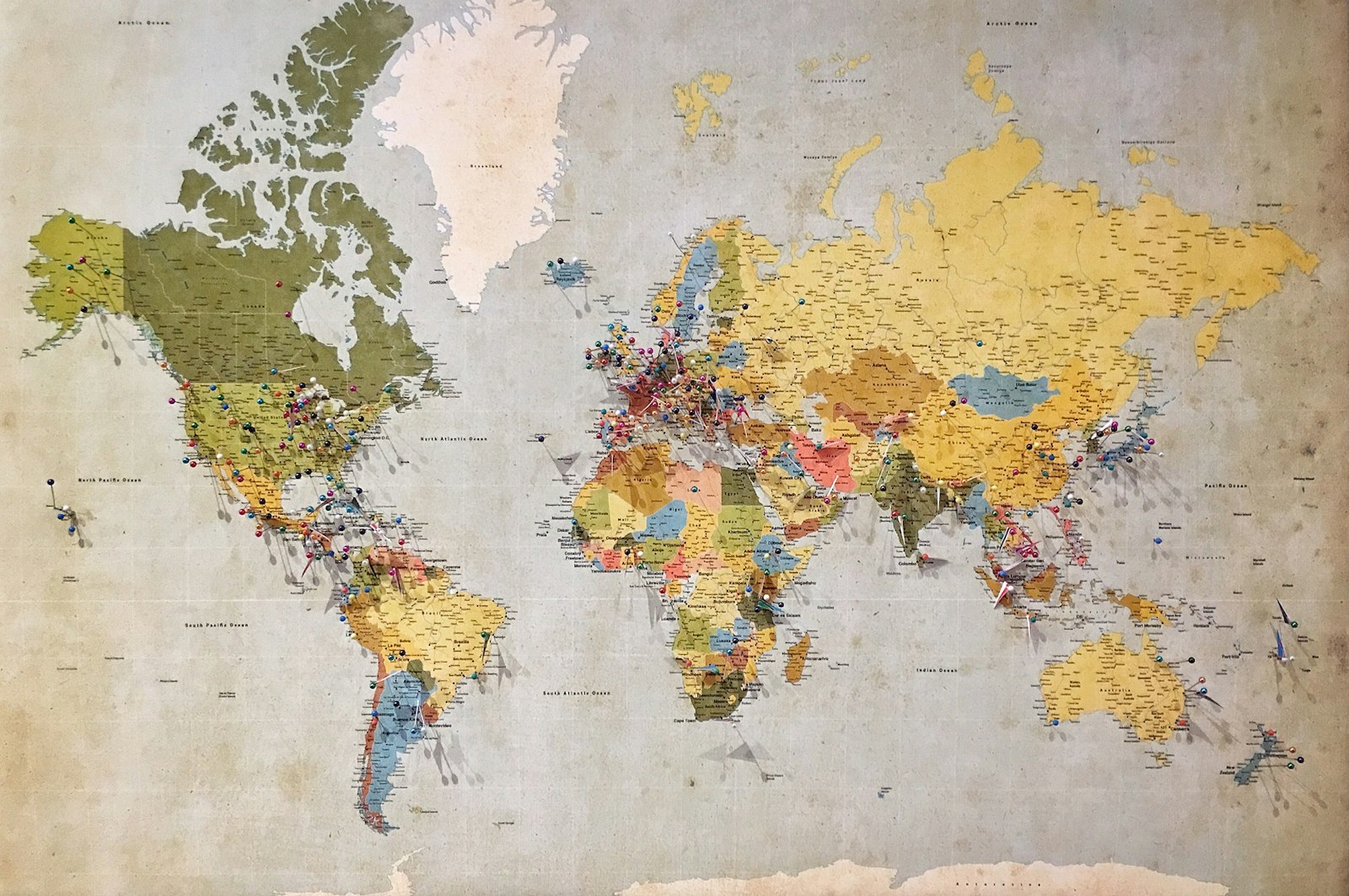
Pins placed across a world map (Photo: Andrew Stutesman / Unsplash), chosen to echo the reach and connections running through all three conversations.
1. What This Means for Retirement Money and Worry
Looking back across all three posts, one theme keeps resurfacing: don't depend too heavily on any single thing.
- The India post touched on rebalancing away from dollar- and US-centric portfolios.
- The autocratic-three post drew a lesson from China refusing to raise its dependence on Russian gas — the risk of relying on a single supplier.
- The Putin-scenario post highlighted preparing for energy price shocks and, just as importantly, scrutinising the nature of the information itself.
Laid out side by side, "diversification" turns out to be the common thread running through money, energy, and information alike. That's not a coincidence — the essence of risk management seems to be the same whether you're looking at geopolitics or a household budget.
Worry is the other side of this coin. Following world events closely can quietly build up a vague sense of dread that "something big is coming." At 66, here are three things I try to keep in mind:
Prepare rather than react. Rather than shifting assets every time something dramatic happens, keeping a diversified portfolio in place day-to-day means I don't need to swing with every headline.
Set boundaries around how much news I take in. I genuinely enjoy learning about world affairs, but following it around the clock only feeds anxiety. I try to draw a clear line between time spent learning and time spent stepping away from it.
Focus energy on what I can actually control. I have no control over what happens to the Putin government or how quickly India rises. But my own asset allocation, my health, and my daily habits are entirely within my control. Putting energy there does more for my peace of mind than following the news ever could.
2. International Relations and Human Relationships — Building a Constructive Future
The other thing that struck me, writing these three posts, was how much relationships between nations resemble relationships between people.
In the autocratic-three post, Putin's deft sidestep of a Chinese reporter's question — followed by lavish praise for India's Modi instead — read exactly like a familiar interpersonal move: ignoring the person fishing for a compliment and praising someone else instead. Xi's subsequent courting of North Korea, in turn, looked a lot like the human instinct to save face.
A few principles seem to hold true whether we're talking about nations or people.
Trust can only be built slowly, over time. The India post referenced a "12-year-old prediction" that eventually came true — a reminder that long-term relationships aren't built overnight. The same is true of trust between family and friends; it's accumulated, day by day.
Relationships built on hierarchy rarely last. The "emperor and kings" dynamic among China, Russia, and North Korea was portrayed as a source of quiet resentment beneath the surface. Relationships premised on one side being above the other tend to develop cracks eventually — a lesson that applies just as much to families and workplaces.
Relationships built on shared interests or values tend to strengthen naturally. Just as India and Japan share a common concern over territorial disputes with China, personal relationships tend to deepen naturally around shared interests and values. In my own life, the relationships I've kept over the years — through gardening, investing, or a shared love of Japanese literature — have lasted precisely because of that common ground.
So What Can an Individual Actually Do?
I can't move geopolitics at a national level. But the idea of "building a constructive future" is something I can practise in the relationships right in front of me.
- Avoid getting caught up in pride or one-upmanship. The kind of jockeying seen between Putin and Xi may be unavoidable at the national level, but at a personal level, it's a trap worth sidestepping.
- Build trust patiently, over the long term. My life split between Japan, the UK, and travels across Asia is a form of diversification — but it's also, in its own way, an ongoing practice of nurturing trust in multiple places over time.
- Connect through shared interests. Gardening, investing, reading, and an interest in healthspan — these loose, interest-based connections end up functioning as a kind of personal security net of their own.
In Closing
Looking back over these three conversations, I'm reminded that world affairs are never really "someone else's story." Whether the lens is practical — managing money — or personal — managing relationships — there's more to learn from international politics than it first appears.
Next time, I'll be back to something closer to home — the greenhouse, most likely. Thank you for reading.
Other books you might like
You're welcome to take a look.
EAST TO WEST: The Heart of Haiku, the Light of Scripture
A fitting book to close this series with — one that turns international relations, seen as a mirror for human ones, back into quiet, personal language. This was my father-in-law's final work.
View on AmazonCataract Surgery-A Memoir: Double cataract surgery in Osaka, Japan
Another record of a milestone I went through at 66, this time much closer to home.
View on AmazonSushi Business in Britain: the complete four-volume series
A novel series following thirty-five years in the British sushi trade, from apprentice to factory manager to a small sushi school.
View on AmazonAbout the Source
This post is a personal summary and reflection drawing on my previous three posts (on India, the autocratic three, and the Putin scenario). All three were prompted by paid conversations featuring Yoshinori Kitano, purchased from "Power Game," a subscription programme run by Direct Publishing.
About Yoshinori Kitano Kitano is a geopolitical and international affairs analyst, with study experience in Moscow, Russia. He publishes widely read newsletters and books analysing world affairs through the lens of national strategy and geopolitics, and serves as the lead instructor for Direct Publishing's "Power Game" subscription programme. Website: rpejournal.com
You can find details of the "Power Game" programme Mr. Kitano teaches here (Japanese language).