Corresponding episode: August 2026 issue, Part 3, ②
Following on from my last post, this conversation also centres on how to deal with China — this time through the lens of Southeast Asia, and how its nations navigate relationships with major powers whose values differ from their own, namely China, Russia, and North Korea. Featuring Yoshinori Kitano.
Note: This post reflects my own personal thoughts, prompted by a paid piece of content — a conversation featured on "Power Game," a subscription programme run by Direct Publishing — that I purchased. Mr. Kitano's website is rpejournal.com.
More in this series
- Sinking Giants, Rising India — What a Diplomatic Report Taught Me About Retirement (on PM Takaichi's India visit and geopolitical diversification)
- Cracks Among the Autocratic Three — Letting Go of the "Monolithic Bloc" Idea (on the internal dynamics of the "autocratic three")
- If Putin's Grip Loosens — A "Scenario" of a World Reshaped by Drone Warfare (a near-future hypothetical)
- International Relations as a Mirror for Human Relationships (the series wrap-up)
- Trump's "Total Defeat"? What a US-Iran Deal Taught Me About Handling Information in Retirement (on the US-Iran ceasefire memorandum)
- America's "Backyard" Is Being Redrawn (on Latin America's political upheaval and the "Donroe Doctrine")
- Will the Chinese Communist Party Really Collapse? What a Comparison with the USSR Taught Me About Long-Term Investing (on the USSR comparison)
- A Taiwan "What If" and the News About Rising Defence Spending (on collapse scenarios and defense strategy)
- The Real Reason Everyone Keeps Visiting Beijing (on great powers approaching China)
- Japan Might Get Another "Northern Territories" Problem (on the Ukraine frontline)
- Japan's Birth Rate Hit 671,000 (on the declining birthrate and mandatory retirement)
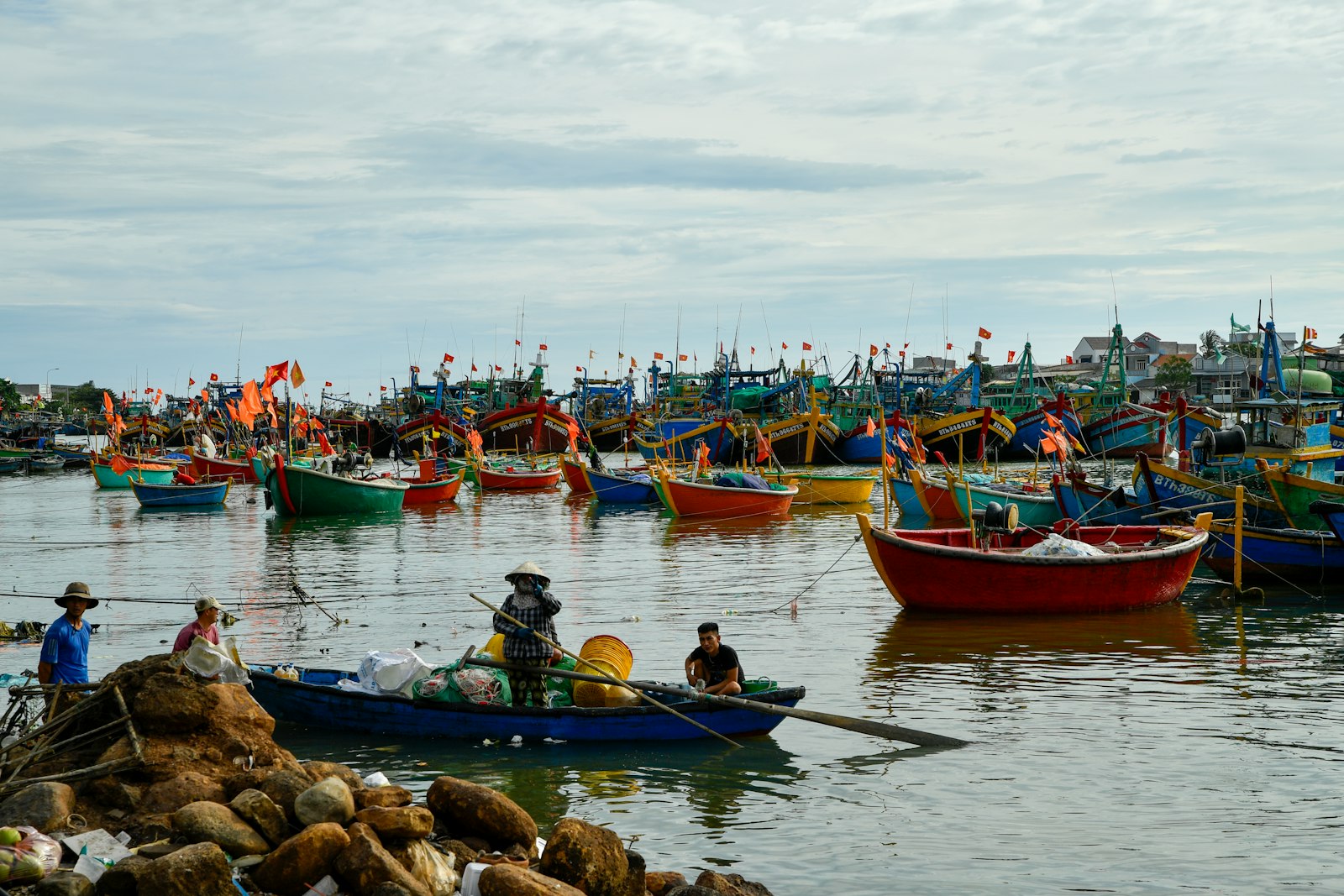
Fishing boats in Mui Ne harbour, Vietnam (Photo: Margo Evardson / Unsplash), chosen with the port towns I visit across Southeast Asia each winter in mind.
A Conversation About My Own Winter Route
Every winter, I spend time travelling through Thailand, the Philippines, Taiwan, and South Korea, in addition to Japan. This particular conversation happened to centre on exactly those Southeast Asian nations, which made it feel more personal than usual.
Profitable, But Frightening
The conversation opened by explaining the double-edged nature of China for Southeast Asia. China is the region's largest trading partner, bringing real economic benefit. At the same time, its claims over the South China Sea via the so-called "nine-dash line" pose one of the biggest threats to the sovereignty of the Philippines, Vietnam, Malaysia, and others in the region.
As a result, Southeast Asian nations have settled into a kind of hedging strategy — maintaining good economic ties with China while keeping their security relationship with the US intact.
Why Not Push Back Against Russia or North Korea Too?
One point I found genuinely interesting was the explanation for why Southeast Asia doesn't bother confronting Russia or North Korea. Since they're geographically distant and pose no direct threat, there's simply no need to pick a fight. Instead, the region identifies its actual threat and doesn't waste energy antagonising everyone else. I found that clear-eyed pragmatism rather striking.
Banding Together Because No One Nation Can Win Alone
The other main thread was a reference to the ancient Chinese strategy of "vertical alliance" (合従策) — smaller states banding together against a single dominant power. Individually, no Southeast Asian nation can stand up to China. But by forming ASEAN as a bloc of ten countries, the region has managed to preserve a measure of independence.
The conversation drew a direct lesson for Japan from this: acting alone against China isn't realistic. Strengthening ties with the Philippines, Vietnam, India, Australia, and Europe, and building that kind of multilateral "circle of allies," is what actually helps maintain a balance of power — and, in turn, helps prevent conflict.
What This Meant for Me, Living in Retirement
The wisdom of not betting everything on one relationship. Southeast Asia's balancing act reflects a very practical response to receiving both economic benefit and security risk from the same source. It resonates with how I think about my own investments — even an attractive opportunity that also carries real risk shouldn't get all of your capital. Keeping multiple options open, always, feels like the real lesson here.
Identifying the real threat, rather than fighting on every front. Southeast Asia's decision not to pick unnecessary fights with Russia or North Korea struck me as instructive too. Rather than spending equal energy worrying about every possible concern, it's worth identifying what genuinely matters and focusing there. With limited time and energy, that feels like a useful principle for retirement life as well.
The strength of having more than one place to belong. ASEAN's ability to preserve its independence by banding together as ten nations feels like it applies to individual lives too. Rather than depending entirely on a single community or relationship, having multiple places to belong and multiple connections matters. My own life, split between Japan and the UK with regular travel across Asia, may have been quietly practising exactly this principle all along.
In Closing
Knowing that the countries I regularly travel through are woven into this larger geopolitical fabric changes how I look at them a little. Next time I'm in the region, I'll be walking through it with this backdrop in mind.
Other books you might like
You're welcome to take a look.
EAST TO WEST: The Heart of Haiku, the Light of Scripture
A book I find myself returning to for quieter words, thinking back on the port towns I visit across Southeast Asia each winter. This was my father-in-law's final work.
View on AmazonCataract Surgery-A Memoir: Double cataract surgery in Osaka, Japan
Another record of a milestone in my own life, from around the same time I turned 66.
View on AmazonSushi Business in Britain: the complete four-volume series
A novel series following thirty-five years in the British sushi trade, from apprentice to factory manager to a small sushi school.
View on AmazonAbout the Source
This post is based on a paid conversation I purchased from "Power Game," a subscription programme run by Direct Publishing, featuring Yoshinori Kitano. It is not a reproduction of that content, but my own personal reflections and thoughts prompted by it.
About Yoshinori Kitano Kitano is a geopolitical and international affairs analyst, with study experience in Moscow, Russia. He publishes widely read newsletters and books analysing world affairs through the lens of national strategy and geopolitics, and serves as the lead instructor for Direct Publishing's "Power Game" subscription programme. Website: rpejournal.com
You can find details of the "Power Game" programme Mr. Kitano teaches here (Japanese language).