Corresponding episode: August 2026 issue, Part 1, ④
A few days ago, I listened to a conversation analysing the war between the US/Israel and Iran that began in February this year, and the ceasefire negotiations that followed. Featuring Yoshinori Kitano, the conversation went through the "Memorandum of Understanding on the Cessation of Hostilities Between the United States and Iran" signed in June, clause by clause.
Note: This post reflects my own personal thoughts, prompted by a paid piece of content — a conversation featured on "Power Game," a subscription programme run by Direct Publishing — that I purchased. Mr. Kitano's website is rpejournal.com.
🎧 Listen to the Discussion(two hosts talk through their thoughts on this article)
This is an AI-generated audio overview of this article, created with Google NotebookLM. Two hosts discuss the article together, sharing their own thoughts and commentary — it is not a reading of the article text.
More in this series
- Sinking Giants, Rising India — What a Diplomatic Report Taught Me About Retirement (on PM Takaichi's India visit and geopolitical diversification)
- Cracks Among the Autocratic Three — Letting Go of the "Monolithic Bloc" Idea (on the internal dynamics of the "autocratic three")
- If Putin's Grip Loosens — A "Scenario" of a World Reshaped by Drone Warfare (a near-future hypothetical)
- International Relations as a Mirror for Human Relationships (the series wrap-up)
- America's "Backyard" Is Being Redrawn (on Latin America's political upheaval and the "Donroe Doctrine")
- Will the Chinese Communist Party Really Collapse? What a Comparison with the USSR Taught Me About Long-Term Investing (on the USSR comparison)
- A Taiwan "What If" and the News About Rising Defence Spending (on collapse scenarios and defense strategy)
- The Real Reason Everyone Keeps Visiting Beijing (on great powers approaching China)
- Dealing with a Neighbour Who's Profitable but Scary (on Southeast Asia's balancing diplomacy)
- Japan Might Get Another "Northern Territories" Problem (on the Ukraine frontline)
- Japan's Birth Rate Hit 671,000 (on the declining birthrate and mandatory retirement)
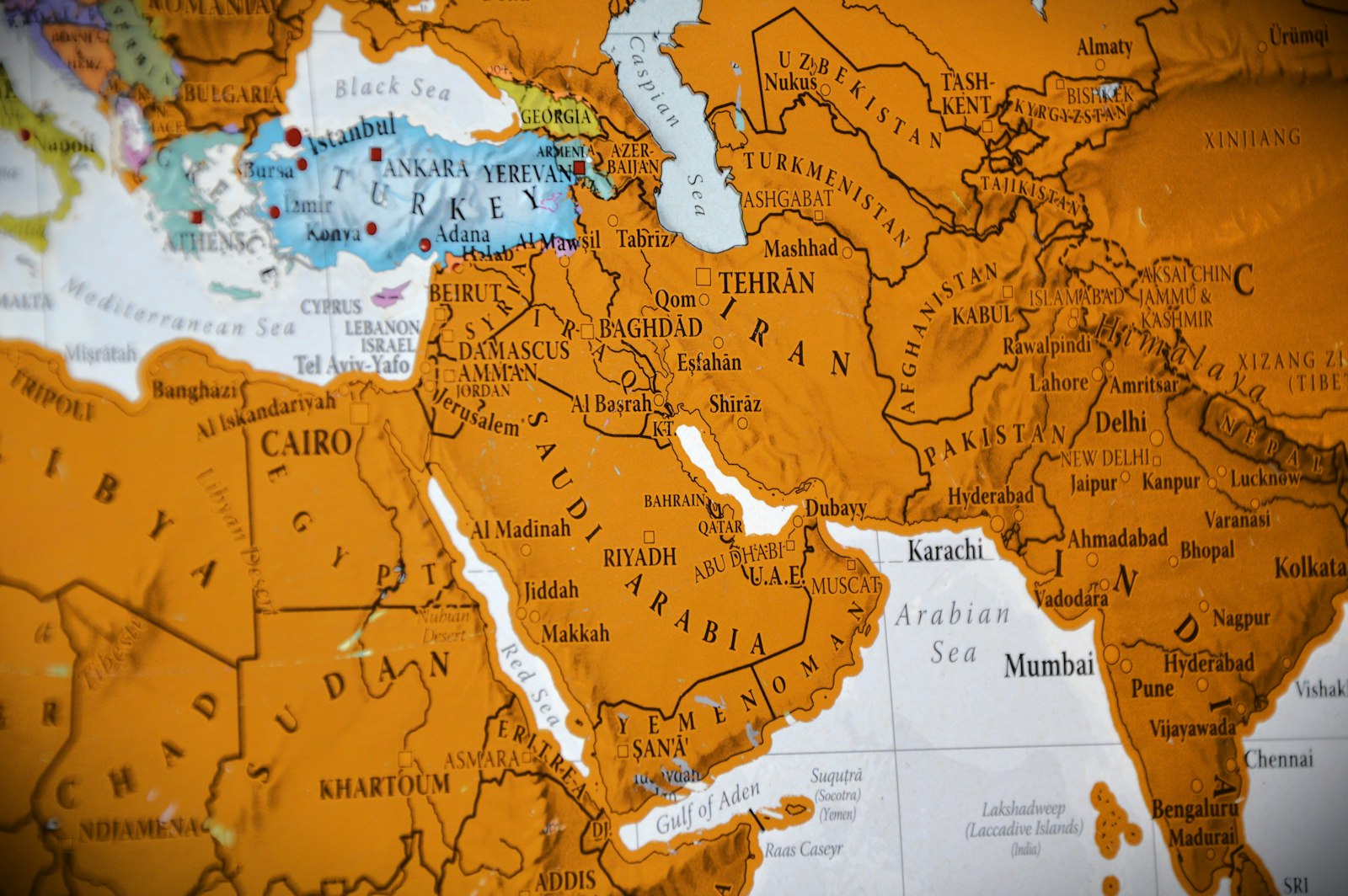
A map of the Middle East (Photo: Emin Huric / Unsplash), chosen with the Strait of Hormuz's repeated blockades and reopenings — the subject of this US-Iran deal — in mind.
Called "Trump's Total Defeat"
Here's what the conversation laid out.
On February 28th this year, the US and Israel struck Iran, starting a war. By June, the two countries had signed a memorandum ending hostilities. The Strait of Hormuz was reported as having been "reopened" — but before the war began, it had never actually been closed. In other words, after paying an enormous cost, the outcome was essentially a return to where things stood before the war started.
Looking closely at the clauses of the memorandum, the terms heavily favoured Iran. They included the release of roughly $120 billion (around ¥19 trillion) in frozen assets, the lifting of oil and petroleum product export restrictions, and a plan for up to $300 billion (around ¥48 trillion) in economic reconstruction. Meanwhile, the nuclear issue — supposedly the whole point of the war — was addressed with little more than a restated pledge not to develop nuclear weapons, with concrete verification measures pushed to later talks. The parallel drawn to past negotiations with North Korea struck me as apt.
The conversation described this as "a total defeat for the Trump administration." The backdrop, apparently, was the upcoming US midterm elections in November. Continued disruption in the Strait of Hormuz would push up gasoline prices and fuel inflation — a political risk serious enough, the argument went, to explain such a lopsided concession.
What I Found When I Looked It Up Myself
That's the gist of the conversation. But I was curious what actually happened to this agreement afterward, so I did a bit of digging on my own. It turned out the deal had effectively collapsed within about three weeks. Trump reportedly declared it "over" shortly afterward, large-scale US airstrikes resumed, and Iran re-blockaded the Strait of Hormuz.
The conversation placed this collapse in April — but when I checked news coverage, the actual collapse happened in July. Given the war started in February and the memorandum was signed in June, July makes far more chronological sense. I suspect this was simply a mishearing during transcription. Even with paid content, since it's ultimately people talking, small errors like this are bound to happen occasionally. I only caught it because I went and checked a primary source myself — and that habit of double-checking before taking a conversation or a headline at face value feels like one worth holding onto.
What This Meant for Me, Living in Retirement
Energy price swings are never someone else's problem. The Strait of Hormuz is a critical chokepoint for global oil transport. Every time it's blockaded and reopened, oil prices and the broader cost of living feel the impact. Whichever way tensions in the Middle East develop, preparing for sudden swings in energy prices is a lesson I've come back to again and again through this series — and this episode only reinforced it.
Keeping some distance from "who won" framing. The conversation used the phrase "Trump's total defeat" — but that's just one way of scoring it. Someone else might frame the same agreement as "bringing the war to an early end." Judging international agreements purely by a win/lose scoreboard can be a risky habit. The same applies to financial information: the more confidently something is framed as "this will make you money" or "this is dangerous," the more it's worth pausing and checking for yourself.
Not skipping the step of checking a primary source. I only caught the date error in the conversation because I actually went and searched for it myself. At 66, rather than letting information wash over me, I try to verify anything that catches my attention. That small extra effort feels like it does double duty — protecting my finances, and keeping my mind a little sharper too.
In Closing
This conversation started with the provocative framing of "Trump's total defeat," but digging a little further revealed an even starker reality — the agreement itself fell apart within weeks. It's a good reminder that following world affairs isn't just about absorbing what you're told; it's worth checking the parts that catch your attention for yourself. I'll try to keep that habit going.
Other books you might like
You're welcome to take a look.
EAST TO WEST: The Heart of Haiku, the Light of Scripture
A fitting book to close out this reflection on checking things for yourself rather than taking them at face value. This was my father-in-law's final work.
View on AmazonCataract Surgery-A Memoir: Double cataract surgery in Osaka, Japan
Another record of a milestone I went through at 66, this time much closer to home.
View on AmazonSushi Business in Britain: the complete four-volume series
A novel series following thirty-five years in the British sushi trade, from apprentice to factory manager to a small sushi school.
View on AmazonAbout the Source
This post is based on a paid conversation I purchased from "Power Game," a subscription programme run by Direct Publishing, featuring Yoshinori Kitano. It is not a reproduction of that content, but my own personal reflections and thoughts prompted by it. Note that I've corrected one date discrepancy in the body of this post after cross-checking it against public reporting.
About Yoshinori Kitano Kitano is a geopolitical and international affairs analyst, with study experience in Moscow, Russia. He publishes widely read newsletters and books analysing world affairs through the lens of national strategy and geopolitics, and serves as the lead instructor for Direct Publishing's "Power Game" subscription programme. Website: rpejournal.com
You can find details of the "Power Game" programme Mr. Kitano teaches here (Japanese language).