Corresponding episode: August 2026 issue, Part 2, ①
A few days ago, I listened to a conversation tackling a genuinely huge question: when, if ever, will the Chinese Communist Party's rule come to an end? Featuring Yoshinori Kitano, the conversation compared the current Chinese Communist Party with the Soviet Union, which collapsed in 1991, to think through how long authoritarian regimes tend to last.
Note: This post reflects my own personal thoughts, prompted by a paid piece of content — a conversation featured on "Power Game," a subscription programme run by Direct Publishing — that I purchased. Mr. Kitano's website is rpejournal.com. This post covers the speakers' own analysis and forecasting, not confirmed factual reporting.
More in this series
- Sinking Giants, Rising India — What a Diplomatic Report Taught Me About Retirement (on PM Takaichi's India visit and geopolitical diversification)
- Cracks Among the Autocratic Three — Letting Go of the "Monolithic Bloc" Idea (on the internal dynamics of the "autocratic three")
- If Putin's Grip Loosens — A "Scenario" of a World Reshaped by Drone Warfare (a near-future hypothetical)
- International Relations as a Mirror for Human Relationships (the series wrap-up)
- Trump's "Total Defeat"? What a US-Iran Deal Taught Me About Handling Information in Retirement (on the US-Iran ceasefire memorandum)
- America's "Backyard" Is Being Redrawn (on Latin America's political upheaval and the "Donroe Doctrine")
- A Taiwan "What If" and the News About Rising Defence Spending (on collapse scenarios and defense strategy)
- The Real Reason Everyone Keeps Visiting Beijing (on great powers approaching China)
- Dealing with a Neighbour Who's Profitable but Scary (on Southeast Asia's balancing diplomacy)
- Japan Might Get Another "Northern Territories" Problem (on the Ukraine frontline)
- Japan's Birth Rate Hit 671,000 (on the declining birthrate and mandatory retirement)
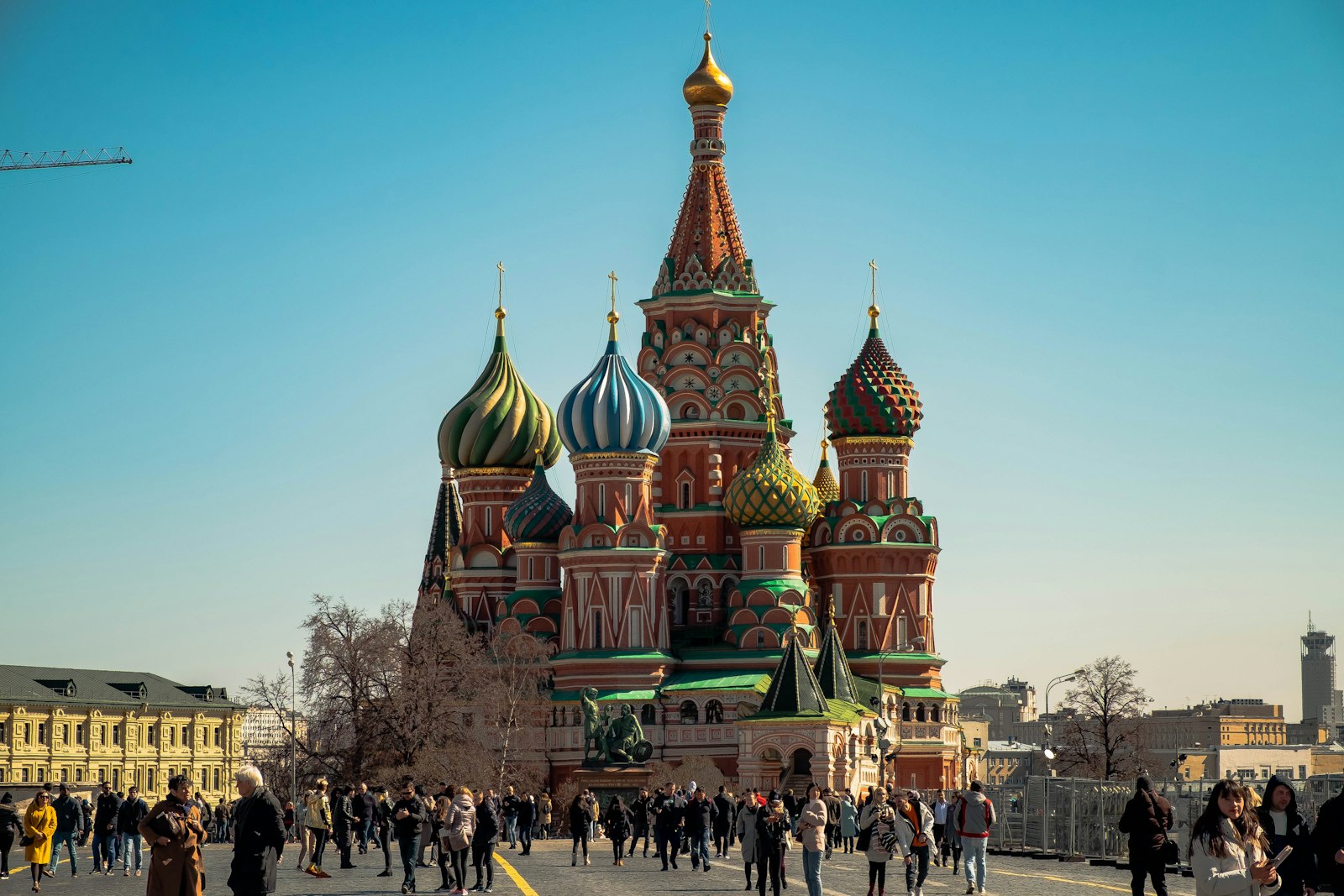
Saint Basil's Cathedral on Red Square, Moscow (Photo: Calvin fitra Anggara / Unsplash), chosen with the Soviet Union's 69-year history in mind.
"I've Been Hearing This for Twenty Years"
What struck me most at the start of the conversation was the host mentioning he'd been hearing predictions of "China's collapse" since around 2006 — and the country still hasn't cracked. I had a similar reaction myself; I've heard some version of "China will collapse eventually" more times than I can count since I started investing.
The conversation began by carefully defining what "China collapsing" actually means. Just as Russia remained after the Soviet Union fell, if China's system were to collapse, it wouldn't mean the country itself disappearing — it would mean the end of one-party rule under the Communist Party specifically. That distinction genuinely clarified something for me. Hearing "China will collapse" tends to conjure an image of the country itself vanishing, when that's not really what's being discussed at all.
What Set China Apart from the USSR
The conversation compared the Soviet Union (which lasted 69 years, from 1922 to 1991) against the Chinese Communist Party (founded in 1949, now 77 years in), leader by leader.
The key turning point, apparently, was Deng Xiaoping's 1978 reform and opening-up policy. While the USSR clung to central planning until the end — leading to chronic shortages of consumer goods that eroded people's daily lives — Deng chose a different path: keep one-party political rule intact, but let the economy embrace capitalism. That decision laid the groundwork for four decades of rapid growth.
The other key divergence was the opposite approaches taken by Gorbachev and Xi Jinping. Gorbachev pushed for political and speech liberalisation (perestroika and glasnost), which ultimately led to the Soviet collapse. According to the conversation, Xi studied that "failure" closely and moved in the opposite direction — tightening speech control and consolidating power for life.
The cost of that approach, apparently, has been growth: China's economy grew over 10% annually under Hu Jintao, but has slowed to around 4% under Xi. Without elections to correct course, the conversation noted, policy failures can't be fixed the way they can in a democracy — all the responsibility ends up resting on a single leader. That observation gave me something to sit with.
What This Meant for Me, Living in Retirement
"It'll collapse eventually" isn't much use for investment decisions. The detail that this prediction has been circulating for nearly twenty years really landed for me. Even if the analysis in this conversation turns out to be correct, whether that means five years from now or thirty, nobody actually knows. Making major changes to my current asset allocation based solely on "it'll happen eventually" strikes me as risky. What matters more is maintaining diversification robust enough to weather whatever happens, whenever it happens.
Institutional flexibility seems to pay off over the long run. Listening to the Deng-versus-Gorbachev comparison, what stood out was that the more economically flexible system ended up lasting longer. That's a lesson about nations, but it feels applicable to personal financial planning too. Rather than clinging rigidly to one approach, leaving room to adjust as circumstances change seems to be the real key to lasting the distance.
Thinking through "what if" and acting on it right now are two different things. Something I keep coming back to throughout this series: understanding a geopolitical scenario and acting on it immediately are separate matters. For anyone holding China-related assets, keeping this kind of long-term structural shift in mind, while making gradual, unhurried adjustments toward diversification, feels like the realistic approach.
In Closing
Having heard "China will eventually collapse" for close to twenty years now, this conversation gave me a chance to look at that claim a little more calmly and carefully. Whether the prediction ever proves right, checking in on this kind of long-term perspective from time to time doesn't feel like wasted effort when it comes to planning for retirement.
Other books you might like
You're welcome to take a look.
EAST TO WEST: The Heart of Haiku, the Light of Scripture
After a comparison spanning decades of Soviet and Chinese history, it's the book I find myself returning to for a quieter kind of language. This was my father-in-law's final work.
View on AmazonCataract Surgery-A Memoir: Double cataract surgery in Osaka, Japan
Another record of a milestone I went through at 66, this time much closer to home.
View on AmazonSushi Business in Britain: the complete four-volume series
A novel series following thirty-five years in the British sushi trade, from apprentice to factory manager to a small sushi school.
View on AmazonAbout the Source
This post is based on a paid conversation I purchased from "Power Game," a subscription programme run by Direct Publishing, featuring Yoshinori Kitano. It is not a reproduction of that content, but my own personal reflections and thoughts prompted by it. Please note that the content discussed here reflects the speakers' own analysis and forecasting, not confirmed fact.
About Yoshinori Kitano Kitano is a geopolitical and international affairs analyst, with study experience in Moscow, Russia. He publishes widely read newsletters and books analysing world affairs through the lens of national strategy and geopolitics, and serves as the lead instructor for Direct Publishing's "Power Game" subscription programme. Website: rpejournal.com
You can find details of the "Power Game" programme Mr. Kitano teaches here (Japanese language).