Corresponding episode: August 2026 issue, Part 1, ②
🎧 Listen to the Discussion(two hosts talk through their thoughts on this article)
This is an AI-generated audio overview of this article, created with Google NotebookLM. Two hosts discuss the article together, sharing their own thoughts and commentary — it is not a reading of the article text.
A few days ago, I listened to a conversation analysing the triangular relationship between China, Russia, and North Korea, featuring Yoshinori Kitano and a host. It turns out these three countries — often lumped together as a unified "autocratic bloc" — are actually caught up in a surprisingly tangled web of internal rivalry. Following on from my last post about India, this one prompted me to update my mental picture once again.
Note: This post reflects my own personal thoughts, prompted by a paid piece of content — a conversation featured on "Power Game," a subscription programme run by Direct Publishing — that I purchased. Mr. Kitano's website is rpejournal.com.
More in this series
- Sinking Giants, Rising India — What a Diplomatic Report Taught Me About Retirement (on PM Takaichi's India visit and geopolitical diversification)
- If Putin's Grip Loosens — A "Scenario" of a World Reshaped by Drone Warfare (a near-future hypothetical)
- International Relations as a Mirror for Human Relationships (the series wrap-up)
- Trump's "Total Defeat"? What a US-Iran Deal Taught Me About Handling Information in Retirement (on the US-Iran ceasefire memorandum)
- America's "Backyard" Is Being Redrawn (on Latin America's political upheaval and the "Donroe Doctrine")
- Will the Chinese Communist Party Really Collapse? What a Comparison with the USSR Taught Me About Long-Term Investing (on the USSR comparison)
- A Taiwan "What If" and the News About Rising Defence Spending (on collapse scenarios and defense strategy)
- The Real Reason Everyone Keeps Visiting Beijing (on great powers approaching China)
- Dealing with a Neighbour Who's Profitable but Scary (on Southeast Asia's balancing diplomacy)
- Japan Might Get Another "Northern Territories" Problem (on the Ukraine frontline)
- Japan's Birth Rate Hit 671,000 (on the declining birthrate and mandatory retirement)
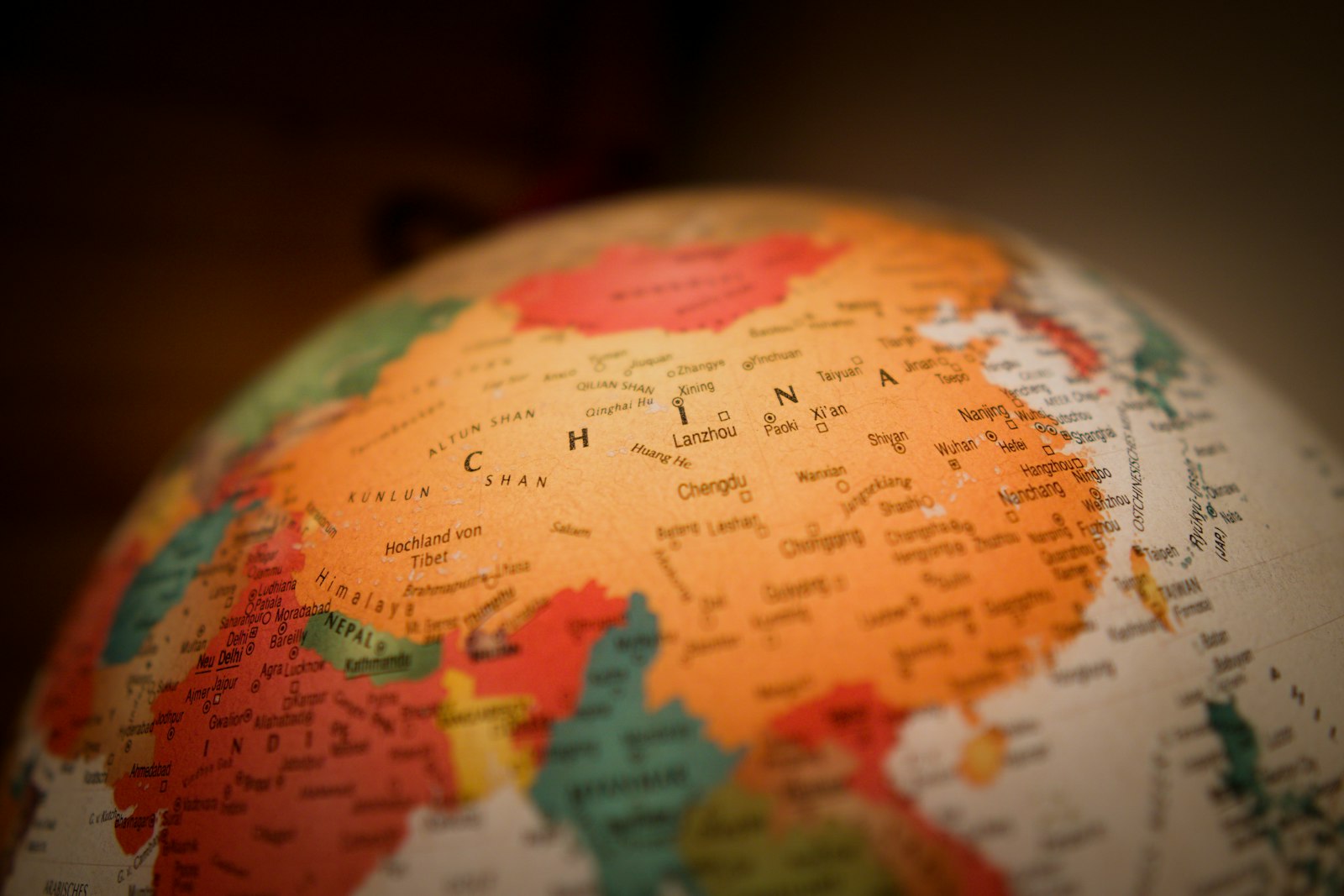
A globe showing East Asia, including China (Photo: Christian Lue / Unsplash).
Not as United as I Assumed
I've always thought of China, Russia, and North Korea as a fairly cohesive bloc. But this conversation suggested that view might be an oversimplification.
The discussion used a vivid metaphor: the old Soviet Union used to be the "elder brother" to China's "younger brother," but that relationship has completely reversed — Xi Jinping now sits as "emperor," with Putin and Kim Jong-un reduced to "kings" beneath him. One episode illustrated this well: Putin pushed hard for the "Power of Siberia 2" gas pipeline project, but Xi effectively declined, wary of becoming too dependent on Russian energy.
What struck me even more was what came next. At an international forum, a Chinese state media reporter tried to prompt Putin into crediting Xi for the improved China-Russia relationship — but Putin sidestepped it and instead heaped praise on India's Modi. In apparent response, Xi turned to North Korea, securing a declaration from Kim Jong-un that ties with China would be the country's "most important strategic priority."
It struck me how much international diplomacy resembles the subtleties of interpersonal relationships. Even between nations, matters of pride and quiet one-upmanship play out in very concrete ways.
What This Means for Someone in Retirement
Honestly, this conversation felt less directly relevant to my own asset allocation than the India report did. Still, a few things stood out worth keeping in mind.
Loosening the assumption that this bloc always acts as one. The idea that China, Russia, and North Korea move in lockstep may be more simplistic than reality. When thinking through Taiwan Strait or Korean Peninsula scenarios, it seems worth factoring in this internal friction rather than assuming a unified front.
Energy dependency risk applies to everyone, not just nations. China's reluctance to let Russian gas make up 50% of its imports came down to fear of energy being weaponised against it. That's the same lesson I took from the India report — not depending too heavily on a single supplier or a single country is a principle that applies just as much to personal finances as it does to national resource strategy.
Keeping an eye on how this affects my travel plans in Asia. Since I spend winters travelling through Taiwan and Korea, tension in this region isn't an abstract concern for me. This conversation suggests that internal friction within the autocratic bloc may, in the short term, weaken its military cohesion — but unpredictability itself hasn't gone away, so I'll keep watching how things develop.
In Closing
This conversation was less about direct investment implications and more about updating how I see the world. It reminded me that relationships between nations, much like relationships between people, are rarely as simple as the word "alliance" suggests.
Next time, I'll bring things back to something a little closer to home.
Other books you might like
You're welcome to take a look.
EAST TO WEST: The Heart of Haiku, the Light of Scripture
After reading about the manoeuvring between nations, it's the book I find myself returning to for a quieter kind of language. This was my father-in-law's final work.
View on AmazonCataract Surgery-A Memoir: Double cataract surgery in Osaka, Japan
Another record of a milestone I went through at 66, this time much closer to home.
View on AmazonSushi Business in Britain: the complete four-volume series
A novel series following thirty-five years in the British sushi trade, from apprentice to factory manager to a small sushi school.
View on AmazonAbout the Source
This post is based on a paid conversation I purchased from "Power Game," a subscription programme run by Direct Publishing, featuring Yoshinori Kitano and a host. It is not a reproduction of that content, but my own personal reflections and thoughts prompted by it.
About Yoshinori Kitano Kitano is a geopolitical and international affairs analyst, with study experience in Moscow, Russia. He publishes widely read newsletters and books analysing world affairs through the lens of national strategy and geopolitics, and serves as the lead instructor for Direct Publishing's "Power Game" subscription programme. Website: rpejournal.com
You can find details of the "Power Game" programme Mr. Kitano teaches here (Japanese language).