Corresponding episode: August 2026 issue, Part 1, ③
A Note Before You Read This post is not based on real-world reporting or factual military analysis. It's built on a near-future, hypothetical scenario discussed in a conversation — a "what if this happened" exercise, not a description of actual events.
🎧 Listen to the Discussion(two hosts talk through their thoughts on this article)
This is an AI-generated audio overview of this article, created with Google NotebookLM. Two hosts discuss the article together, sharing their own thoughts and commentary — it is not a reading of the article text.
A few days ago, I listened to a conversation exploring a "what if" scenario around the Russia-Ukraine situation, featuring Yoshinori Kitano and a co-speaker. It laid out a hypothetical near-future in which Ukraine gains the upper hand through drone innovation, and Putin's grip on power begins to loosen.
Note: This post reflects my own personal thoughts, prompted by a paid piece of content — a conversation featured on "Power Game," a subscription programme run by Direct Publishing — that I purchased. Mr. Kitano's website is rpejournal.com.
More in this series
- Sinking Giants, Rising India — What a Diplomatic Report Taught Me About Retirement (on PM Takaichi's India visit and geopolitical diversification)
- Cracks Among the Autocratic Three — Letting Go of the "Monolithic Bloc" Idea (on the internal dynamics of the "autocratic three")
- International Relations as a Mirror for Human Relationships (the series wrap-up)
- Trump's "Total Defeat"? What a US-Iran Deal Taught Me About Handling Information in Retirement (on the US-Iran ceasefire memorandum)
- America's "Backyard" Is Being Redrawn (on Latin America's political upheaval and the "Donroe Doctrine")
- Will the Chinese Communist Party Really Collapse? What a Comparison with the USSR Taught Me About Long-Term Investing (on the USSR comparison)
- A Taiwan "What If" and the News About Rising Defence Spending (on collapse scenarios and defense strategy)
- The Real Reason Everyone Keeps Visiting Beijing (on great powers approaching China)
- Dealing with a Neighbour Who's Profitable but Scary (on Southeast Asia's balancing diplomacy)
- Japan Might Get Another "Northern Territories" Problem (on the Ukraine frontline)
- Japan's Birth Rate Hit 671,000 (on the declining birthrate and mandatory retirement)
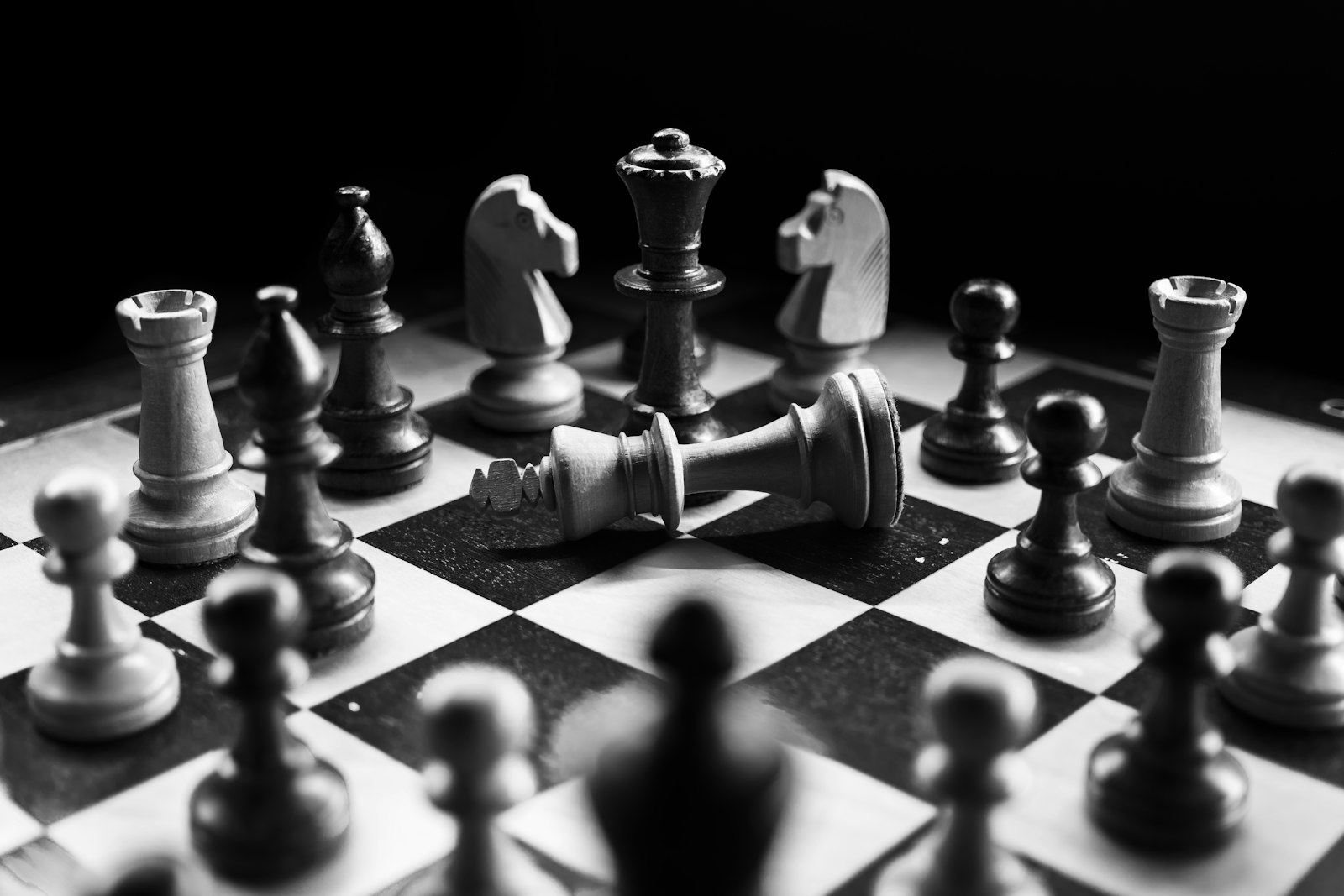
Chess pieces on a board (Photo: Felix Mittermeier / Unsplash), chosen to echo this scenario as one move in a larger strategic game.
The Shape of the Scenario
Here's roughly what the hypothetical scenario laid out.
Over several years of war, Ukraine develops its own drone technology at remarkable speed, eventually producing around half of its drones domestically. It strikes Russian oil facilities over 1,500km from the front line, and sinks naval vessels using underwater kamikaze drones. Around Russia's biggest holiday — Victory Day on May 9th — Ukraine plays a psychological game that dents Putin's authority. Strikes on oil infrastructure timed to coincide with an international economic forum, followed by a large-scale drone attack on Moscow itself, gradually erode confidence among Russia's elite.
Even as a hypothetical, the broader theme — that drone technology is reshaping the nature of warfare — echoes things I've seen in real reporting elsewhere. The idea that cheap, mass-producible technology could increasingly outweigh a handful of expensive weapons systems struck me as a genuinely thought-provoking point, regardless of how this particular scenario plays out.
What This Scenario Made Me Think About
Since this is a hypothetical, I'm not treating any of the specific events as fact. But thinking through a "what if" like this still felt worthwhile as someone living in retirement.
Sudden energy price swings are always worth planning for. If Russia's oil and gas supply chains were ever seriously disrupted, global energy prices would move sharply. This echoes a theme from my last two posts — the risk of depending too heavily on a single supply source. Regardless of how realistic this particular scenario is, preparing for energy price volatility remains a universally sound principle for a retirement budget.
Developing the habit of checking what kind of content I'm consuming. If I hadn't caught that this conversation was a hypothetical scenario, I might have written about it as if it were factual reporting — and potentially misled readers. As AI-generated content and long-form conversations become more common, pausing to ask "is this a factual report, or an analytical scenario?" feels like an increasingly important habit, especially as we get older. In a small way, that kind of scrutiny feels like decent exercise for the brain, too.
Quietly factoring major geopolitical shifts into financial planning. If something serious were ever to happen to the Putin government, global resource markets and security dynamics would shift substantially. Regardless of how likely that is, occasionally running the thought experiment — "what would happen to my finances and daily life if this occurred?" — seems like time well spent.
In Closing
This post had a different flavour from my last two — a "scenario" piece rather than an analysis of real events. If anything, it was a good reminder of how important it is to check whether something is fact or hypothesis before writing about it. I'll keep sharing what catches my attention as I follow world affairs.
Other books you might like
You're welcome to take a look.
EAST TO WEST: The Heart of Haiku, the Light of Scripture
After a hypothetical like this one, it's the book I find myself returning to for a quieter kind of language. This was my father-in-law's final work.
View on AmazonCataract Surgery-A Memoir: Double cataract surgery in Osaka, Japan
Another record of a milestone I went through at 66, this time much closer to home.
View on AmazonSushi Business in Britain: the complete four-volume series
A novel series following thirty-five years in the British sushi trade, from apprentice to factory manager to a small sushi school.
View on AmazonAbout the Source
This post is based on a paid conversation I purchased from "Power Game," a subscription programme run by Direct Publishing, featuring Yoshinori Kitano. It is not a reproduction of that content, but my own personal reflections and thoughts prompted by it. Please also note that this particular conversation was presented as a near-future hypothetical scenario, not factual reporting.
About Yoshinori Kitano Kitano is a geopolitical and international affairs analyst, with study experience in Moscow, Russia. He publishes widely read newsletters and books analysing world affairs through the lens of national strategy and geopolitics, and serves as the lead instructor for Direct Publishing's "Power Game" subscription programme. Website: rpejournal.com
You can find details of the "Power Game" programme Mr. Kitano teaches here (Japanese language).