Corresponding episode: August 2026 issue, Part 3, ①
A few days ago, I listened to a conversation analysing why the leaders of the US, Russia, and Europe have all been making high-profile visits to Beijing in quick succession. Featuring Yoshinori Kitano, the conversation dug into what's really driving each country to move closer to China.
Note: This post reflects my own personal thoughts, prompted by a paid piece of content — a conversation featured on "Power Game," a subscription programme run by Direct Publishing — that I purchased. Mr. Kitano's website is rpejournal.com.
More in this series
- Sinking Giants, Rising India — What a Diplomatic Report Taught Me About Retirement (on PM Takaichi's India visit and geopolitical diversification)
- Cracks Among the Autocratic Three — Letting Go of the "Monolithic Bloc" Idea (on the internal dynamics of the "autocratic three")
- If Putin's Grip Loosens — A "Scenario" of a World Reshaped by Drone Warfare (a near-future hypothetical)
- International Relations as a Mirror for Human Relationships (the series wrap-up)
- Trump's "Total Defeat"? What a US-Iran Deal Taught Me About Handling Information in Retirement (on the US-Iran ceasefire memorandum)
- America's "Backyard" Is Being Redrawn (on Latin America's political upheaval and the "Donroe Doctrine")
- Will the Chinese Communist Party Really Collapse? What a Comparison with the USSR Taught Me About Long-Term Investing (on the USSR comparison)
- A Taiwan "What If" and the News About Rising Defence Spending (on collapse scenarios and defense strategy)
- Dealing with a Neighbour Who's Profitable but Scary (on Southeast Asia's balancing diplomacy)
- Japan Might Get Another "Northern Territories" Problem (on the Ukraine frontline)
- Japan's Birth Rate Hit 671,000 (on the declining birthrate and mandatory retirement)
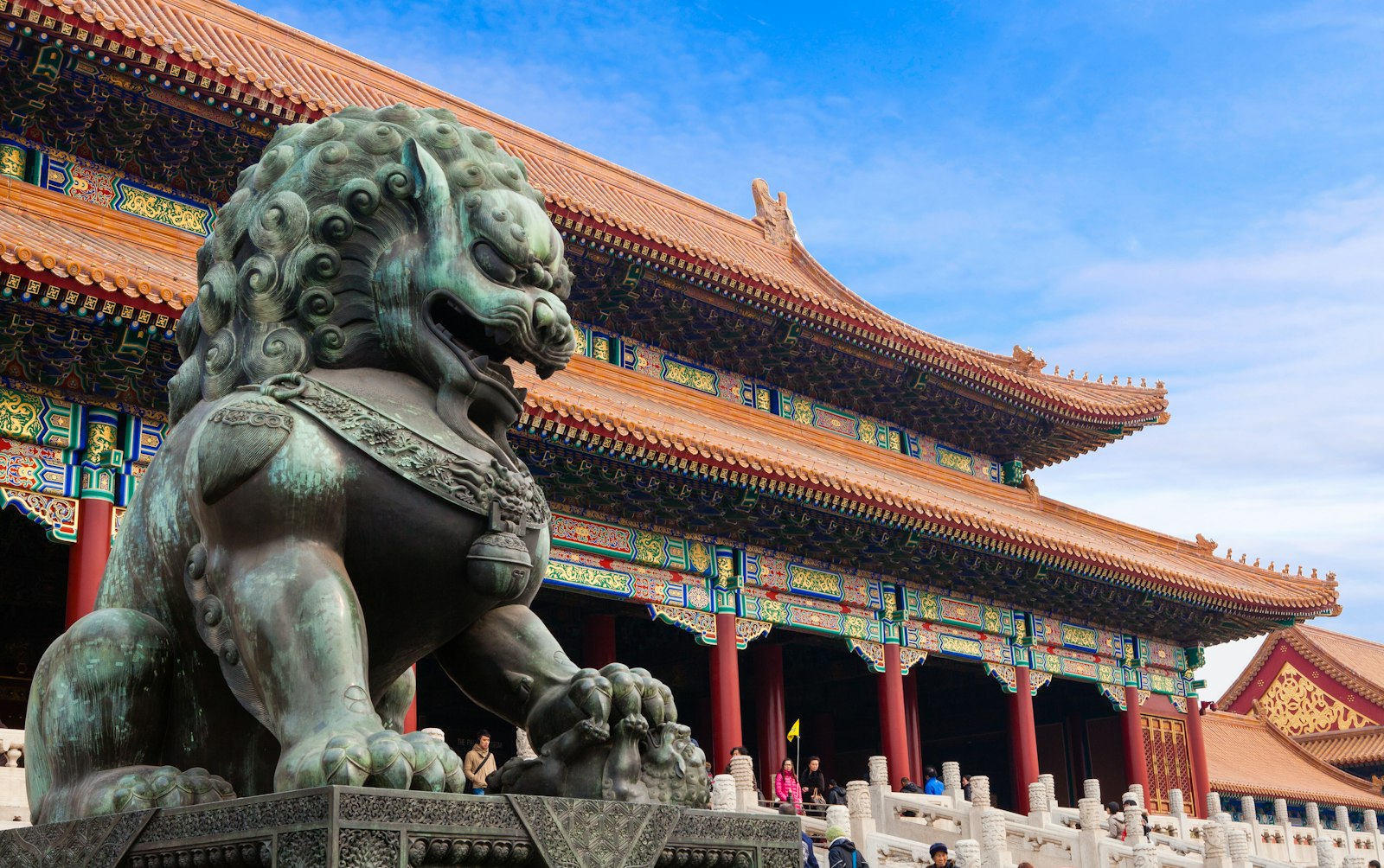
A guardian lion at the Forbidden City's Hall of Supreme Harmony (Photo: Rafik Wahba / Unsplash), chosen to evoke the parade of world leaders' visits to Beijing.
Not Admiration — Weakness
At the start of the conversation, the host described the parade of world leaders visiting Beijing as looking almost like a return to the old imperial "tribute" system — from Xi Jinping's vantage point, it might look like "barbarian kings" paying their respects to the emperor.
But listening further, it became clear that none of these countries are approaching China out of admiration for Xi's government. Each is being driven by a genuine vulnerability of its own.
The US depends heavily on China for rare earth elements essential to its tech, defence, and energy industries, and fears what would happen if that supply were cut off. Efforts to reduce that dependence are underway, but they'll take years to bear fruit — meaning, for now, Washington can't afford to push too hard against Beijing.
Russia, cut off from SWIFT and facing sanctions after invading Ukraine, has had little choice but to sell its oil and gas to China, settling in yuan. According to the conversation, Moscow has effectively accepted the role of China's "junior partner."
Europe, meanwhile, is hedging against an unpredictable Trump administration — approaching China partly as insurance against the risk of finding itself at odds with both the US and China at once.
Each Country's Weakness Became Its Reason to Approach
Hearing how three major powers are each drawn toward China for entirely different reasons, what struck me was how simple the underlying logic of "relying on someone" often turns out to be. It's rarely about respect or trust — more often, it's simply that someone has found your weak spot. That's true between nations, but it feels just as true in personal relationships and business dealings.
The conversation also noted that, amid all this, Japan alone has held firm rather than bending to Chinese pressure — drawing intense propaganda criticism from Beijing as a result, criticism that Western nations, according to the conversation, aren't taking at face value.
What This Meant for Me, Living in Retirement
Dependence on a single country or resource is a weakness even for a superpower. Even a country as powerful as the US has a real vulnerability tied to a single resource — rare earths. It's yet another example of a theme that keeps resurfacing throughout this series: diversification. Whether it's a portfolio, an energy supply, or international relations, relying too heavily on one thing you can't do without eventually becomes a liability.
Being "relied upon" is less stable than it looks. China is currently in the position of being courted by everyone — but that's not because it's admired. It's simply that interests happen to align, for now. If those interests shift, so will the relationship. It's a reminder that assuming "I'm needed, so I'm safe" can be a risky assumption in personal relationships too.
There's value in choosing not to be swept along. While other countries approach China out of self-interest, Japan holding its own ground was, frankly, encouraging to read about. Not getting swept up in the prevailing mood, and holding onto your own standards, feels like a lesson that applies just as much to retirement finances and everyday relationships as it does to national diplomacy.
In Closing
Looking closely at the "pilgrimage to Beijing" phenomenon, each country's individual circumstances reveal a picture far more complicated than a simple story of "China winning." I want to keep the habit of asking "why" behind the headlines, rather than taking them at face value.
Other books you might like
You're welcome to take a look.
EAST TO WEST: The Heart of Haiku, the Light of Scripture
A book I find myself returning to for quieter words, after reading about the manoeuvring between great powers. This was my father-in-law's final work.
View on AmazonCataract Surgery-A Memoir: Double cataract surgery in Osaka, Japan
Another record of a milestone in my own life, from around the same time I turned 66.
View on AmazonSushi Business in Britain: the complete four-volume series
A novel series following thirty-five years in the British sushi trade, from apprentice to factory manager to a small sushi school.
View on AmazonAbout the Source
This post is based on a paid conversation I purchased from "Power Game," a subscription programme run by Direct Publishing, featuring Yoshinori Kitano. It is not a reproduction of that content, but my own personal reflections and thoughts prompted by it.
About Yoshinori Kitano Kitano is a geopolitical and international affairs analyst, with study experience in Moscow, Russia. He publishes widely read newsletters and books analysing world affairs through the lens of national strategy and geopolitics, and serves as the lead instructor for Direct Publishing's "Power Game" subscription programme. Website: rpejournal.com
You can find details of the "Power Game" programme Mr. Kitano teaches here (Japanese language).