Corresponding episode: August 2026 issue, Part 3, ③
A while back I wrote about a hypothetical "scenario" involving Putin's grip on power loosening. This time, I listened to a conversation covering the actual, current state of the front line in Ukraine and where ceasefire negotiations stand. Featuring Yoshinori Kitano.
Note: This post reflects my own personal thoughts, prompted by a paid piece of content — a conversation featured on "Power Game," a subscription programme run by Direct Publishing — that I purchased. Mr. Kitano's website is rpejournal.com.
More in this series
- Sinking Giants, Rising India — What a Diplomatic Report Taught Me About Retirement (on PM Takaichi's India visit and geopolitical diversification)
- Cracks Among the Autocratic Three — Letting Go of the "Monolithic Bloc" Idea (on the internal dynamics of the "autocratic three")
- If Putin's Grip Loosens — A "Scenario" of a World Reshaped by Drone Warfare (a near-future hypothetical)
- International Relations as a Mirror for Human Relationships (the series wrap-up)
- Trump's "Total Defeat"? What a US-Iran Deal Taught Me About Handling Information in Retirement (on the US-Iran ceasefire memorandum)
- America's "Backyard" Is Being Redrawn (on Latin America's political upheaval and the "Donroe Doctrine")
- Will the Chinese Communist Party Really Collapse? What a Comparison with the USSR Taught Me About Long-Term Investing (on the USSR comparison)
- A Taiwan "What If" and the News About Rising Defence Spending (on collapse scenarios and defense strategy)
- The Real Reason Everyone Keeps Visiting Beijing (on great powers approaching China)
- Dealing with a Neighbour Who's Profitable but Scary (on Southeast Asia's balancing diplomacy)
- Japan's Birth Rate Hit 671,000 (on the declining birthrate and mandatory retirement)
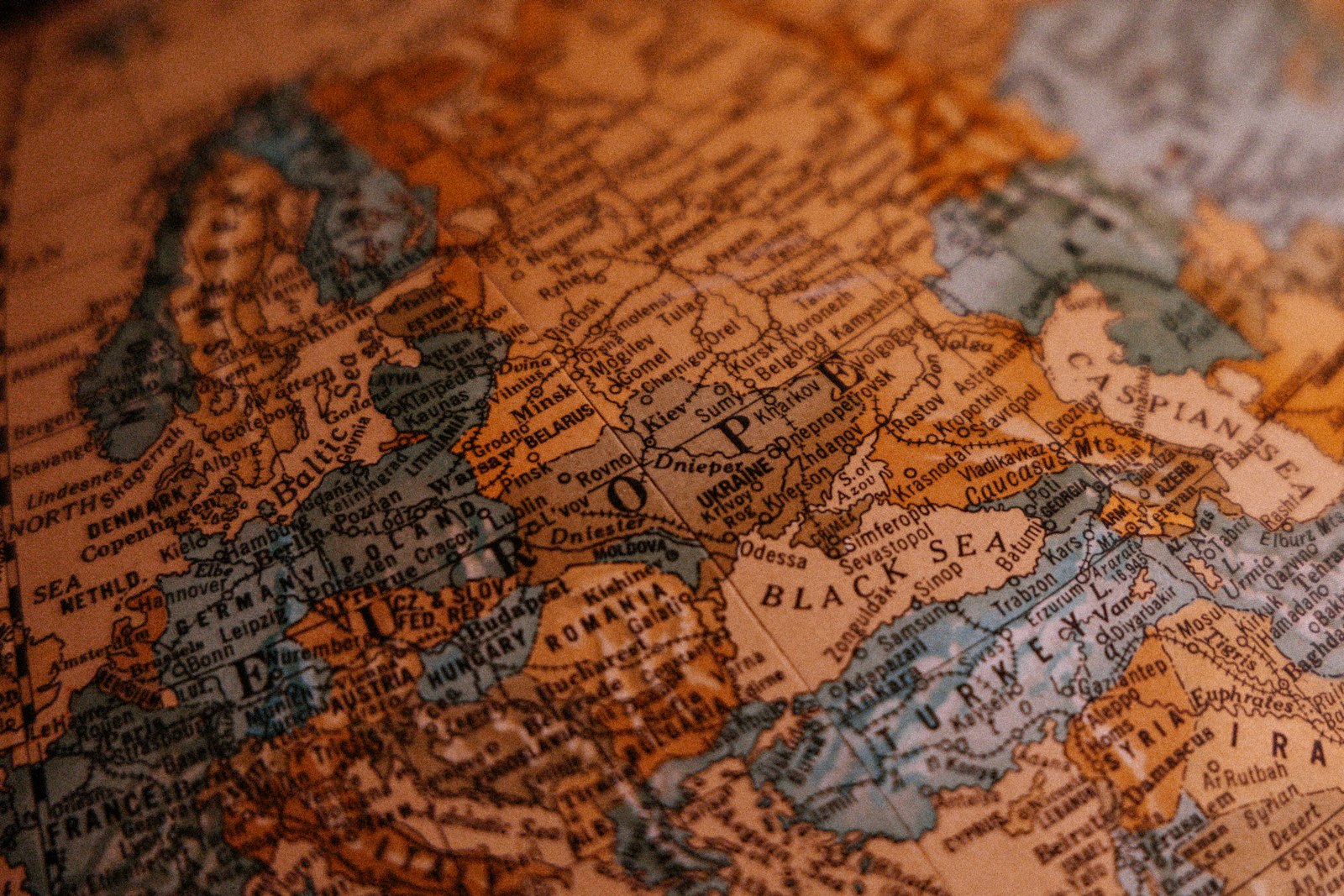
A map focused on Ukraine (Photo: Hans / Unsplash), chosen deliberately as an abstract map rather than footage of the fighting itself.
What Social Media Says vs. What's Actually Happening
The conversation opened with a listener's question: they'd seen posts online claiming Russia had made major advances in southern Ukraine — was that true? The answer involved separating the ground war from everything else happening around it.
On the ground, Russian forces are indeed grinding forward, slowly. But Ukraine isn't being pushed into overwhelming defeat, according to the conversation.
The War You See, and the War You Don't
What stood out most was hearing how Ukraine has been using long-range drones to repeatedly strike oil facilities in Moscow, St. Petersburg, and Crimea. As a result, Russia is apparently facing domestic fuel shortages severe enough to require importing from India.
I'd previously written about a hypothetical "scenario" in which drone warfare reshapes the nature of conflict. What I heard this time was, essentially, that scenario playing out as actual, current events. Behind the dramatic ground-war headlines, there's a quieter, less visible war being fought over supply lines — and hearing that shifted how I read the news.
Japan Might Get Another "Northern Territories" Problem
The other point that stuck with me concerned what happens after any ceasefire. According to the conversation, if fighting stopped along the current front line, nearly all of Luhansk and 70–80% of Donetsk, Kherson, and Zaporizhzhia would remain under Russian control, effectively frozen in place.
Since Ukraine won't recognise that as a legitimate transfer of territory, the situation would likely resemble Japan's own "Northern Territories" dispute with Russia — an unresolved issue dragging on for decades, with demands for return that never quite go anywhere. As a Japanese person, that comparison landed immediately. Given how long the Northern Territories dispute has dragged on, it made me realise this war, too, might be something the world simply has to live alongside for a long time, rather than something resolved cleanly.
The conversation also described how Trump had proposed a ceasefire along the current lines, only for Putin to derail the talks by demanding the "root causes of the crisis" be addressed — a demand that effectively killed the negotiation. Without Putin's removal from power or death, the conversation suggested, a genuine resolution seems unlikely.
What This Meant for Me, Living in Retirement
Learning to live with a "long-running problem," courtesy of the Northern Territories. Japan has carried its Northern Territories dispute for decades while still living life day to day. This conversation reminded me that the world holds a number of problems everyone knows won't resolve quickly — and yet has to live alongside anyway. Ukraine may well be one of those, going forward, and it's worth adjusting expectations for a long haul rather than a clean resolution.
Keeping in mind both what's visible and what isn't. Behind the dramatic ground-war headlines, a quieter war over supply lines is apparently unfolding — one that gets far less coverage. That's worth remembering when reading the news generally: don't judge the whole picture from the most visible headline, and stay alert to the parts that don't make the front page. The same instinct is useful when parsing investment information too.
Energy price impact remains worth watching. Domestic fuel shortages inside Russia are a concrete example of the energy-price volatility risk this series keeps returning to. Alongside the Middle East, Russia-Ukraine remains a factor worth watching for its effect on energy prices.
In Closing
A comparison to Japan's own "Northern Territories" dispute made the likely long-term nature of the Ukraine conflict feel very real to me. The world holds plenty of problems that take decades to resolve, if they ever do. I'll keep following this one with patience, rather than expecting a quick end.
Other books you might like
You're welcome to take a look.
EAST TO WEST: The Heart of Haiku, the Light of Scripture
A book I find myself returning to for quieter words, after thinking through what it means to live alongside a long-running problem. This was my father-in-law's final work.
View on AmazonCataract Surgery-A Memoir: Double cataract surgery in Osaka, Japan
Another record of a milestone in my own life, from around the same time I turned 66.
View on AmazonSushi Business in Britain: the complete four-volume series
A novel series following thirty-five years in the British sushi trade, from apprentice to factory manager to a small sushi school.
View on AmazonAbout the Source
This post is based on a paid conversation I purchased from "Power Game," a subscription programme run by Direct Publishing, featuring Yoshinori Kitano. It is not a reproduction of that content, but my own personal reflections and thoughts prompted by it.
About Yoshinori Kitano Kitano is a geopolitical and international affairs analyst, with study experience in Moscow, Russia. He publishes widely read newsletters and books analysing world affairs through the lens of national strategy and geopolitics, and serves as the lead instructor for Direct Publishing's "Power Game" subscription programme. Website: rpejournal.com
You can find details of the "Power Game" programme Mr. Kitano teaches here (Japanese language).