Corresponding episode: August 2026 issue, Part 4, "Power Game Monthly Mission" — Review of Last Month’s Answers
This post is a slight departure from the usual format. Rather than one of Yoshinori Kitano's regular conversations, this one covers a listener-mailbag segment called "Monthly Mission" from the same "Power Game" programme, where listener submissions on Japan's declining birthrate were discussed after news broke that annual births had fallen to 671,000 in 2025.
Note: This post reflects my own personal thoughts, prompted by a paid segment (a listener Q&A, not a two-person conversation) — from "Power Game," a subscription programme run by Direct Publishing — that I purchased. The programme is hosted by Yoshinori Kitano. Mr. Kitano's website is rpejournal.com.
More in this series
- Sinking Giants, Rising India — What a Diplomatic Report Taught Me About Retirement (on PM Takaichi's India visit and geopolitical diversification)
- Cracks Among the Autocratic Three — Letting Go of the "Monolithic Bloc" Idea (on the internal dynamics of the "autocratic three")
- If Putin's Grip Loosens — A "Scenario" of a World Reshaped by Drone Warfare (a near-future hypothetical)
- International Relations as a Mirror for Human Relationships (the series wrap-up)
- Trump's "Total Defeat"? What a US-Iran Deal Taught Me About Handling Information in Retirement (on the US-Iran ceasefire memorandum)
- America's "Backyard" Is Being Redrawn (on Latin America's political upheaval and the "Donroe Doctrine")
- Will the Chinese Communist Party Really Collapse? What a Comparison with the USSR Taught Me About Long-Term Investing (on the USSR comparison)
- A Taiwan "What If" and the News About Rising Defence Spending (on collapse scenarios and defense strategy)
- The Real Reason Everyone Keeps Visiting Beijing (on great powers approaching China)
- Dealing with a Neighbour Who's Profitable but Scary (on Southeast Asia's balancing diplomacy)
- Japan Might Get Another "Northern Territories" Problem (on the Ukraine frontline)
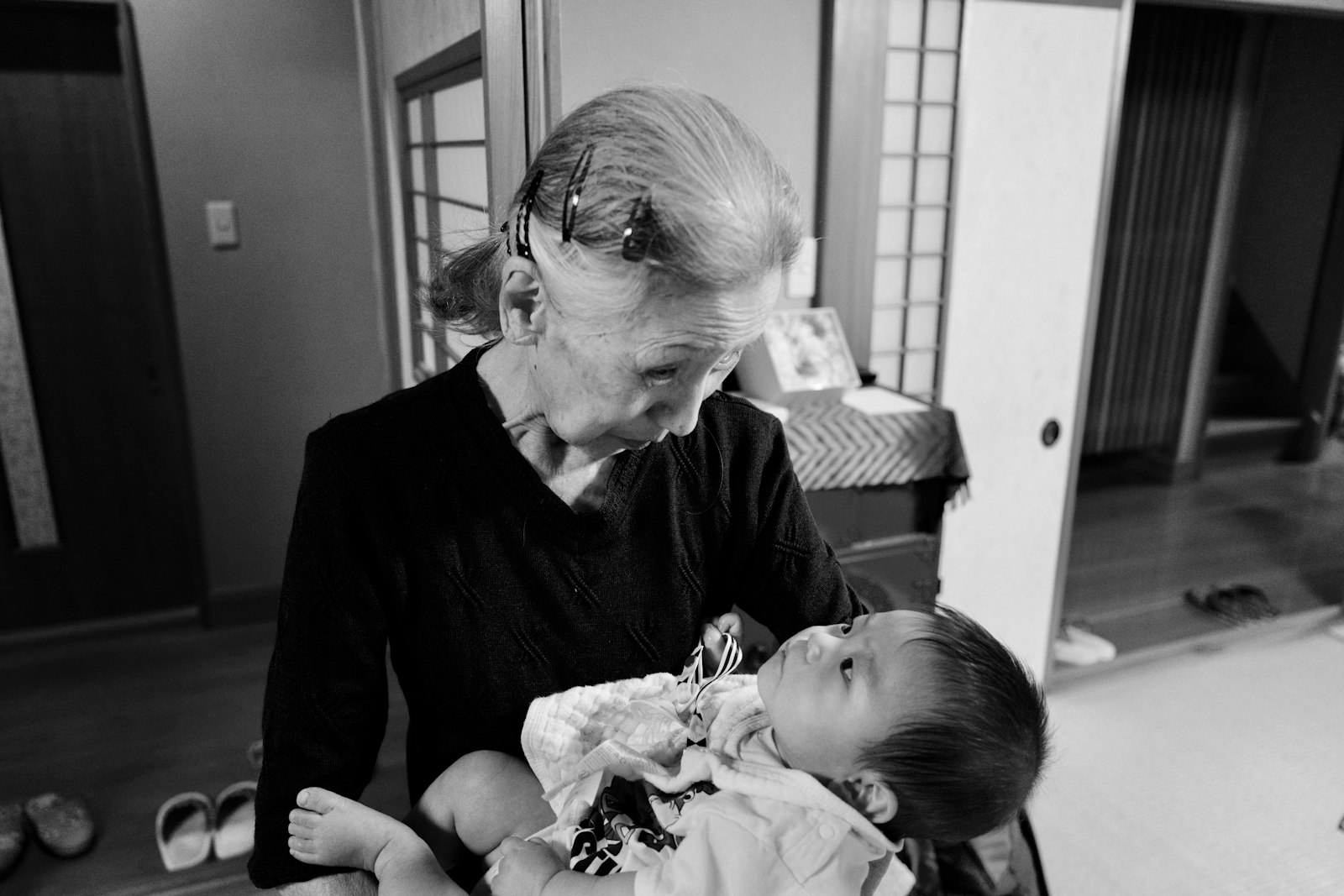
A woman holding a baby in her arms (Photo: Kazuo Ota / Unsplash), chosen with the cross-generational theme of birthrate decline and elder employment in mind.
The Number: 671,000
Japan's annual births fell to 671,236 in 2025, marking the tenth consecutive year of record lows. It once topped a million. The episode used this news as a springboard for listener submissions on "which part of Japanese society will change most because of population decline, and why."
A few of the submissions stuck with me. One argued for properly compensating essential but understaffed sectors — agriculture, fisheries, medical and elder care — rather than leaning on low-wage foreign labour, which the submission characterised in fairly stark terms. Another pointed out that a shrinking population directly threatens Japan's ability to staff its Self-Defense Forces, tying demographic decline straight to national security. A third argued for redesigning infrastructure — logistics, elder care, administrative processes — around AI and robotics. And one submission proposed something genuinely different: stepping back from the postwar growth-at-all-costs model and looking instead to Edo-period Japan's circular, community-centred way of life as inspiration for a more sustainable "wellbeing society."
All of this was discussed and reacted to by the hosts as the segment moved through each submission.
The Part That Actually Landed for Me, at 66
Honestly, out of everything discussed, the submission that hit closest to home was the call to abolish mandatory retirement and build a society where older people can keep working as long as they want to.
Having retired at 65 last year, the question of whether mandatory retirement should exist at all is one that overlaps directly with my own life choices. The segment framed this in the context of moving beyond "silver democracy" — where politics caters overwhelmingly to older voters — toward genuinely investing in younger generations and families. But hearing "older people should stay active and working" stirred something more complicated in me than simple agreement.
My own retirement wasn't really about becoming unable to work. It felt more like closing one chapter — decades in the Japanese food business and later an acupuncture and herbal medicine clinic — and choosing to open a different one. If mandatory retirement disappeared and working indefinitely became the assumed default for older people, would choosing to retire start to feel like a slightly awkward choice to make? That thought caught me off guard.
What This Meant for Me
Working longer and choosing to retire shouldn't be framed as opposites. I understand the call to abolish mandatory retirement as being about removing age as an arbitrary barrier to choice — not as pressure to keep working. What matters, I think, is that retiring remains just as respected a choice as continuing to work. Being able to keep working, and being able to step back and engage with society differently, both deserve equal standing. That kind of flexibility feels increasingly necessary as Japan ages.
The foreign labour debate deserves policy thinking, not just sentiment. The submission warning against low-wage foreign labour dependence is, I think, a genuinely contested topic with reasonable views on more than one side. How to structure any expansion of foreign labour — wages, working conditions, the social safety net — feels like a policy design question, better served by careful thinking than by strong emotional framing in either direction.
"Small but rich" resonates with how I want to live in retirement, too. The suggestion to draw inspiration from Edo-period circular living genuinely resonated with me. Rather than chasing endless growth, building a life around community and reuse — that's not just a national-scale idea. It overlaps closely with how I actually want to spend my own retirement: tending the garden, staying connected to neighbours, and keeping things small and sustainable.
In Closing
The conversation started with a stark number — 671,000 — but what stayed with me afterward was the question of mandatory retirement. Discussions about an ageing, shrinking Japan tend to fall into a "who supports whom" framing. As someone living on the other side of that framing, I want to keep thinking through what my own honest answer looks like.
Other books you might like
You're welcome to take a look.
EAST TO WEST: The Heart of Haiku, the Light of Scripture
A book I find myself returning to for quieter words, after sitting with the question of mandatory retirement as it applies to my own life. This was my father-in-law's final work.
View on AmazonCataract Surgery-A Memoir: Double cataract surgery in Osaka, Japan
Another record of a milestone in my own life, from around the same time I turned 66.
View on AmazonSushi Business in Britain: the complete four-volume series
A novel series following thirty-five years in the British sushi trade, from apprentice to factory manager to a small sushi school.
View on AmazonAbout the Source
This post is based on a paid listener-mailbag segment I purchased from "Power Game," a subscription programme run by Direct Publishing, hosted by Yoshinori Kitano. It is not a reproduction of that content, but my own personal reflections and thoughts prompted by it.
About Yoshinori Kitano Kitano is a geopolitical and international affairs analyst, with study experience in Moscow, Russia. He publishes widely read newsletters and books analysing world affairs through the lens of national strategy and geopolitics, and serves as the lead instructor for Direct Publishing's "Power Game" subscription programme. Website: rpejournal.com
You can find details of the "Power Game" programme Mr. Kitano teaches here (Japanese language).