Corresponding episode: August 2026 issue, Part 1, ⑤
A few days ago, I listened to a conversation analysing a string of political upheavals across Latin America, featuring Yoshinori Kitano. It walked through four countries — Venezuela, Cuba, Colombia, and Peru — and how the Trump administration's "Donroe Doctrine" (a blend of "Donald" and "Monroe") has been playing out across the region.
Note: This post reflects my own personal thoughts, prompted by a paid piece of content — a conversation featured on "Power Game," a subscription programme run by Direct Publishing — that I purchased. Mr. Kitano's website is rpejournal.com.
More in this series
- Sinking Giants, Rising India — What a Diplomatic Report Taught Me About Retirement (on PM Takaichi's India visit and geopolitical diversification)
- Cracks Among the Autocratic Three — Letting Go of the "Monolithic Bloc" Idea (on the internal dynamics of the "autocratic three")
- If Putin's Grip Loosens — A "Scenario" of a World Reshaped by Drone Warfare (a near-future hypothetical)
- International Relations as a Mirror for Human Relationships (the series wrap-up)
- Trump's "Total Defeat"? What a US-Iran Deal Taught Me About Handling Information in Retirement (on the US-Iran ceasefire memorandum)
- Will the Chinese Communist Party Really Collapse? What a Comparison with the USSR Taught Me About Long-Term Investing (on the USSR comparison)
- A Taiwan "What If" and the News About Rising Defence Spending (on collapse scenarios and defense strategy)
- The Real Reason Everyone Keeps Visiting Beijing (on great powers approaching China)
- Dealing with a Neighbour Who's Profitable but Scary (on Southeast Asia's balancing diplomacy)
- Japan Might Get Another "Northern Territories" Problem (on the Ukraine frontline)
- Japan's Birth Rate Hit 671,000 (on the declining birthrate and mandatory retirement)
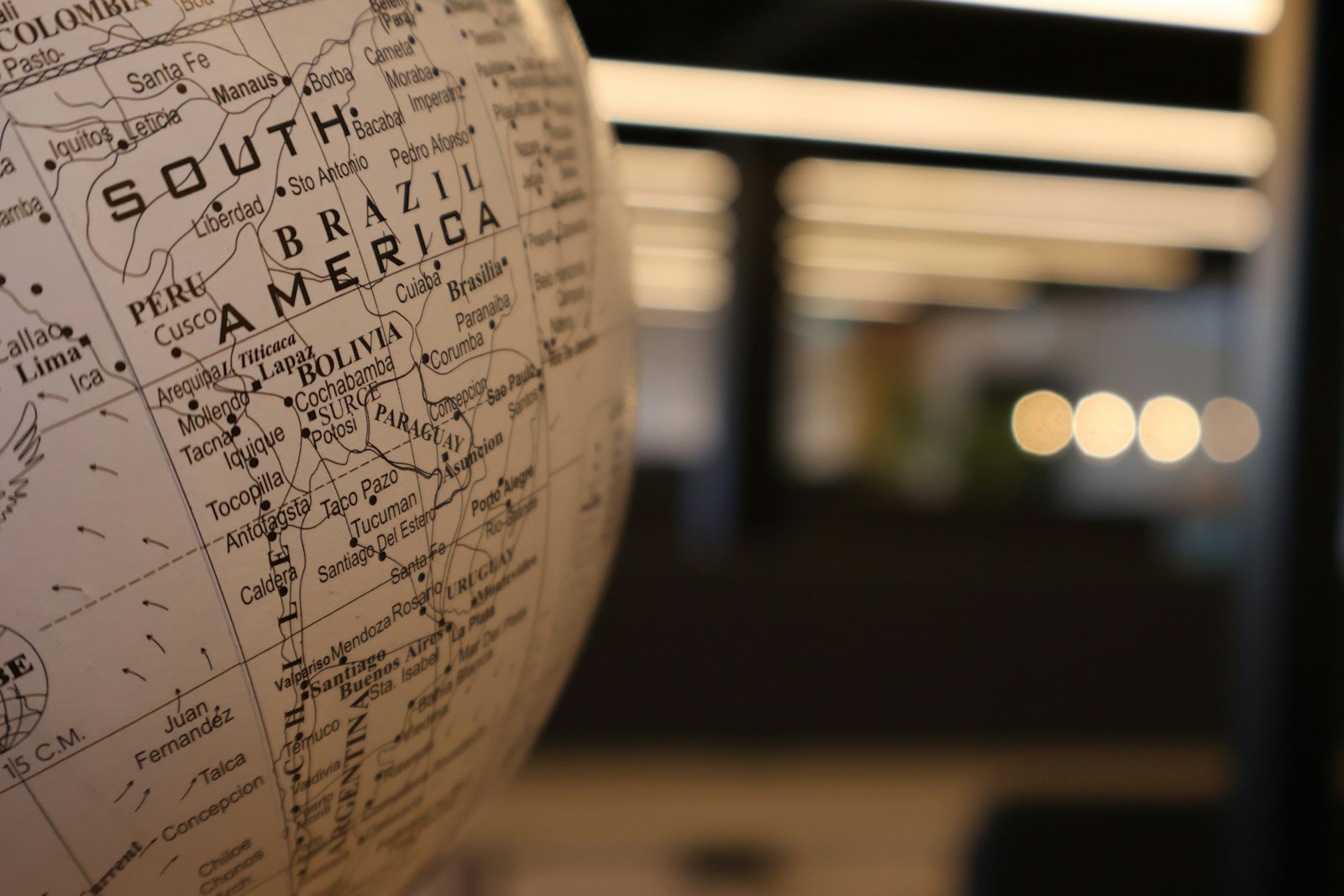
A globe showing the South American continent (Photo: Colin White / Unsplash), chosen with the string of political upheavals across Venezuela, Colombia, and Peru in mind.
The "Donroe Doctrine"
The conversation opened with the national security strategy the Trump administration announced in December 2025, built on three pillars: a return to the Monroe Doctrine, a move toward reconciliation with Russia, and treating China as a competitor rather than a threat. The first pillar — a "return to the Monroe Doctrine" — has apparently picked up the nickname "Donroe Doctrine," combining "Donald" with "Monroe." The idea: the Western Hemisphere, and Latin America in particular, is America's own turf, and outside influence — especially from China — won't be tolerated there.
In my last post, I wrote about the US-Iran memorandum being called "a total defeat for Trump." What struck me this time was the contrast — while that was unfolding, the administration was apparently racking up real wins closer to home.
Political Upheaval Across Four Countries
Here's roughly what the conversation described.
In January this year, US forces struck Venezuela and captured President Maduro, who had leaned anti-American and pro-China. His successor was made to accept handing over oil rights to the US and expelling Chinese companies, flipping the country's alignment almost overnight.
Cuba faced a different kind of pressure — the US cut off the oil supply it had been receiving via Venezuela, and in May, US federal prosecutors indicted Raúl Castro, brother of revolutionary leader Fidel Castro, on murder charges tied to a 1996 incident involving the shooting down of a civilian aircraft.
Then in June, both Colombia and Peru saw changes in power. In Colombia, a left-wing government that had leaned into China's Belt and Road Initiative lost to a pro-American right-wing candidate in a razor-thin election. In Peru, a pro-China president was toppled by a corruption scandal, and in the election that followed, Keiko Fujimori — of Japanese descent — finally won the presidency on her fourth attempt.
What stood out most to me was Peru. China had built a massive port there, Chancay, investing roughly ¥350 billion and holding a 60% stake — a project significant enough that President Xi Jinping himself attended the opening ceremony. Watching that region pivot toward a pro-American, pro-Japanese direction felt like a genuine sign of how much the balance of power in the region is shifting.
What This Meant for Me, Living in Retirement
Political upheaval in resource-rich countries has a way of reaching everyone eventually. Venezuela holds some of the world's largest oil reserves. Political upheaval there, or moves like cutting off Cuba's energy supply, ripple outward into oil prices and the broader global economy, even for those of us with no direct stake in the region. It's a reminder that Latin America deserves a spot alongside the Middle East on the list of things worth watching for energy price risk.
Even massive infrastructure investments can lose their footing with a single change of government. Peru's Chancay port shows how a huge investment by one country can suddenly become precarious the moment political power shifts. If any of my assets are tied to infrastructure or companies operating in a particular country, how politically stable that country actually is deserves more weight than I might normally give it.
Momentum on one side doesn't mean stability everywhere. My last post covered "Trump's total defeat." This one told a story of success for the very same administration, around the very same time — just in a different region. The same government, viewed from a different angle, tells an almost opposite story. That's a good reminder of how risky it is to judge a whole administration — or a whole situation — from a single piece of news. In investing too, it's worth cultivating the habit of looking at more than one angle before drawing conclusions.
In Closing
What struck me most this time was hearing "total defeat" and "success" applied to the very same administration within the same short stretch of time, just from different corners of the world. It's a good reminder to keep more than one vantage point in mind when following world affairs, rather than judging the whole picture from a single region or a single headline.
Other books you might like
You're welcome to take a look.
EAST TO WEST: The Heart of Haiku, the Light of Scripture
A fitting book to close out this reflection on not judging the whole from a single angle. This was my father-in-law's final work.
View on AmazonCataract Surgery-A Memoir: Double cataract surgery in Osaka, Japan
Another record of a milestone I went through at 66, this time much closer to home.
View on AmazonSushi Business in Britain: the complete four-volume series
A novel series following thirty-five years in the British sushi trade, from apprentice to factory manager to a small sushi school.
View on AmazonAbout the Source
This post is based on a paid conversation I purchased from "Power Game," a subscription programme run by Direct Publishing, featuring Yoshinori Kitano. It is not a reproduction of that content, but my own personal reflections and thoughts prompted by it.
About Yoshinori Kitano Kitano is a geopolitical and international affairs analyst, with study experience in Moscow, Russia. He publishes widely read newsletters and books analysing world affairs through the lens of national strategy and geopolitics, and serves as the lead instructor for Direct Publishing's "Power Game" subscription programme. Website: rpejournal.com
You can find details of the "Power Game" programme Mr. Kitano teaches here (Japanese language).