Corresponding episode: August 2026 issue, Part 1, ①
🎧 Listen to the Discussion(two hosts talk through their thoughts on this article)
This is an AI-generated audio overview of this article, created with Google NotebookLM. Two hosts discuss the article together, sharing their own thoughts and commentary — it is not a reading of the article text.
A few days ago, I listened to a conversation analysing Prime Minister Takaichi's visit to India, featuring Yoshinori Kitano, lead instructor of "Power Game," a subscription programme run by Direct Publishing, in discussion with a host. I have to admit, I sat with it for a while afterwards. As someone who retired at 65 and now splits life between Japan and the UK, this felt like more than just another news item.
Note: This post reflects my own personal thoughts, prompted by a paid piece of content I purchased. Mr. Kitano's website is rpejournal.com.
More in this series
- Cracks Among the Autocratic Three — Letting Go of the "Monolithic Bloc" Idea (on the internal dynamics of the "autocratic three")
- If Putin's Grip Loosens — A "Scenario" of a World Reshaped by Drone Warfare (a near-future hypothetical)
- International Relations as a Mirror for Human Relationships (the series wrap-up)
- Trump's "Total Defeat"? What a US-Iran Deal Taught Me About Handling Information in Retirement (on the US-Iran ceasefire memorandum)
- America's "Backyard" Is Being Redrawn (on Latin America's political upheaval and the "Donroe Doctrine")
- Will the Chinese Communist Party Really Collapse? What a Comparison with the USSR Taught Me About Long-Term Investing (on the USSR comparison)
- A Taiwan "What If" and the News About Rising Defence Spending (on collapse scenarios and defense strategy)
- The Real Reason Everyone Keeps Visiting Beijing (on great powers approaching China)
- Dealing with a Neighbour Who's Profitable but Scary (on Southeast Asia's balancing diplomacy)
- Japan Might Get Another "Northern Territories" Problem (on the Ukraine frontline)
- Japan's Birth Rate Hit 671,000 (on the declining birthrate and mandatory retirement)
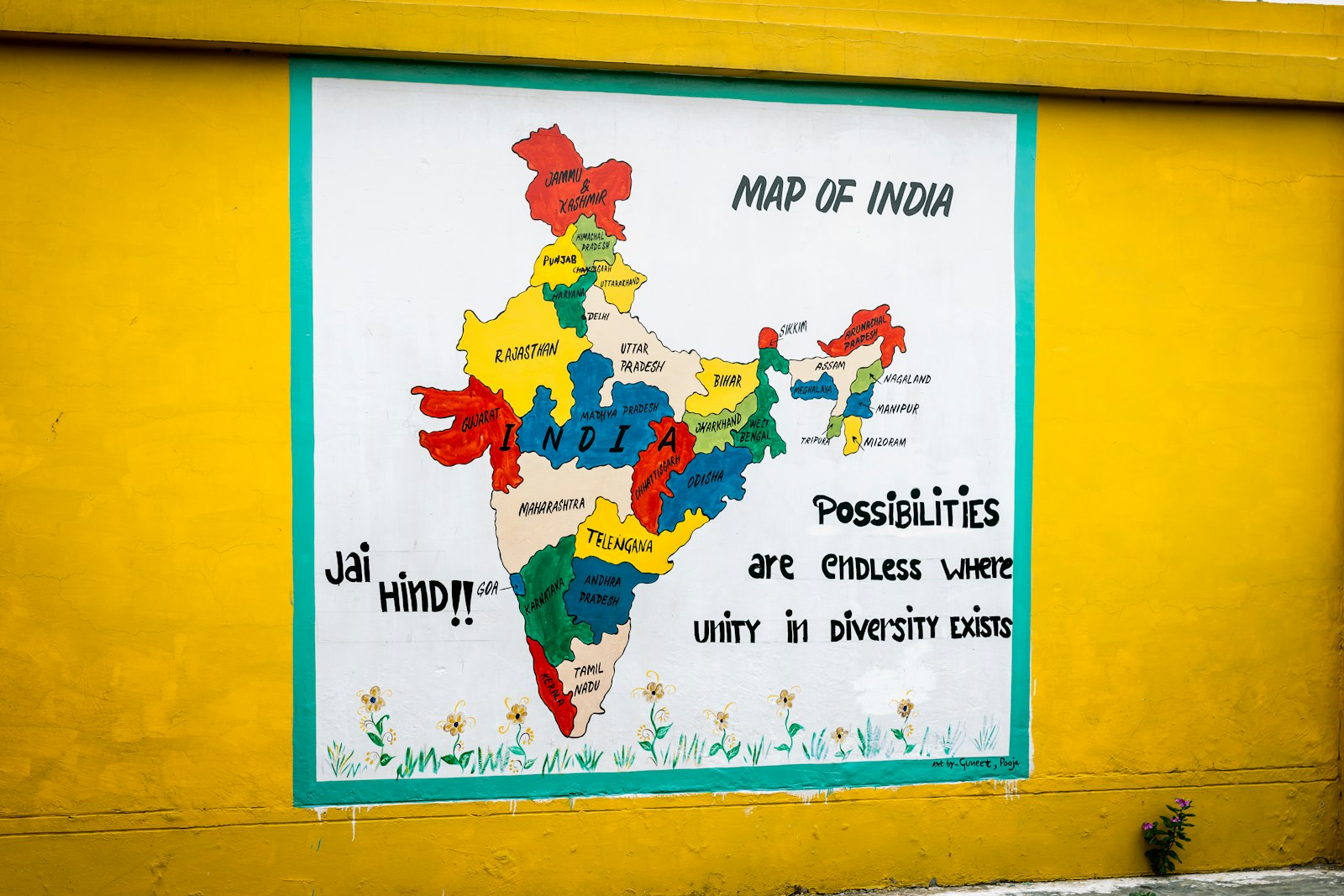
A map of India (Photo: Gayatri Malhotra / Unsplash). India became the world's most populous country in 2023, and is projected to reach 1.68 billion people by 2050.
The "Sinking Three, Rising India" View
The core argument goes like this.
The three powers that have shaped the world for decades — the United States, China, and Russia — are all showing signs of decline. The US is turning inward, telling its allies to raise their own defence spending instead of relying on Washington. China is grappling with a collapsing property bubble and a birth rate of around 0.9. Russia has been weakened by its prolonged war in Ukraine.
And stepping into that space, the report argues, is India. India became the world's most populous country in 2023, and is projected to reach 1.68 billion people by 2050 — while China's population is expected to shrink to 1.26 billion over the same period. That's a gap of over 400 million people.
I'll be honest — the mental map I've carried for years, with America and China at the centre of everything, may need a bit of updating.
Not Someone Else's Problem
I've spent years as an individual investor in property and stocks, and if I'm honest, my portfolio has leaned fairly heavily on the US and the dollar. Betting on the world's strongest economy and strongest currency has, for decades, been a perfectly rational choice.
But one episode in the report stuck with me. When Iran blocked the Strait of Hormuz this past March, President Trump reportedly asked allied nations to send naval vessels — and not a single one responded. Kitano called it a historic moment revealing just how far American influence has eroded.
Reading that, I felt a quiet nudge to reconsider my own asset allocation. The assumption that "America is unshakeable" may be loosening, slowly but surely.
What I'm Actually Thinking About Doing
That said, I'm not about to overhaul my portfolio overnight. At 66, I simply don't have the appetite for big risks anymore. Still, there are a few things I'm starting to think through:
Taking currency diversification one step further. Living between yen and pounds already gives me some natural diversification. But moving a little further away from dollar-centric thinking feels worth exploring.
A small, cautious step toward India. I'm not ready to jump straight into Indian equities. But learning about Japanese companies with a strong India presence, or India-focused funds listed in developed markets, feels like a reasonable starting point. The demographic dividend and India's role as a "China Plus One" destination both look likely to persist for some time.
Taking stock of China exposure. It seems worth reviewing how much of my portfolio still leans on China-dependent sectors — property, export manufacturing — just to know where I stand.
My Two-Base Life Was Already a Form of Geopolitical Diversification
One thing struck me as I read the report: my life split between Japan (winters) and the UK (the rest of the year), with trips through Thailand, the Philippines, Taiwan, and Korea along the way, was already a kind of geopolitical diversification — I just hadn't thought of it that way.
Not depending on a single country or economic bloc for everything is, in essence, the same logic as diversifying a portfolio. It wasn't a deliberate strategy on my part, but reading this report made me realise it had been quietly working as a hedge all along.
An Unexpected Link to Healthspan
There's another thread here that connects to something I've cared about for a long time — healthspan.
Having some grounding in both Western medicine and Eastern medicine (acupuncture and herbal medicine), I've come to appreciate the value of not relying entirely on a single healthcare system. Japan's medical system, the UK's NHS, wellness resources across Asia — drawing on the strengths of each feels like exactly the same logic as diversifying assets geopolitically.
In Closing
I didn't expect a news report about a prime minister's trip to India to make me reflect this much on my own lifestyle and finances. World affairs can feel distant and abstract, but I've come to think that living well in retirement means keeping at least half an eye on these larger shifts — without letting them take over.
My next post will return to something a little closer to home — probably the greenhouse — but for now, these were some thoughts prompted by looking a little further afield.
Other books you might like
You're welcome to take a look.
EAST TO WEST: The Heart of Haiku, the Light of Scripture
After a big-picture post like this one, it's the book I find myself returning to for a quieter kind of language. This was my father-in-law's final work.
View on AmazonCataract Surgery-A Memoir: Double cataract surgery in Osaka, Japan
Another record of a milestone I went through at 66, this time much closer to home.
View on AmazonSushi Business in Britain: the complete four-volume series
A novel series following thirty-five years in the British sushi trade, from apprentice to factory manager to a small sushi school.
View on AmazonAbout the Source
This post is based on a paid conversation I purchased from "Power Game," a subscription programme run by Direct Publishing, featuring Yoshinori Kitano and a host. It is not a reproduction of that content, but my own personal reflections and thoughts prompted by it.
About Yoshinori Kitano Kitano is a geopolitical and international affairs analyst, with study experience in Moscow, Russia. He publishes widely read newsletters and books analysing world affairs through the lens of national strategy and geopolitics, and serves as the lead instructor for Direct Publishing's "Power Game" subscription programme. Website: rpejournal.com
You can find details of the "Power Game" programme Mr. Kitano teaches here (Japanese language).
Any investment decisions should be made based on your own circumstances, ideally with professional advice.